
Overview: NMDC Ltd and Steel Authority of India Ltd (SAIL) have incorporated subsidiaries at GIFT City’s International Financial Services Centre (IFSC), according to Ministry of Corporate Affairs records reported by Business Standard. NMDC intends to use its subsidiary to support overseas mineral investments, while SAIL’s entity is designed primarily for group treasury management. Their move highlights how Indian businesses can assess IFSC structures for overseas expansion, foreign-currency funding and cross-border financial operations.
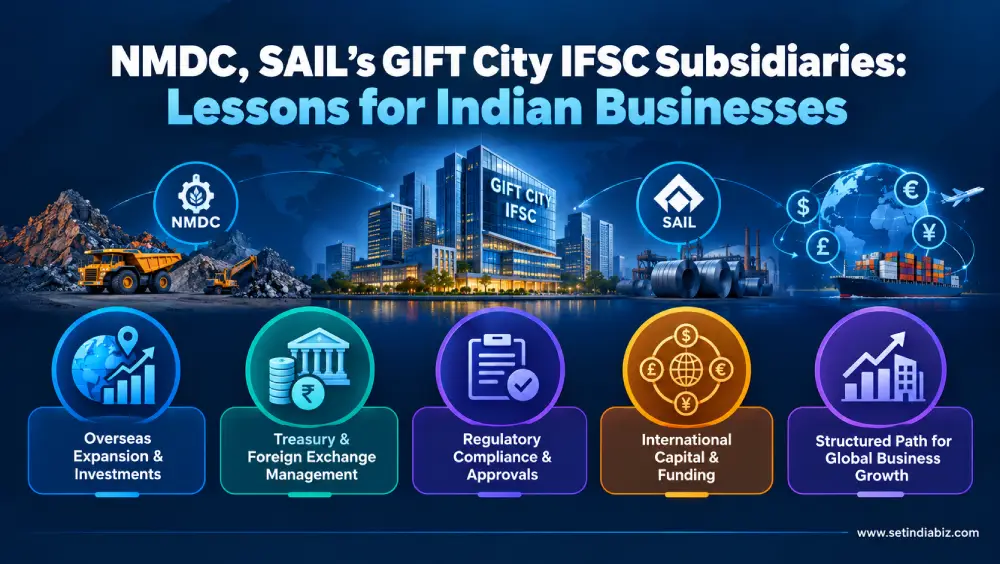
NMDC and SAIL’s move into GIFT City comes as Indian companies explore new structures for overseas investments and international financial operations. Their separate objectives highlight two potential uses of the IFSC: facilitating strategic investments abroad and managing group treasury functions.
For businesses considering a similar route, the key question is whether an IFSC entity fits their commercial plans and regulatory obligations. The answer depends on the proposed activities, funding arrangements and applicable approvals.
NMDC, SAIL GIFT City Subsidiaries
Indian public-sector enterprises are looking overseas to secure critical raw materials and manage international financial exposure. NMDC and SAIL have established separate entities at GIFT City, Gujarat, with different business objectives.
- NMDC Global IFSC Ltd: NMDC has envisaged the subsidiary as a strategic investment and financial platform for overseas expansion, particularly in critical and strategic minerals. Its proposed activities include investments, acquisitions, joint ventures and partnerships involving overseas mineral projects.
- SAIL Global IFSC Ltd: The subsidiary is intended primarily to manage group treasury operations. Its memorandum of association, as reported by Business Standard, covers activities including cash management, intra-group lending, foreign exchange and trade finance.
Once operational, these structures could give the parent companies a central platform to organise overseas investments, manage group liquidity and address foreign-exchange exposure. They may also provide access to international funding options, subject to regulatory permissions and commercial viability.
However, incorporation establishes a legal entity; it does not automatically authorise every proposed financial activity or establish that operations have commenced.
Key Lessons for Indian Businesses
The development is relevant to manufacturers, infrastructure companies and corporate groups planning overseas acquisitions or international expansion.
Consider an Indian manufacturer planning to acquire a stake in an overseas supplier. Before establishing an IFSC entity, it should assess four questions:
- Business purpose: Will the entity hold overseas investments, manage group liquidity or arrange funding for international operations?
- Funding requirements: What are the proposed sources of capital, borrowing costs and repayment arrangements?
- Foreign-exchange exposure: Could a centralised treasury arrangement improve the management of currency risks?
- Regulatory compliance: Which approvals, reporting requirements and foreign-exchange rules apply to the proposed transactions?
A separate IFSC entity makes commercial sense when it serves a defined business need. Incorporation also brings administrative expenses and continuing compliance obligations, so the expected benefits must justify the additional cost.
Companies considering overseas investments should examine the applicable framework under the Foreign Exchange Management Act (FEMA), including the Overseas Investment Rules, Regulations and Directions. The requirements depend on the investment, the parties involved and the transaction structure.
GIFT IFSC Setup: Eligibility and Regulatory Requirements
The International Financial Services Centres Authority (IFSCA) regulates financial services and institutions within India’s IFSCs. Its framework for Global/Regional Corporate Treasury Centres (GRCTCs) was introduced on 4th April, 2025, and amended on 9th June, 2025.
A business intending to operate a GRCTC must assess the framework’s registration, capital, staffing and operational requirements.
Key conditions include:
- Minimum owned funds: The framework specifies minimum owned funds of US$200,000.
- Qualified personnel: At least five qualified personnel must be based in the IFSC, including a Head of Treasury and a Compliance Officer, before operations commence.
- Conditional staffing relaxation: On an applicant’s request, the IFSCA Chairperson may grant a relaxation from the staffing requirement, taking account of the proposed activities and expected business volume. The relaxation cannot exceed one year from the commencement of operations.
- Regulatory permissions: The required IFSCA registration and a valid Letter of Approval under the Special Economic Zones Act, 2005, must be in place before the entity conducts business under the framework.
- Continuing compliance: Applicable governance, risk-management, documentation and regulatory reporting obligations must be met.
These conditions relate to the GRCTC framework. They should not be treated as universal requirements for every entity established at GIFT City. Businesses must first establish which regulatory route applies to their proposed activities.
GIFT IFSC should be evaluated as part of a company’s international business strategy, not as an automatic route to cheaper finance or tax savings. Expected benefits must be weighed against funding terms, transaction volumes, applicable tax treatment and operating expenses.
Setindiabiz Support
Businesses considering GIFT City structures need to connect their commercial objectives with the relevant incorporation, investment and regulatory requirements. Setindiabiz supports businesses with corporate and regulatory services, including company and subsidiary incorporation, corporate documentation, FEMA and RBI compliance and ongoing corporate filings, as applicable to the engagement.
For companies planning overseas expansion, the initial assessment involves identifying the proposed investment route, suitable entity structure, required documentation and continuing compliance obligations. This helps businesses understand the requirements before committing to a particular structure.
FAQs
NMDC intends to use its subsidiary to support overseas mineral investments. SAIL’s subsidiary is designed primarily for group treasury management, including cash management, foreign exchange and trade finance.
Potentially, depending on the proposed activities, eligibility conditions and applicable regulatory framework. Incorporation alone does not authorise regulated financial activities.
No. Financial outcomes depend on funding terms, creditworthiness, transaction volumes, applicable tax rules and operating expenses. Businesses should assess the net commercial benefit before proceeding.
It should assess the commercial purpose, ownership and funding structure, permitted activities, regulatory approvals, FEMA obligations, tax treatment and continuing compliance costs.
NMDC and SAIL’s GIFT City subsidiaries highlight how Indian companies are exploring specialised structures for overseas investment and corporate treasury management. For other businesses, the practical lesson is to assess the commercial purpose, regulatory route and total cost before establishing an IFSC entity. A sound structure must serve a defined business need, with the necessary permissions and compliance arrangements in place before operations begin.
