

GST Annual Return Filing. GSTR-9/9C
Every regular taxpayer with turnover above ₹2 crore files the annual return in GSTR-9, and those with turnover above ₹5 crore also file a self-certified reconciliation in GSTR-9C. Setindiabiz reconciles your year, resolves mismatches and files both on time.


Trusted By Leading Brands






























🗹 Key Information |
||
|---|---|---|
| 1 | Statutory Basis | Section 44, CGST Act & Rule 80, CGST Rules. |
| 2 | Forms | GSTR-9 & GSTR-9C (Reconciliation) |
| 3 | GSTR-9 | Regular taxpayers whose aggregate annual turnover exceeds ₹2 crore must file their GST Annual Return using Form GSTR-9. |
| 4 | GSTR-9C | Form GSTR-9C reconciles filed GST returns with audited financial statements. It is filed per GSTIN by taxpayers whose aggregate annual turnover exceeds ₹5 crore. |
| 5 | Due date | 31 December (FY 2025-26 → 31-12-2026) |
| 6 | Government fee | NIL (Late fee applies only to the delay) |
| 7 | Certification | Self-certified by the taxpayer |
| 8 | Revision | Not permitted once filed; corrections by DRC-03 |
| 9 | Maximum late fee | ₹50–₹200 per day; cap 0.04%–0.50% of Turnover |
GST Annual Return (GSTR-9 & GSTR-9C)?
The GST annual return closes a financial year on the GST portal by consolidating every monthly and quarterly return a business has filed. Form GSTR-9 is the consolidated annual return, mandated under Section 44 of the CGST Act, 2017, read with Rule 80. Form GSTR-9C is a reconciliation statement that ties the GSTR-9 figures to the audited financial statements.
GSTR-9 is required once aggregate turnover crosses ₹2 crore; GSTR-9C is required once aggregate turnover crosses ₹5 crore. Both are filed for each GSTIN by 31 December following the year. Setindiabiz’s GST process experts reconcile your GSTR-1, GSTR-2B and GSTR-3B against your books, resolve mismatches, and file both forms accurately.

Pradeep Vallat
Founder "Autonomo""Setindiabiz’s knowledgeable, disciplined, and organized team made our company registration, tax, and IPR filings smooth, hassle-free, and worry-free."
Who Must File (and Who Is Exempt)
Liability to file the GST annual return turns on aggregate annual turnover (AATO) under Section 44 read with Rule 80, computed at the PAN level across every GSTIN, all-India. GSTR-9 becomes mandatory above ₹2 crore, and GSTR-9C above ₹5 crore. The exemption for small taxpayers below ₹2 crore is now permanent rather than renewed each year, and a clear list of registrant types is carved out altogether; knowing which bucket you fall in is the first decision before any data is touched.

GSTR-9 (2 Crore+)
Every regular taxpayer whose aggregate annual turnover exceeds ₹2 crore in the financial year, computed across all GSTINs on the PAN.
GSTR-9C (5 Crore+)
Taxpayers with a turnover exceeding ₹5 crore must file a self-certified reconciliation statement per GSTIN, along with GSTR-9 and audited annual accounts.

Optional below ₹2 crore
Taxpayers with turnover up to ₹2 crore enjoy a permanent GSTR-9 exemption. With voluntary filing still available.

Per-GSTIN filing
Turnover is measured at the PAN level, but filing is per GSTIN. Thus, four GSTINs, each with ₹1.5 crore (₹6 crore PAN total), must all file GSTR-9 and GSTR-9C.

Exempt categories
- Composition dealers
- ISD/E-Com Operators
- Casual taxable persons,
- Non-resident & OIDAR

Cancelled registrations
A GSTIN cancelled during the year still files the annual return for the period it was active in that financial year.
GSTR-9 vs GSTR-9C
The two forms are often spoken of together, but they do different jobs and apply at different turnover levels. GSTR-9 is the annual consolidation of your filed returns; GSTR-9C reconciles that consolidation against your audited books. The single most misunderstood point is certification; the old GST audit by a Chartered Accountant or Cost Accountant was removed from FY 2020-21, so the taxpayer now self-certifies GSTR-9C. The table below sets the two side by side.
| No | Particular | GSTR-9 | GSTR-9C |
|---|---|---|---|
| 1 | Nature | Annual consolidation of GSTR-1, GSTR-2B and GSTR-3B | Reconciliation of GSTR-9 with audited financial statements |
| 2 | Turnover threshold (AATO) | Above ₹2 crore | Above ₹5 crore |
| 3 | Statutory basis | Section 44 & Rule 80(1) | Section 44 & Rule 80(3) |
| 4 | Certification | Filed by the taxpayer | Self-certified by the taxpayer (no CA/CMA audit since FY 2020-21) |
| 5 | Filing level | Per GSTIN | Per GSTIN (a PAN can have several) |
| 6 | Attachment | None | Copy of the audited annual accounts |
| 7 | Structure | 6 parts, 19 tables | Parts I–V reconciliation plus Part B self-certification |
| 8 | Revision | Not allowed | Not allowed |
Statutory Due Dates for GST Annual Return
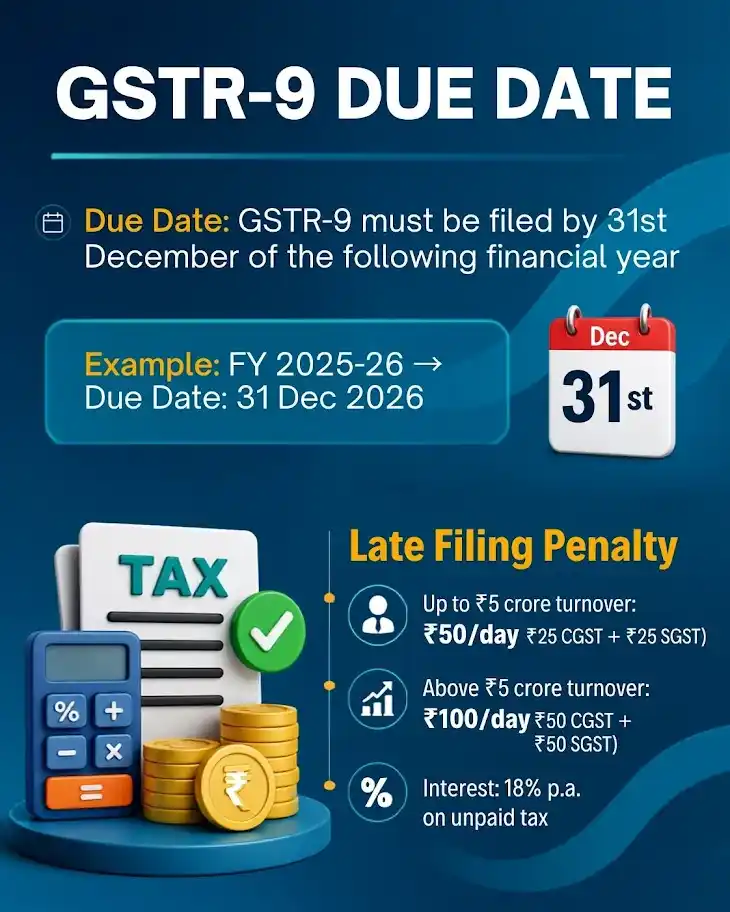
The annual return and reconciliation statement are both due by 31 December following the close of the financial year, under Section 44 of the CGST Act, 2017 and Rule 80. For FY 2025-26, that means 31 December 2026. Extensions are infrequent and come only by a specific CBIC notification, usually in response to a portal disruption, so the date is best treated as hard. There is also an outer time limit beyond which the portal will simply not accept the return.
| No | Event | Due date | If missed |
|---|---|---|---|
| 1 | GSTR-9 / GSTR-9C , FY 2025-26 | 31-12-2026 | Graded late fee accrues from 01-01-2027 |
| 2 | GSTR-9 / GSTR-9C , FY 2024-25 | 31-12-2025 (lapsed) | Late fee accruing daily; file without further delay |
| 3 | Outer limit to file any return | 3 years from the original due date | Filing is permanently barred thereafter |
| 4 | Tax shortfall on reconciliation | Before filing | Additional tax via DRC-03, with interest under Section 50 |
Documents Required
The annual return is built from records you already hold, the year’s filed returns, your books of account and the reconciliations between them. There is no new data to generate, but the figures must agree before filing, as the forms cannot be revised afterwards. Where turnover crosses ₹5 crore, the audited financial statements drive the GSTR-9C reconciliation, so they need to be finalised first.
From your filed GST returns
From your books and financials
Pro Tip: Reconcile your GSTR-2B input tax credit against your books before filing. Table 8A is locked to GSTR-2B, and an unexplained gap in Part IV is the single most common trigger for a departmental query.
Process – How Setindiabiz Files Your GST Annual Return
Our process is built around reconciliation because the figures in GSTR-9 and GSTR-9C must agree with both your returns and your books before anything is filed. We collect the year, match it line by line, settle any differences, and only then prepare and file. The steps below are calibrated to the fullest ca
Step 01: Scope & data collection
Confirm applicability and gather the year. We confirm whether you file GSTR-9 alone or with GSTR-9C, then collect your portal access and records.
🕒 Turnaround: 1–2 working days.Step 02: Reconciliation Match returns against your books.
We reconcile GSTR-1, GSTR-2B and GSTR-3B against your sales, purchase and ITC records, flagging every variance.
🕒 Turnaround: 3–5 working days.Step 03: Resolve mismatches & finalise ITC. Close the gaps.
We resolve mismatches, classify ITC correctly across Part IV, and account for amendments and cross-year adjustments.
🕒 Turnaround: 2–3 working days.Step 04: Pay any shortfall (DRC-03). Discharge additional liability.
Where reconciliation reveals short-paid tax or excess ITC, we compute it, and you discharge it through Form DRC-03.
🕒 Turnaround: 1 working day.Step 05: Prepare & self-review GSTR-9 (and GSTR-9C). Draft both forms.
We prepare GSTR-9 and GSTR-9C with the audited-account reconciliation, then run a full internal review.
🕒 Turnaround: 2–3 working days.Step 06: Self-certify & file on the GST portal.
You self-certify, we file on the portal, and then we share the acknowledgement for your records.
🕒 Turnaround: same day.Late Fees & Penalties
Late filing of the annual return attracts a daily late fee under Section 47(2) of the CGST Act, 2017, rationalised by turnover slab via Notification No. 07/2023-Central Tax dated 31 March 2023, applicable from FY 2022-23 onwards. The fee is charged per day of delay, split equally between the CGST and SGST Acts, and capped at a percentage of State turnover. GSTR-9C now carries its own separate late fee, and a general penalty can apply on top.
| No | Aggregate turnover (AATO) | Late fee per day | Maximum cap |
|---|---|---|---|
| 1 | Up to ₹5 crore | ₹50 (₹25 CGST + ₹25 SGST) | 0.04% of State/UT turnover |
| 2 | Above ₹5 crore to ₹20 crore | ₹100 (₹50 CGST + ₹50 SGST) | 0.04% of State/UT turnover |
| 3 | Above ₹20 crore | ₹200 (₹100 CGST + ₹100 SGST) | 0.50% of State/UT turnover |
Notes:
- The fee is “per Act”, equal amounts under CGST and SGST. No late fee is charged on IGST.
- GSTR-9C carries a separate late fee, auto-computed in the new Table 17, running from the later of the GSTR-9 filing date or 31 December to the date GSTR-9C is filed (Circular No. 246/03/2025-GST). [VERIFY: confirm 9C late-fee mechanics and circular reference at publish]
- Non-filing may also attract a general penalty of up to ₹25,000 under Section 125.
- Interest at 18% per annum under Section 50 applies on any tax shortfall paid through DRC-03.
Frequently Asked Questions
GSTR-9 consolidates all the GSTR-1, GSTR-2B, and GSTR-3B you filed during the year into one return. It is mandated under Section 44 of the CGST Act, 201,7, read with Rule 80, and provides the department with a single, consolidated view of your year.
Every regular taxpayer whose aggregate annual turnover exceeds ₹2 crore is tested at the PAN level across all GSTINs. Below ₹2 crore, it is optional: a permanent exemption under Notification No. 15/2025-Central Tax.
The turnover threshold is tested at the PAN level, all-India, but you file one GSTR-9 for each GSTIN registered under the PAN.
Yes. The annual return is still due for the period the registration was active in that financial year.
No. They follow the GSTR-4 annual route, and GSTR-9/9C do not apply. Input Service Distributors, TDS and TCS deductors, and casual and non-resident taxpayers are also exempt.
No, there is no revision facility. Clerical errors must be intimated to the jurisdictional officer in writing, and any tax shortfall must be paid through Form DRC-03.
A reconciliation statement that ties your GSTR-9 figures to your audited financial statements, under Section 44, read with Rule 80(3). It is required once turnover crosses ₹5 crore.
No, not since FY 2020-21. The Section 35(5) GST audit was omitted by the Finance Act, 2021, and GSTR-9C is now self-certified by the taxpayer or authorised signatory.
Aggregate annual turnover above ₹5 crore, tested at the AN level. It is filed separately for each GSTIN, so a single PAN can carry several GSTR-9C filings.
Between ₹2 crore and ₹5 crore, only GSTR-9. Above ₹5 crore, GSTR-9 and GSTR-9C together, with a copy of the audited accounts.
A copy of the audited annual financial statements. The reconciliation flows from those statements to the turnover, tax and ITC declared in GSTR-9.
31 December 2026 for both GSTR-9 and GSTR-9C, under Section 44 and Rule 80. Extensions are rare and come only by a specific CBIC notification.
Graded by turnover under Notification No. 07/2023-Central Tax: ₹50 per day up to ₹5 crore, ₹100 per day for ₹5–20 crore, and ₹200 per day above ₹20 crore, each split equally between CGST and SGST.
Yes. A separate late fee is auto-computed in Table 17 of GSTR-9C, running from the later of the GSTR-9 filing date or 31 December to the date GSTR-9C is filed.
Yes, 0.04% of State/UT turnover up to ₹20 crore turnover, and 0.50% above ₹20 crore. No late fee is charged on IGST.
From July 2025, the portal blocks any GST return filed beyond three years from its due date. After that, filing is permanently barred.
There is no government filing fee. You only pay a late fee if you file after the due date, plus any tax shortfall through DRC-03.
Table 8A is auto-populated from GSTR-2B, and you reconcile it against the ITC in your books and GSTR-3B. Unexplained gaps in Part IV are a common notice trigger.
To pay any additional tax detected during reconciliation, short-paid output tax or excess ITC before or at the time of filing the annual return.
Yes. Our process experts reconcile and file GSTR-9/9C for each GSTIN on your PAN, keeping the PAN-level position consistent across States.
Your GST portal access, the year’s GSTR-1 and GSTR-3B data, GSTR-2B statements, books of account, and, above ₹5 crore, the audited financial statements.
