

Individual ITR Filing in India
Filing your income tax return is the annual declaration of your income and tax to the Income Tax Department. Whether you earn a salary, capital gains, freelance income or interest, Setindiabiz specialists pick the right ITR form and file it correctly – fully online.
ITR Filing Starts at ₹750/-


Trusted By Leading Brands






























Key Information of ITR Filing |
||
|---|---|---|
| 1 | Who must file | Anyone whose total income exceeds the basic exemption limit, plus persons caught by the mandatory-filing triggers in the seventh proviso to Section 139(1), even with nil tax. |
| 2 | ITR Forms | ITR-1 (Sahaj), ITR-2, ITR-3, ITR-4 (Sugam) — notified for AY 2026-27 on 31-03-2026. |
| 3 | Default tax regime | New regime under Section 115BAC; old regime is available on election (Form 10-IEA where business income exists). |
| 4 | Nil-tax limit (new regime) | Up to ₹12 lakh taxable income via the Section 87A rebate (up to ₹60,000); about ₹12.75 lakh for salary after the ₹75,000 standard deduction. |
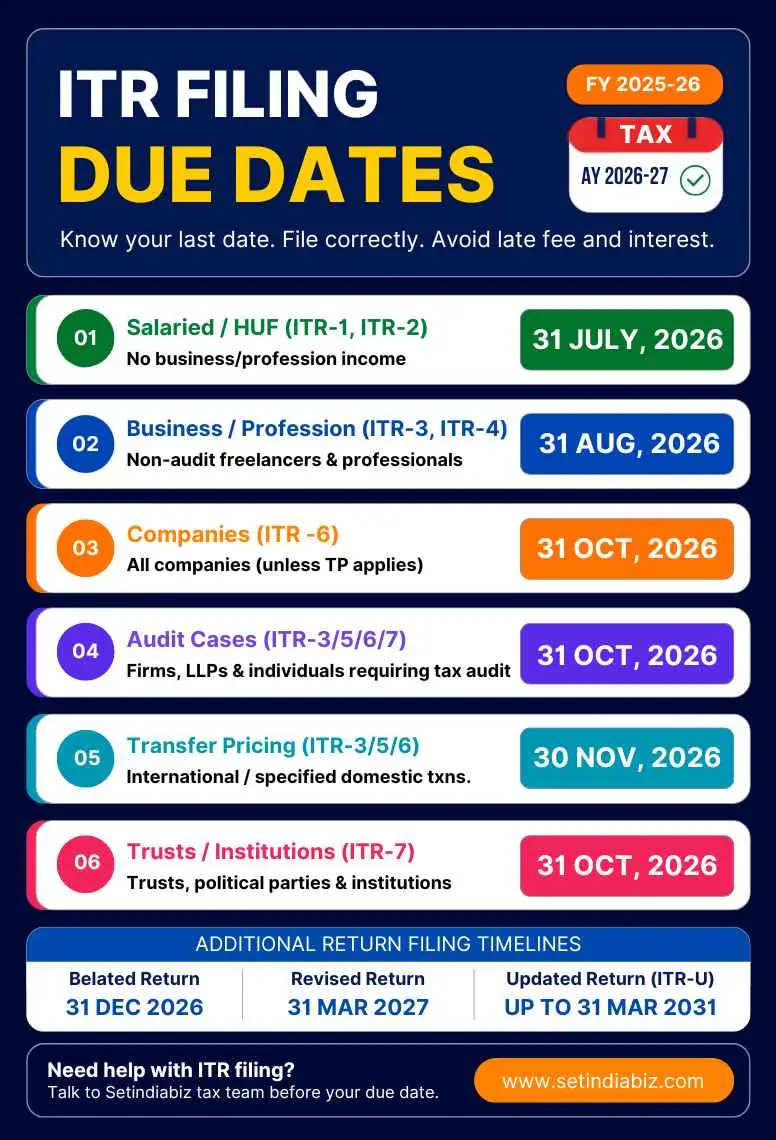
| 5 | Due date | 31-07-2026 (ITR-1/ITR-2, non-audit); 31-08-2026 (ITR-3/ITR-4, non-audit business/profession). |
| 6 | Belated / Revised | Belated: 31-12-2026 (Section 139(4)). Revised: Section 139(5) until 31st March 2027. |
| 7 | Updated return | ITR-U within 48 months of the AY end (Section 139(8A)). |
| 8 | Cost | Professional fee by profile/package; nil government fee to file. |
What is Individual ITR Filing?
An Income Tax Return (ITR) is the form on which an individual reports income, deductions and taxes paid for a financial year to the Income Tax Department, under Section 139 of the Income-tax Act, 1961. Your return for FY 2025-26 is assessed in AY 2026-27 and is governed entirely by the 1961 Act, even though you file it after 1 April 2026 — income earned from 1 April 2026 (Tax Year 2026-27) moves to the Income-tax Act, 2025.
Setindiabiz files your return end-to-end: we reconcile your salary, capital gains and interest against your AIS and Form 26AS, compare the old and new regimes, choose the correct ITR form, and e-file and e-verify within the statutory window. You get a filed return, an ITR-V acknowledgement, and a clean record for loans, visas and refunds.

Pradeep Vallat
Founder "Autonomo""Setindiabiz’s knowledgeable, disciplined, and organized team made our company registration, tax, and IPR filings smooth, hassle-free, and worry-free."
Pricing For Income Tax Return
Salaried Standard
- ✓One Employer Form 16
- ✓Bank Interest Income
- ✓26AS Data Import
- ✓Tax Payment Assistance
Salaried Plus
- ✓More than one employer Form 16
- ✓Bank Interest Income
- ✓26AS Data Import
- ✓Tax Payment Assistance
- ✓Single House Rental Income
Salaried Pro
- ✓More than one employer Form 16
- ✓Bank Interest Income
- ✓26AS Data Import
- ✓Tax Payment Assistance
- ✓Multiple House Rental Income
- ✓Agriculture Income
- ✓Company Director or DP
Professional Plan
- ✓More than one employer Form 16
- ✓Multiple House Rental Income
- ✓Professional Income (Non Audit) 44ADA
- ✓Bank Interest Income
- ✓26AS Data Import
- ✓Tax Payment Assistance
Business/Trader Plan
- ✓More than one employer Form 16
- ✓Multiple House Rental Income
- ✓Business Income (Non Audit) 44AD
- ✓Bank Interest Income
- ✓26AS Data Import
- ✓Tax Payment Assistance
F&O Trader
- ✓More than one employer Form 16
- ✓Multiple House Rental Income
- ✓Business Income (Non Audit)
- ✓Multiple Capital Gain Income
- ✓F&O Income/Loss (Non Audit)
- ✓Income from Other Sources
- ✓Agricultural Income
Capital Gain Basic
- ✓More than one employer Form 16
- ✓Multiple House Rental Income
- ✓Property Sale Capital gain
- ✓Bank Interest Income
- ✓26AS Data Import
- ✓Tax Payment Assistance
Capital Gain Plus
- ✓More than one employer Form 16
- ✓Multiple House Rental Income
- ✓Property Sale Capital gain
- ✓Mutual Fund Capital Gain
- ✓Equity Trading - One Platform
- ✓Bank Interest Income
- ✓26AS Data Import
- ✓Tax Payment Assistance
Capital Gain Pro
- ✓More than one employer Form 16
- ✓Multiple House Rental Income
- ✓Property Sale Capital gain
- ✓Mutual Fund Capital Gain
- ✓Equity Trading - Multiple Platform
- ✓Bank Interest Income
- ✓26AS Data Import
- ✓Tax Payment Assistance
NRI
- ✓More than one employer Form 16
- ✓Multiple House Rental Income
- ✓Section 44 AD/44ADA Income
- ✓Multiple Capital Gain Income
- ✓Speculative Income
- ✓ESOPs (Employee Stock Option Plans)
- ✓RSUs (Restricted Stock Units)
- ✓Income Earned in NRO/NRE Account
- ✓DTAA Guidance
- ✓Digital Virtual Assets (cryptocurrencies)
- ✓Declaration of Foreign Assets
- ✓Income from Other Sources
- ✓Agriculture Income
Foreigner/Foreign Income
- ✓Foreign salary(Including Foreign Tax relief)
- ✓Foreign Tax Credit / Form 67
- ✓More than one employer Form 16
- ✓Multiple House Rental Income
- ✓Section 44 AD/44ADA Income
- ✓Multiple Capital Gain Income
- ✓Speculative Income
- ✓ESOPs (Employee Stock Option Plans)
- ✓RSUs (Restricted Stock Units)
- ✓Income Earned uin NRO/NRE Account
- ✓DTAA Guidance
- ✓Digital Virtual Assets (cryptocurrencies)
- ✓Income from Other Sources
- ✓Agriculture Income
Crypto Pack
- ✓More than one employer Form 16
- ✓Multiple House Rental Income
- ✓Property Sale Capital gain
- ✓Mutual Fund Capital Gain
- ✓Equity Trading - Multiple Platform
- ✓Digital Virtual Assets (cryptocurrencies)
- ✓Bank Interest Income
- ✓26AS Data Import
- ✓Tax Payment Assistance
Who Must File an Income Tax Return?
Under Section 139(1) of the Income-tax Act, 1961, you must file a return if your total income before deductions exceeds the basic exemption limit. For FY 2025-26, this limit is ₹4,00,000 under the default new regime and ₹2,50,000 under the old regime (increasing to ₹3,00,000 for seniors and ₹5,00,000 for super-seniors). Residential status under Section 6 determines the scope: residents report global income, while non-residents report only India-source income. Mandatory filing is required even if income is nil or below the limit for specific triggers, such as high-value spending or holding foreign assets. The following table details these exceptions, their thresholds, and governing provisions.
| No | Situation/trigger | Threshold or condition | Mandatory ITR |
|---|---|---|---|
| 1 | Deposits in current account(s) | Aggregate over ₹1 crore in the year | Yes |
| 2 | Foreign travel expenditure | Over ₹2 lakh (own or another person’s) | Yes |
| 3 | Electricity expenditure | Over ₹1 lakh in the year | Yes |
| 4 | Business turnover/gross receipts | Over ₹60 lakh | Yes |
| 5 | Professional gross receipts | Over ₹10 lakh | Yes |
| 6 | TDS + TCS in the year | ₹25,000 or more (₹50,000 for senior citizens) | Yes |
| 7 | Deposits in savings bank account(s) | Aggregate ₹50 lakh or more | Yes |
| 8 | Foreign assets/income | Any holding, signing authority or beneficial interest in an entity incorporated outside India | Yes |
| 9 | Director in a company | Should use ITR-2 or ITR-3; disclose DIN, company PAN, shareholding. (ITR-1/ITR-4 barred) | Yes (See Notes) |
| 10 | Partner/designated partner | Must use ITR-3 (ITR-1/ITR-4 barred) | Yes (See Notes) |
| 11 | Holder of unlisted equity shares | Must use ITR-2 or ITR-3; disclose holding in Part A-General | Yes (See Notes) |
Income Tax Slabs for FY 2025-26 (AY 2026-27)
How much tax you pay depends on the regime you file under. The new regime under Section 115BAC is the default and offers lower slab rates with a ₹75,000 standard deduction and a Section 87A rebate that takes tax to nil up to ₹12 lakh; the old regime keeps higher rates but lets you claim deductions such as 80C, 80D, HRA and home-loan interest. Both carry a 4% Health & Education Cess on tax. The two slab tables are set out below.
New regime (default) — Section 115BAC
| Taxable income | Rate |
|---|---|
| Up to ₹4,00,000 | Nil |
| ₹4,00,001 – ₹8,00,000 | 5% |
| ₹8,00,001 – ₹12,00,000 | 10% |
| ₹12,00,001 – ₹16,00,000 | 15% |
| ₹16,00,001 – ₹20,00,000 | 20% |
| ₹20,00,001 – ₹24,00,000 | 25% |
| Above ₹24,00,000 | 30% |
| Standard deduction ₹75,000 (salary/pension). The Section 87A rebate of up to ₹60,000 makes tax nil for resident taxable income up to ₹12 lakh; marginal relief applies just above ₹12 lakh. Surcharge is capped at 25% under this regime. The 87A rebate does not extend to income taxed at special rates (for example, capital gains under Sections 111A/112A) | |
Old regime (The taxpayer can opt for this)
| Taxable income | Rate |
|---|---|
| Up to ₹2,50,000 | Nil |
| ₹2,50,001 – ₹5,00,000 | 5% |
| ₹5,00,001 – ₹10,00,000 | 20% |
| Above ₹10,00,000 | 30% |
| Basic exemption is ₹3,00,000 for senior citizens (60–79) and ₹5,00,000 for super-senior citizens (80+). Standard deduction: ₹50,000; Section 87A rebate: ₹12,500, making tax nil up to ₹5 lakh. Surcharge runs up to 37%. | |
Old Regime vs New Regime — Which Should You Choose?
The choice of regime is the single biggest decision for your return, and it is yours to make each year (with one restriction for business income). The new regime wins for most people with few deductions; the old regime can still win where you have a home loan, large 80C/80D investments, or significant HRA. The table compares the two, followed by a plain takeaway.
| No | Feature | New regime (default) | Old regime |
|---|---|---|---|
| 1 | Governing provision | Section 115BAC | Normal slabs, Income-tax Act 1961 |
| 2 | Slab rates | Lower (Nil up to ₹4 lakh) | Higher (Nil up to ₹2.5 lakh) |
| 3 | Standard deduction | ₹75,000 | ₹50,000 |
| 4 | Section 87A rebate | Up to ₹60,000 (nil tax to ₹12 lakh) | ₹12,500 (nil tax to ₹5 lakh) |
| 5 | 80C / 80D / HRA / 24(b) | Not available | Available |
| 6 | NPS 80CCD(1B) ₹50,000 | Not available | Available |
| 7 | How to opt | Default — no action |
|
| 8 | Best suited to | Income up to ~₹12.75 lakh | Home loan, large 80C/80D, high HRA |
Documents Required to File Your ITR
You do not upload most documents to the portal, but you need them on hand to compute income correctly and to defend the return if the Income Tax Department raises a query under Section 143(1). The exact set depends on your income heads; the essentials and head-wise extras are listed below. Always reconcile against your Annual Information Statement (AIS) and Form 26AS first — mismatches are the leading cause of notices.
Mandatory In All Cases
-
PAN Card ?A valid permanent account number (PAN) issued by the Income Tax Department linked to Aadhaar and operative (Section 139AA); an inoperative PAN cannot file a return or receive a refund.
-
Aadhaar Card ?Residents (for PAN linking and OTP e-verification); NRIs are exempt and e-verify by net banking, EVC or signed ITR-V.
-
All active bank accounts ?The taxpayer has to submit details of all bank accounts held in India during the year: name, number, IFSC and type (savings/current/cash credit/overdraft/NRO); dormant accounts (inactive 3+ years) excluded. At least one account is pre-validated for any refund.
-
Closing balance of bank accounts ?only (i) ITR-4 presumptive filers (combined business-account balance, new field E21, Notification 45/2026), and (ii) Schedule AL of ITR-2/ITR-3 where total income exceeds ₹50 lakh. Not for a simple ITR-1.
Salaried Individuals
-
Form 16 ?salary TDS certificate from your employer.
-
Form 26AS and AIS/TIS ?consolidated TDS, tax paid and reported transactions.
-
Rent receipts / HRA details and home-loan interest certificate ?under the old regime.
Investors & capital gains
-
Broker / mutual-fund capital gains statement ?for Sections 111A/112A/112 computation.
-
Interest certificates ?savings, FD and bond interest.
Business & professional (ITR-3 / ITR-4)
-
Books, bank statements and receipts ?or turnover/gross-receipt summary for the presumptive scheme.
-
Form 16A / 26QB / TDS certificates ?tax deducted by clients.
Deduction proofs (old regime)
-
80C ?(LIC, PPF, ELSS, principal repayment), 80D (health insurance), 80CCD(1B) (NPS), 80E/80G as applicable.
Pro tip: download your AIS and Form 26AS on day one and tally every entry — fixing a mismatch before you file is far cheaper than answering a Section 143(1) intimation later.
How Setindiabiz Files Your Return
The process below is the full, assisted route; simple salaried cases collapse the middle steps into one sitting. We work entirely online and keep you informed at each stage, so the only thing you do is share documents and approve the final computation.
Step 01: Share your details
We collect your PAN, income documents and bank details through a secure channel, and confirm your residential status under Section 6 so we report the right scope of income.
🕒 Turnaround: same day.Step 02: Reconcile AIS & Form 26AS
Our specialists pull your AIS, TIS and Form 26AS and match every TDS and high-value entry, flagging mismatches before they become a notice under Section 143(1).
🕒 Turnaround: 1 working day.Step 03: Compute tax both ways
We compute your liability under the new regime (Section 115BAC) and the old regime, and recommend the lower-tax option, applying the Section 87A rebate and standard deduction.
🕒 Turnaround: 1 working day.Step 04: Select form & prepare the return
We pick the correct ITR (ITR-1/2/3/4), prepare the return, and, where the old regime is chosen with business income, file Form 10-IEA.
🕒 Turnaround: 1 working day.Step 05: File and pay self-assessment tax
We e-file on the Income Tax portal and, if any balance is due, generate the self-assessment tax challan (Section 140A) for you to pay before submission.
🕒 Turnaround: same day.Step 06: E-verify within 30 days
You e-verify by Aadhaar OTP, net banking or EVC — or we help you post the signed ITR-V to CPC Bengaluru. The return is invalid until verified, so this step must be done within 30 days.
🕒 Turnaround: same day; refund tracking thereafter.Statutory Due Dates for FY 2025-26 (AY 2026-27)
Missing the due date does not bar you from filing, but it triggers interest and a late fee and can forfeit loss carry-forward, so the dates below matter. They apply to income earned in FY 2025-26 and are set under Section 139(1) of the Income-tax Act, 1961; the late-filing consequences sit in Sections 234A and 234F.
| No | Taxpayer/return | Due date | Provision |
|---|---|---|---|
| 1 | Individuals/HUF, no audit (ITR-1, ITR-2) | 31-07-2026 | Section 139(1) |
| 2 | Individuals/HUF with business/profession, no audit (ITR-3, ITR-4) | 31-08-2026 | Section 139(1) |
| 3 | Taxpayers requiring an audit | 31-10-2026 | Section 139(1), 44AB |
| 4 | Designated partner/partner of an LLP or firm whose accounts are audited | 31-10-2026 | Explanation 2(a)(iii), Section 139(1) |
| 5 | Company director, or partner of a non-audit LLP/firm — personal return | 31-07-2026 (ITR-2) or
31-08-2026 (ITR-3), by profile |
Section 139(1) |
| 6 | Transfer-pricing cases (Form 3CEB) | 30-11-2026 | Section 139(1), 92E |
| 7 | Belated return | 31-12-2026 | Section 139(4) |
| 8 | Revised return | 31-03-2027 | Section 139(5) |
| 9 | Updated return (ITR-U) | Within 48 months of the AY end | Section 139(8A) |
Late Filing, Interest & Penalties
Filing after the due date carries a defined, escalating cost rather than an open-ended risk — it is worth knowing the numbers before you delay. The interest and fee provisions are in Sections 234A, 234B, 234C and 234F of the Income-tax Act, 1961; from Tax Year 2026-27, the late-filing fee moves to Section 428 of the Income-tax Act, 2025, at the same amounts.
| No | Default | Consequence | Provision |
|---|---|---|---|
| 1 | Tax is unpaid after the due date | Interest at 1% per month or part month | Section 234A |
| 2 | Shortfall of advance tax | Interest at 1% per month | Sections 234B & 234C |
| 3 | Filing a belated return | Late fee ₹5,000 (₹1,000 if total income ≤ ₹5 lakh) | Section 234F |
| 4 | Under-reporting | Penalty 50%–200% of tax | Section 270A |
| 5 | Late filing | Loss of carry-forward of business/capital losses (house-property loss survives) | Section 139(3), 80 |
Which ITR Form Should You File?
Picking the right form is the first decision on your return; filing the wrong ITR can render it defective under Section 139(9) and delay your refund. Rather than read four descriptions, find every row below that applies to you: the form you need is the one carrying a ✔ on all of them. ITR-3 is the most comprehensive, covering almost every situation, while ITR-1 (Sahaj) and ITR-4 (Sugam) are the simplest but most restricted. All four were notified for AY 2026-27 on 31 March 2026.
| No | Your situation | ITR-1 | ITR-2 | ITR-3 | ITR-4 |
|---|---|---|---|---|---|
| 1 | Resident individual, total income up to ₹50 lakh | ✔ | ✔ | ✔ | ✔ |
| 2 | Total income above ₹50 lakh | ✘ | ✔ | ✔ | ✘ |
| 3 | Salary or pension | ✔ | ✔ | ✔ | ✔ |
| 4 | One house property | ✔ | ✔ | ✔ | ✔ |
| 5 | More than one house property | ✘ | ✔ | ✔ | ✘ |
| 6 | Interest / other normal income | ✔ | ✔ | ✔ | ✔ |
| 7 | Only small LTCG up to ₹1.25 lakh (Section 112A) | ✔ | ✔ | ✔ | ✔ |
| 8 | Capital gains — shares, mutual funds, property | ✘ | ✔ | ✔ | ✘ |
| 9 | Agricultural income above ₹5,000 | ✘ | ✔ | ✔ | ✘ |
| 10 | Presumptive business/profession (Sec 44AD/44ADA/44AE) | ✘ | ✘ | ✔ | ✔ |
| 11 | Business or profession with regular books | ✘ | ✘ | ✔ | ✘ |
| 12 | F&O, intraday or speculative income | ✘ | ✘ | ✔ | ✘ |
| 13 | Director in a company | ✘ | ✔ | ✔ | ✘ |
| 14 | Holds unlisted equity shares | ✘ | ✔ | ✔ | ✘ |
| 15 | Partner drawing remuneration/interest from a firm | ✘ | ✘ | ✔ | ✘ |
| 16 | Foreign income, foreign assets or Schedule FA | ✘ | ✔ | ✔ | ✘ |
| 17 | Non-resident (NRI) | ✘ | ✔ | ✔ | ✘ |
Frequently Asked Questions
The Income-tax Act, 1961. Income of FY 2025-26 is assessed in AY 2026-27 under the old Act, even though you file after 1 April 2026. The Income-tax Act, 2025 applies only from Tax Year 2026-27 (income earned on or after 1 April 2026).
Not always — but you must file if you fall under any high-value trigger in the seventh proviso to Section 139(1), such as large current-account deposits, foreign-travel spend over ₹2 lakh, or TDS of ₹25,000 or more. A voluntary nil return is also the only way to claim a refund.
Under the default new regime, it is ₹4,00,000. Under the old regime, it is ₹2,50,000, rising to ₹3,00,000 for senior citizens (60–79) and ₹5,00,000 for super-senior citizens (80+).
Yes, if your India-source taxable income exceeds the basic exemption or you meet a Section 139(1) trigger. Your residential status under Section 6 sets the scope of income. Note that the Section 87A rebate is for resident individuals only.
Yes. Under Section 139AA, your PAN must be linked to Aadhaar and operative; an inoperative PAN cannot be used to file or to receive a refund.
Usually, ITR-1 (Sahaj), if you are a resident with total income up to ₹50 lakh from salary, one house property and other sources. For AY 2026-27, ITR-1 also allows LTCG up to ₹1.25 lakh under Section 112A. With larger capital gains, multiple properties or foreign assets, use ITR-2.
ITR-4 (Sugam) if you declare income on a presumptive basis under Section 44ADA (profession) or 44AD (business) with total income up to ₹50 lakh. If you maintain books or exceed the presumptive limits, use ITR-3.
Directorship or designated-partnership does not by itself make filing compulsory at nil income — the seventh proviso to Section 139(1) does not list it. But in practice, you almost always draw remuneration, sitting fees, interest or dividends above the exemption limit, so filing is unavoidable; and you cannot use ITR-1 or ITR-4 — you must file ITR-2 or ITR-3 and disclose your DIN, the company’s PAN and your shareholding.
No — it is the default under Section 115BAC, but you may opt for the old regime. A salaried taxpayer chooses while filing; a taxpayer with business income must file Form 10-IEA to opt out, and switching back later is restricted.
Under the new regime, the Section 87A rebate of up to ₹60,000 cancels the tax on resident taxable income up to ₹12 lakh. For salary, the ₹75,000 standard deduction lifts the effective nil-tax point to about ₹12.75 lakh; marginal relief smooths the jump just above ₹12 lakh.
If your deductions are small, the new regime usually wins. If you have a home loan, full 80C and 80D investments and significant HRA, the old regime can be better. The only reliable answer is to compute both, which we do before filing.
Listed-equity LTCG over ₹1.25 lakh is taxed at 12.5% under Section 112A; STCG on listed equity is 20% under Section 111A (rates effective 23 July 2024). These figures feed into ITR-2 or ITR-3.
31 July 2026 for non-audit individuals filing ITR-1 or ITR-2. Non-audit returns with business or professional income (ITR-3/ITR-4) are slated for 31 August 2026; audit cases are due 31 October 2026. Confirm the latest dates on the Income Tax portal before filing.
Yes, as a belated return under Section 139(4), up to 31 December 2026 for AY 2026-27, with a late fee under Section 234F and interest under Section 234A.
File a revised return under Section 139(5) to correct it. The revised return window for AY 2026-27 is being confirmed (sources cite 31 December 2026, with an indication of an extended date); we will file within the applicable cut-off.
A late fee of ₹5,000 under Section 234F, reduced to ₹1,000 if your total income is up to ₹5 lakh, plus interest at 1% per month on unpaid tax under Section 234A. You may also lose the right to carry forward losses.
Possibly, through an updated return (ITR-U) under Section 139(8A), now allowed within 48 months of the assessment year’s end. Additional tax applies — 60% in the third year and 70% in the fourth — and ITR-U cannot be used to claim a refund or report a loss.
A simple salaried return can be completed in a single sitting once documents are shared; capital-gains and business returns typically take two to three working days for reconciliation, computation and review before e-filing.
File the return, e-verify it, and ensure your bank account is pre-validated on the portal. Refunds are paid by the Income Tax Department with interest under Section 244A; we track the status until credit.
A return is not valid until verified. You e-verify within 30 days via Aadhaar OTP, net banking or EVC, or by posting the signed ITR-V to CPC Bengaluru. Miss the window, and the return is treated as never filed.
No — ITR filing is largely paperless. You keep Form 16, capital-gains statements and deduction proofs as records to support the figures and to answer any intimation under Section 143(1).
The professional fee depends on your income profile (salaried, investor, presumptive business, or trader/NRI). There is no government fee to file. Self-assessment tax under Section 140A, if any, is payable by you, and GST on the professional fee is extra.
No. Setindiabiz is a private professional-services firm. Your return is filed on, and processed only by, the Income Tax Department of India; we prepare, compute, file and e-verify on your behalf.
