
Overview: India’s apparel exporters could gain ground in the UK and European Union as trade agreements improve tariff access. Together, these markets represent an estimated US$220 billion in annual apparel imports, according to Jefferies research reported by Financial Express. Lower duties alone will not secure new orders. Manufacturers must remain competitive, meet buyer requirements and maintain accurate origin and export documentation.
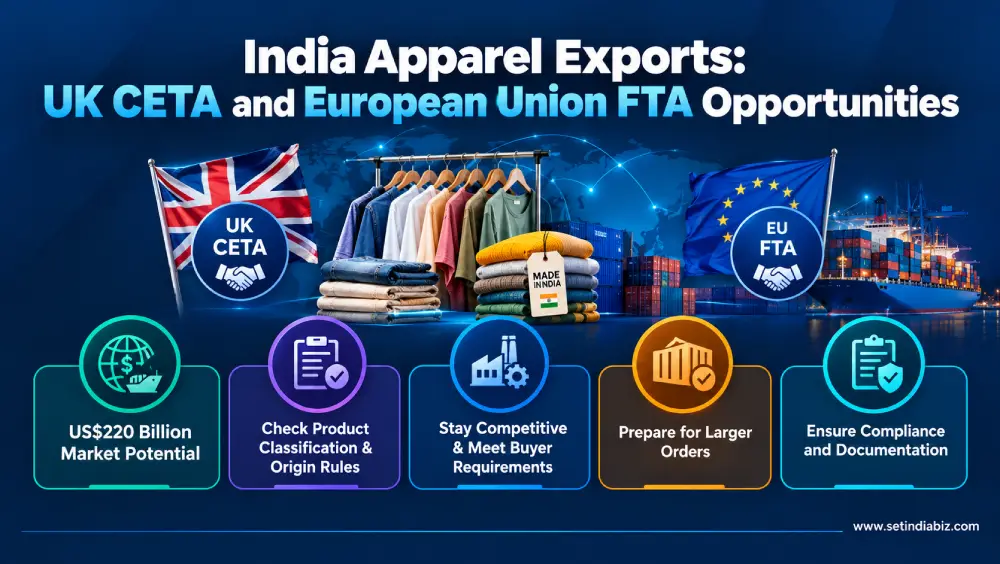
The UK-India trade deal is now in force, while India’s proposed trade agreement with the European Union moves through the formal approval process. Together, these developments could improve market access for Indian apparel exporters, but tariff concessions alone will not guarantee business growth. Manufacturers and merchant exporters must understand the applicable trade rules and prepare their production, pricing and export documentation before pursuing new contracts.
A New Opportunity for Indian Apparel Exporters
The UK-India Comprehensive Economic and Trade Agreement (CETA) entered into force on 15th July, 2026. It offers preferential tariff treatment for eligible Indian products. Meanwhile, negotiations for the India-EU Free Trade Agreement (FTA) concluded on 27th January, 2026. The European Commission submitted proposals to advance the agreement towards signature and conclusion in September, but it has not yet entered into force.
For Indian garment manufacturers and merchant exporters, the opportunity is clear: reach more overseas buyers and compete on better tariff terms. Turning that opportunity into repeat orders, however, will depend on pricing, quality, delivery and compliance.
Commercial Potential of US$220 Bn Market
Jefferies research cited by Financial Express estimates that the UK and EU together account for around US$220 billion in annual apparel imports. India has an established textile manufacturing base, but exporters still face competition from countries with strong sourcing networks and preferential market access.
Textile MSMEs and manufacturers in clusters such as Tiruppur could use the changing trade landscape to approach new buyers. Yet the total market value is not a forecast of Indian export sales. Actual gains will depend on product demand, capacity and eligibility for preferential tariffs.
Check Product Classification and Origin Rules
Under UK-India CETA, exporters must check the tariff schedule and rules of origin for the product they intend to ship. They should not assume that every garment qualifies for zero duty.
Product classification is a practical starting point. HS (Harmonised System) Chapter 61 covers knitted or crocheted apparel, while Chapter 62 covers apparel that is not knitted or crocheted. The precise code depends on the garment and its characteristics.
Origin rules matter just as much. Stitching a garment in India does not automatically establish eligibility for preferential treatment. Exporters should check the product-specific rule and retain relevant purchase invoices, supplier details, fabric and yarn sourcing records, and production documents.
Speak to fabric and yarn suppliers early. Missing records for imported inputs can make it harder to substantiate an origin claim when a buyer or customs authority requests evidence.
The EU agreement is not yet in force. Exporters can prepare their documentation now, but should not promise customers EU tariff savings until the relevant provisions become operational.
Prepare the Business Before Taking Larger Orders
Lower duties will not make up for poor quality or late deliveries. Manufacturers should review production capacity, defect rates, fabric wastage and delivery schedules before accepting larger contracts.
Product diversification may also open opportunities. Businesses can assess demand for man-made fibre garments and sportswear before committing capital to new machinery or production lines.
Cash flow needs equal attention. Raw materials, wages and freight may have to be paid well before the overseas buyer settles the invoice. Smaller manufacturers can consider working with established exporters or merchant-export partners when a direct contract exceeds their production or financial capacity.
Setindiabiz Support
Businesses should establish their corporate and tax compliance before expanding into overseas markets. Setindiabiz supports this groundwork through relevant services, including:
- Company incorporation and applicable corporate compliance.
- MSME/Udyam registration for eligible businesses.
- Import Export Code (IEC) applications.
- GST LUT filing and applicable export-related GST refund processes.
Eligible GST-registered exporters may use a valid Letter of Undertaking (LUT) to export without upfront payment of integrated GST, subject to applicable conditions. They should also reconcile invoices, shipping bills and GST records to resolve discrepancies promptly.
An IEC supports export operations where required, but does not itself establish eligibility for preferential tariffs. Udyam registration does not guarantee export incentives; each scheme has separate conditions.
Watch: GST LUT Filing Explained | How to File on the GST Portal
FAQs
Yes, if the product qualifies under the applicable tariff schedule and meets the agreement’s origin and documentation requirements.
No. The agreement has advanced towards formal approval but has not yet entered into force.
No. Preferential tariffs depend on product classification, origin eligibility and the relevant agreement’s requirements.
UK-India CETA offers a current opportunity for eligible Indian apparel exports, while the India-EU FTA could widen market access after it enters into force. Manufacturers must combine tariff awareness with competitive production, reliable delivery and sound records. SetIndiaBiz supports businesses with incorporation, IEC, Udyam and GST compliance as they prepare for international growth.
