
Overview: The India-New Zealand Free Trade Agreement (FTA) will enter into force on 20th October 2026, opening the way for Indian goods to receive preferential access to the New Zealand market. Exporters preparing consignments should review product-specific rules of origin, tariff classification and supporting documents before claiming the benefit. Indian GST and export-documentation requirements will continue to apply separately.
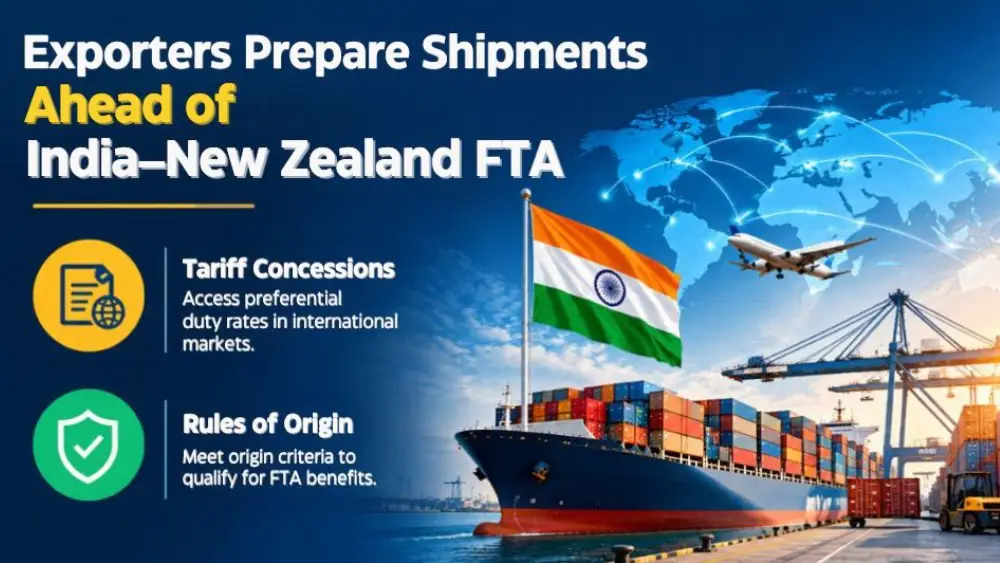
Indian exporters are approaching a new trade opportunity as the India-New Zealand FTA moves towards implementation. The agreement promises zero-duty access for Indian goods exports from day one, but businesses must meet the relevant conditions to claim preferential tariff treatment.
For companies planning shipments around the commencement date, preparation matters. Product classification, origin evidence and consistency across commercial and shipping documents can affect whether a consignment qualifies for the agreed tariff benefit.
India-New Zealand FTA to Take Effect on 20 October
India and New Zealand signed the FTA on 27th April 2026. The Ministry of Commerce and Industry announced on 21st September that the agreement would enter into force on 20 October 2026. The government has stated that 100% of India’s exports to New Zealand will receive zero-duty access from day one, subject to the agreement’s requirements.
Textiles, apparel, leather and footwear, engineering goods, carpets, ceramics and processed food are among the sectors expected to benefit. The agreement also covers wider areas of economic cooperation, including services and investment.
The commercial benefit will depend on the product being exported and compliance with the applicable rules. Exporters should therefore confirm the treatment of their specific goods rather than assume that every consignment will qualify automatically.
What Exporters Should Check Before Dispatch
Businesses preparing consignments should review four areas before claiming preferential duty treatment.
- Product classification: Confirm the correct Harmonised System (HS) code and check the tariff treatment applicable to that product in New Zealand. Classification affects which tariff concession applies.
- Rules of origin: Establish whether the goods satisfy the relevant product-specific origin requirements. Shipping goods from India alone does not necessarily make them originating goods under the FTA.
- Proof of origin: Arrange the required Certificate of Origin or other permitted origin documentation, as applicable. The FTA’s rules and documentation provisions should guide the process. India’s Certificate of Origin platform provides access to the relevant digital services.
- Consignment records: Match the product description, quantity, invoice details and origin information across the commercial invoice, packing list, shipping bill and origin documents. Resolve discrepancies before dispatch wherever possible.
Indian GST Compliance Remains Separate
The FTA’s customs-duty concessions in New Zealand do not remove Indian GST obligations. Exporters should continue to follow the GST route applicable to their business and consignments.
Businesses exporting goods without payment of integrated GST (IGST) under a Letter of Undertaking (LUT) should ensure that the LUT is valid for the relevant financial year. Export invoices must also be reported in the applicable GST returns, including GSTR-1 and GSTR-3B, as required. Eligible exporters may claim a refund of unutilised input tax credit through Form GST RFD-01, subject to the prescribed conditions.
Export Readiness Includes Routine Business Compliance
FTA preparation also brings routine business records into focus. Exporters should keep their Importer Exporter Code (IEC) details current, maintain consistent invoices and supporting records, and ensure that applicable GST filings are in order.
Setindiabiz Support
Setindiabiz supports businesses with export-related compliance, including IEC-related requirements, GST registration, LUT filing and export documentation. Our experts help businesses prepare for exports by ensuring that the required documentation is in place and applicable compliance requirements are addressed, so businesses can approach export transactions with greater readiness.
FAQs
The agreement is scheduled to enter into force on 20th October, 2026.
No. Exporters must meet the applicable rules of origin and documentation requirements to claim preferential tariff treatment.
Depending on the consignment, these may include the commercial invoice, packing list, shipping bill and required proof of origin. Product classification and the applicable FTA provisions should also be checked.
No. Indian GST requirements, including applicable LUT and return-filing obligations, remain separate from the tariff concessions available in New Zealand.
The India-New Zealand FTA creates an opportunity for Indian exporters, but businesses should prepare before claiming preferential duty treatment. Confirming product classification, meeting origin requirements and reconciling shipment documents can reduce avoidable delays. Reviewing IEC details and Indian GST obligations alongside these checks will help businesses prepare for the new trading arrangements.
