
Overview: India’s global capability centre (GCC) sector generated $98.4 billion in FY26 revenue, with 2,117 centres employing 2.36 million professionals, according to the Zinnov–Nasscom report. Meanwhile, reports suggest that the Big Four professional services firms generated more than $2 billion in combined GCC-related revenue during the year. The figures reflect the growing importance of India in global business operations.
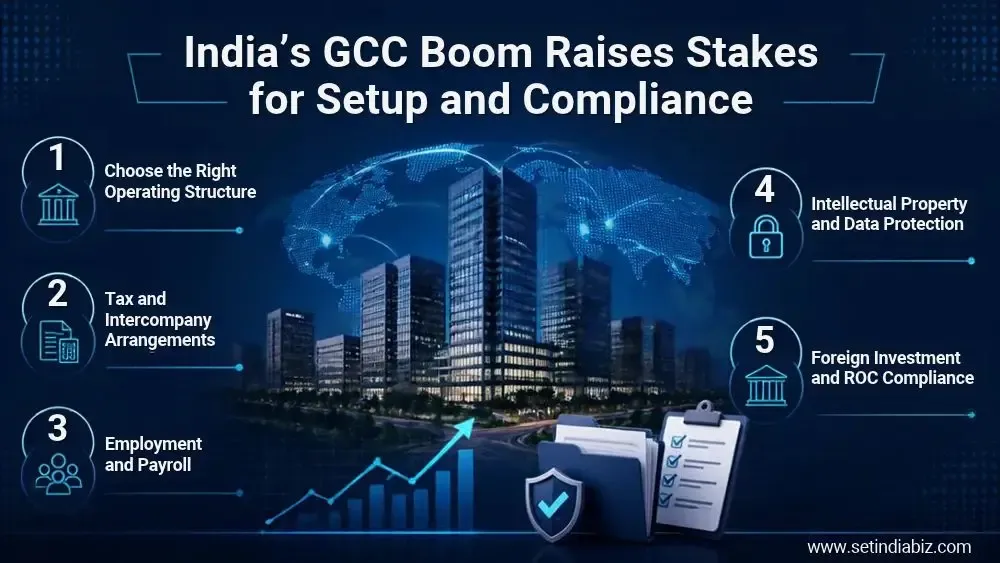
India’s global capability centre (GCC) sector is expanding beyond traditional support functions, with multinational companies increasingly using their Indian operations for technology, research and product development. The latest industry figures underline the scale of this shift.
As foreign companies consider setting up or expanding GCCs in India, choosing the right business structure is only the first step. Tax, foreign investment, employment and corporate compliance requirements also need to be built into the plan from the outset.
The GCC Boom Brings New Business Decisions
The Big Four’s growing GCC business reflects a wider shift in how multinational companies use their Indian operations. Deloitte India and EY India each crossed ₹5,000 crore in GCC-related revenue in FY26, according to an Economic Times report.
Indian centres are increasingly taking on technology development, research, product work and business transformation instead of handling only routine support functions. As their responsibilities expand, the decisions surrounding their establishment become more consequential.
Foreign companies planning to set up a GCC in India need to look beyond office space and recruitment. They must choose an appropriate operating structure, understand the applicable investment rules and establish clear arrangements with overseas group entities. Tax and employment compliance also need attention before operations scale up.
What Foreign Companies Must Plan Before Setting Up a GCC
Four areas deserve attention when planning a new centre.
Choose the right operating structure
A foreign company should assess whether an Indian subsidiary or another permitted structure suits its proposed activities. A subsidiary, branch office and liaison office have different legal and regulatory requirements. A liaison office, for example, cannot be used as a substitute for an operating business where its activities fall outside the permitted scope.
The company should assess ownership, foreign investment rules, applicable approvals and reporting obligations before committing to a structure.
Get tax and intercompany arrangements right
The Indian centre and its overseas group entities should document the services provided, responsibilities, charges and payment terms. Where the entities are associated enterprises, transfer pricing rules may apply to their international transactions. The company should assess its documentation and reporting obligations accordingly.
GST registration, invoicing and the treatment of cross-border services also depend on the actual arrangement. These questions are easier to address before the centre starts billing overseas group companies.
Prepare employment and payroll processes
Recruitment plans should account for employment contracts, payroll, applicable labour registrations and statutory benefits. The precise requirements depend on the establishment, workforce and relevant laws.
A centre that expands recruitment before putting these processes in place may face avoidable administrative gaps. Foreign companies should therefore build payroll and employment compliance into their operational plans.
Protect intellectual property and business data
GCCs involved in technology, research or product development need clear contractual terms governing intellectual property ownership and confidentiality. Companies should establish who owns the work produced in India and how confidential information may be accessed and used.
They should also assess applicable data protection requirements, cybersecurity responsibilities and cross-border data arrangements. The controls needed will depend on the nature of the work and the information handled.
Setindiabiz Support
Setindiabiz supports foreign companies with Indian subsidiary incorporation and ongoing corporate compliance. Depending on the proposed operating structure and activities, relevant services include applicable FEMA reporting, GST registration and compliance, accounting and bookkeeping, payroll services, relevant labour registrations, tax filings and annual ROC compliance.
FAQs
A GCC is an operation established by a multinational company to perform functions such as technology, finance, research, analytics, product development or business operations for its wider organisation.
The appropriate structure depends on the proposed activities, ownership, foreign investment rules, tax position and operational requirements. Companies should assess the permitted activities and applicable compliance obligations before commencing operations.
Key areas include incorporation, applicable foreign investment reporting, transfer pricing, GST, payroll, employment obligations, corporate filings, data protection and intellectual property arrangements. The exact requirements depend on the centre’s activities and structure.
India’s GCC sector is moving towards higher-value work, creating opportunities for foreign companies to establish strategic operations in the country. The business case should be matched by sound planning. Companies that address their legal structure, intercompany arrangements, tax obligations and workforce compliance together will be better placed to manage their responsibilities as the centre grows.
