
Overview: The FEMA Trade Rules 2026 will bring a consolidated framework for export and import transactions from October 1, 2026. The framework covers goods, services, software and merchanting trade, with greater responsibility for Authorised Dealer (AD) banks in handling extensions, set-offs, value reductions and specified third-party transactions. Exporters and importers will also see changes in EDF, EDPMS and IDPMS reporting.
With the new FEMA Trade Rules 2026 coming into effect from October 1, 2026, exporters and importers need to understand the changes that will affect their payment timelines, reporting and transaction processes. The Reserve Bank of India (RBI) has amended the Foreign Exchange Management (Export and Import of Goods and Services) Regulations, 2026, including the export-realisation periods and transitional provisions for certain existing transactions. The revised framework also gives Authorised Dealer (AD) banks a greater role in handling specified export, import and merchanting-trade transactions.
FEMA Trade Rules 2026 Take Effect from October 1
RBI notified the Foreign Exchange Management (Export and Import of Goods and Services) Regulations, 2026 in January 2026. The new regulations will come into force on October 1, 2026, replacing the existing regulatory framework for the export and import of goods and services.
The September 22, 2026 amendment changes the export-realisation period under the new regulations. The standard period has been reduced from 15 months to 9 months, while the period applicable to exports invoiced or settled in Indian Rupees has been reduced from 18 months to 12 months.
The amendment also introduces a provision allowing AD banks to handle specified export, import and merchanting-trade transactions undertaken before October 1 that previously required RBI approval. In an earlier article, Setindiabiz reported the news perspective, here is a detailed update for exporters and importers.
Key Changes for Exporters
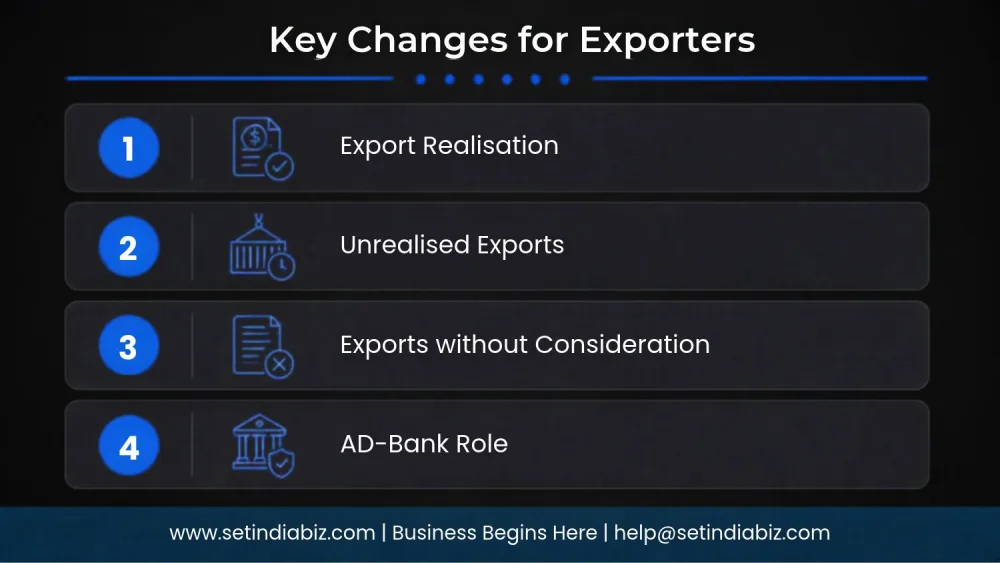
The revised FEMA export rules bring several practical changes for businesses receiving export proceeds.
- Export realisation: Once the amendments come into force on October 1, 2026, export proceeds will generally have to be realised and repatriated within 9 months. A 12-month period will apply to specified exports invoiced and/or settled in Indian Rupees. AD banks may allow extensions in permitted cases.
- Unrealised exports: If export proceeds remain unrealised beyond one year after the due date or an extended period allowed by the AD bank, further exports must generally be made against full advance payment or an irrevocable Letter of Credit.
- Exports without consideration: Goods exported without consideration can be declared at nil value in the EDF, subject to the applicable FEMA framework.
- AD-bank role: Once the amendments come into force on October 1, 2026, AD banks can deal with specified reductions in export value, non-realisation, set-offs and third-party receipts after examining the transaction and supporting documents.
Exporters who are on the Caution List as of September 30, 2026, will continue to be governed by the relevant existing orders until their names are removed from the list.
EDF Reporting Changes for Service Exports
The Export Declaration Form (EDF) will also apply to service exports under the new framework. A single EDF can cover service exports to one or more recipients during a month.
Service exporters generally have to submit the EDF within 30 days from the end of the month in which the invoice is raised. An exporter of services other than software may also submit the EDF on or before receipt of payment, subject to the applicable conditions.
Software exports will also be reported through EDF under the new framework, replacing the earlier SOFTEX-based reporting process.
Service export proceeds will generally have to be realised and repatriated within 9 months from the invoice date. The applicable period is 12 months in the specified case where the export is invoiced and/or settled in Indian Rupees.
Import Payments Move Closer to Contract Terms
The new FEMA import rules move away from the earlier fixed six-month payment period. Import payments will generally follow the period specified in the underlying contract, subject to the regulatory framework. An AD bank may extend the payment period where permitted.
The earlier US$ 200,000 threshold linked to standby Letters of Credit or guarantees for advance import payments is also replaced by an AD-bank approach. Banks can specify thresholds under their internal policies and procedures.
Where an advance remains unadjusted or cannot be repatriated, subsequent advance payments may require an unconditional and irrevocable standby Letter of Credit or an eligible bank guarantee.
Advance remittances for imports of gold and silver are generally not permitted under the regulations, subject to applicable provisions under other FEMA rules or directions.
Service Imports Enter IDPMS
The new framework also brings imports of services into Import Data Processing and Monitoring System (IDPMS) reporting.
Importers must submit the relevant documents to their AD banks. The bank is required to enter the details in IDPMS within five working days of receiving the documents.
Payment can follow the period agreed in the underlying contract, subject to the FEMA framework and any extension allowed by the AD bank. Interest on delayed payment cannot exceed the applicable all-in-cost ceiling for trade credit.
The regulations also permit specified set-offs between export receivables and import payables. These arrangements can cover transactions involving overseas group or associate companies, subject to the prescribed conditions.
EDPMS and IDPMS Get Greater Importance
The new framework places greater emphasis on the closure and monitoring of export and import transactions through Export Data Processing and Monitoring System (EDPMS) and IDPMS.
A declaration-based process is available for specified transactions up to ₹10 lakh, reducing documentation requirements for smaller-value cases. The regulations also provide a similar route for certain reductions or non-realisation of export value within the prescribed limit.
Businesses should therefore review old outstanding entries as well as their internal reconciliation process before the new framework starts.
Merchanting Trade Gets More Flexibility
The earlier nine-month overall completion requirement for merchanting trade has been removed.
The gap between the outward and inward remittances must generally not exceed six months, although an AD bank may extend the period in permitted cases.
Third-party payments and receipts may also be permitted after the AD bank examines the reasons and supporting documents. The export and import legs of a merchanting transaction must continue to be appropriately monitored through EDPMS and IDPMS.
FEMA Trade Rules 2026: Key Changes at a Glance
| Area | Key Change from October 1, 2026 |
|---|---|
| Export realisation | 9 months; 12 months for the specified INR-related category |
| Service exports | EDF reporting |
| Software exports | EDF replaces SOFTEX-based reporting |
| Import payments | Linked primarily to contractual terms |
| Import advances | AD-bank policies and specified safeguards |
| Gold and silver imports | Advance remittance generally not permitted, subject to applicable provisions |
| Merchanting trade | Six-month remittance gap, with AD-bank extension |
| Third-party transactions | Permitted subject to applicable conditions and AD-bank scrutiny |
| EDPMS/IDPMS | Greater emphasis on transaction monitoring and closure |
What Businesses Should Prepare
The October 1 change affects more than the payment date recorded in an export or import contract. Businesses should check whether their documentation, bank instructions and internal records are ready for the revised framework.
Key areas include:
- racking export receivables against the revised 9-month and 12-month realisation periods.
- Updating EDF processes for service and software exports.
- Reconciling outstanding EDPMS and IDPMS entries.
- Reviewing advance-payment arrangements with AD banks.
- Keeping supporting documents for extensions, set-offs, value reductions and third-party transactions.
- Reviewing merchanting trade contracts and payment flows.
- Identifying transactions that may require transitional treatment.
- Checking the status of exporters appearing on the Caution List as of 30th September, 2026.
Businesses with older or pending transactions should also discuss the applicable treatment with their AD banks, particularly where the transaction was undertaken before October 1 and previously required RBI approval.
FAQs
When will the FEMA Trade Rules 2026 become effective?
The Foreign Exchange Management (Export and Import of Goods and Services) Regulations, 2026 will come into force from October 1, 2026. The September 2026 amendment will also take effect from the same date.
What is the new export realisation period under FEMA 2026?
The revised period is generally 9 months. A 12-month period applies to the specified exports invoiced and/or settled in Indian Rupees. AD banks may allow extensions in permitted cases.
Will SOFTEX continue under the new FEMA framework?
No. The new framework brings software exports within the Export Declaration Form (EDF) process. This replaces the earlier SOFTEX-based reporting process for software exports.
What happens to exporters on the Caution List?
Exporters appearing on the Caution List as of September 30, 2026, will continue to be governed by the relevant existing orders until their names are removed from the list.
What should exporters and importers do before October 1, 2026?
Businesses should review their export and import contracts, payment timelines, EDF requirements, EDPMS and IDPMS records, advance-payment arrangements and supporting documentation. Older transactions should also be checked for any applicable transitional provisions.
Setindiabiz Support
The FEMA Trade Rules 2026 give exporters, importers and merchanting traders several areas to review, particularly export realisation timelines, EDF reporting, EDPMS/IDPMS records, payment arrangements and merchanting trade structures.
Setindiabiz experts support entities with FEMA compliance reviews, export-import documentation, AD-bank coordination, transaction structuring and ongoing compliance, export realisation timelines, EDF reporting, EDPMS/IDPMS reconciliation, import payment arrangements, third-party transactions and merchanting trade structures under the revised FEMA framework.
A timely compliance review helps identify documentation gaps and keep banking and foreign-exchange processes aligned with the applicable FEMA requirements.
The FEMA Trade Rules 2026 will change export realisation timelines, reporting requirements and payment processes from October 1, 2026. The September amendment has also reduced the standard export-realisation period to 9 months and introduced transitional provisions for specified existing transactions.
Exporters, importers and merchanting businesses should review their contracts, payment workflows, EDF filings, EDPMS/IDPMS records and supporting documents before the new framework takes effect.
In This Article
Author Bio

Setindiabiz Editorial Team is a multidisciplinary collective of Chartered Accountants, Company Secretaries, and Advocates offering authoritative insights on India’s regulatory and business landscape. With decades of experience in compliance, taxation, and advisory, they empower entrepreneurs and enterprises to make informed decisions.
