
Overview: Reserve Bank of India’s Foreign Exchange Maintenance Act (FEMA) amendment on 2nd November, 2026, has simplified reporting for service exports and imports. Resident individual exporters are deemed to have submitted the Export Declaration Form (EDF) after providing the required payment information to their authorised dealer (AD) bank. Other service exporters receive similar treatment where the inward remittance for a service does not exceed ₹10 lakh.
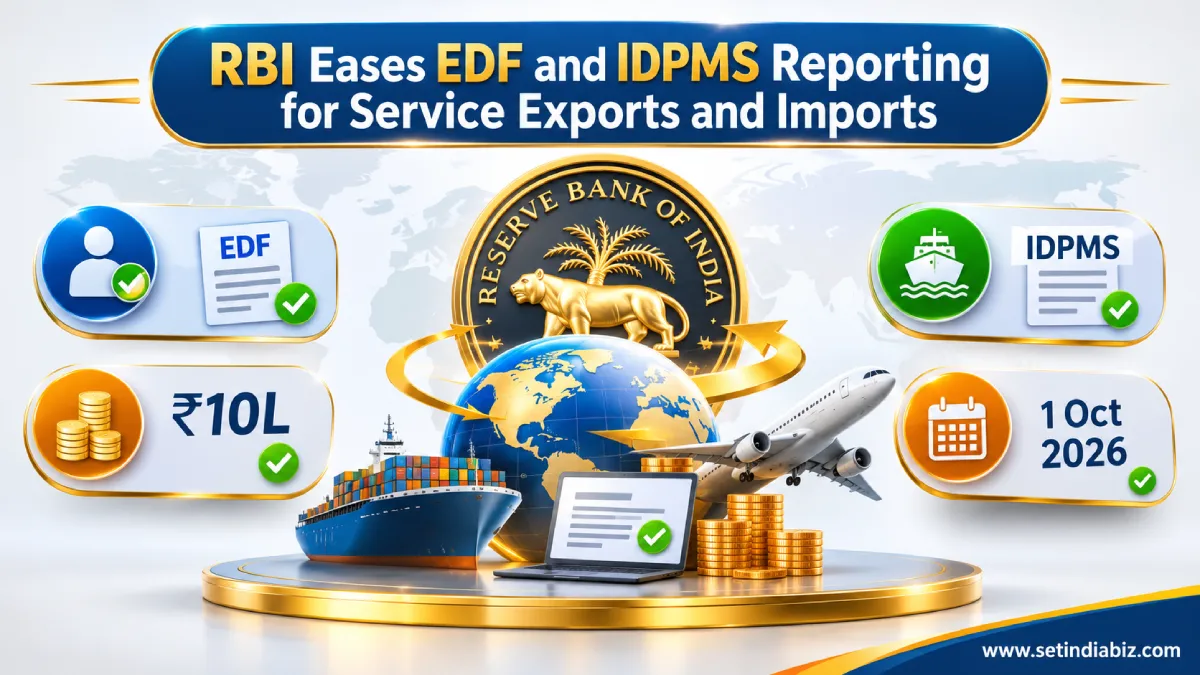
Import Data Processing and Monitoring System (IDPMS) reporting for service imports is restricted to specified transactions involving importers other than resident individuals. The changes apply from 1st October 2026.
The Foreign Exchange Management (Export and Import of Goods and Services) Regulations, 2026, introduced a common reporting framework for goods and services exports and imports from 1st October, 2026. The Export Declaration Form (EDF) requirement for service exports raised practical questions for freelancers, consultants and businesses receiving payments from overseas clients.
The RBI has now issued a further amendment to simplify reporting. It provides deemed EDF submission treatment for resident individual service exporters and other exporters receiving remittances within the prescribed limit. It also narrows the circumstances in which authorised dealer banks must report service imports in the Import Data Processing and Monitoring System (IDPMS).
What Has Changed in EDF Reporting?
The Foreign Exchange Management (Export and Import of Goods and Services) (Second Amendment) Regulations, 2026, notified on 2nd November, 2026, amend Regulation 3(2) of the principal regulations. The amendment defines a resident individual as a person resident in India who is a natural person.
Before this amendment, service exporters were generally required to submit an EDF declaring the full export value within 30 days from the end of the month in which the invoice was raised. Exporters of services other than software could also submit the EDF on or before receipt of payment.
The amended provision provides two forms of deemed submission:
- Resident individual exporters: A resident individual is treated as having submitted the EDF after providing the AD bank with the information required to credit the service payment to their account. No separate EDF is required under this provision.
- Other service exporters: Companies, LLPs, partnership firms and other exporters who are not resident individuals receive the same treatment if the inward remittance for the service does not exceed ₹10 lakh or its equivalent in foreign currency. If the remittance exceeds this limit, the regular EDF requirement continues to apply.
The ₹10 lakh threshold relates to the inward remittance for the particular service, not the exporter’s annual turnover. Exactly ₹10 lakh qualifies for the relaxation. Resident individuals receive the deemed-submission facility without a corresponding monetary ceiling.
What Has Changed for Service Imports?
The amendment also revises Regulation 18(1)(d), which governs service-import reporting in Import Data Processing and Monitoring System (IDPMS).
An authorised dealer bank must now enter service-import details within five working days of receiving the information furnished by the importer only when both the following conditions are satisfied:
- The importer is a person other than a resident individual.
- The invoice or contract value exceeds ₹10 lakh or its equivalent in foreign currency.
Accordingly, this specific IDPMS entry requirement does not apply to resident individual importers or to other importers whose invoice or contract value is ₹10 lakh or less.
The five-working-day timeline is an obligation on the AD bank, not a separate filing deadline imposed on the importer.
What Should Service Exporters and Importers Do?
The reporting relaxations do not remove other applicable FEMA and trade-compliance obligations.
Service exporters should:
- Confirm whether they qualify as resident individuals under the FEMA definition.
- Provide the AD bank with the required payment information.
- Check the inward remittance value before relying on the ₹10 lakh relaxation if you exporters other than resident individuals.
- Retain invoices, service agreements, remittance advice and supporting records.
The deemed EDF facility does not change the deadline for realising and repatriating export proceeds. Under the revised 2026 framework, the general period is nine months from the invoice date for exports invoiced in foreign currency and twelve months where exports are invoiced and/or settled in Indian rupees, subject to permitted extensions.
Service exporters seeking benefits under the Foreign Trade Policy must hold an Importer-Exporter Code (IEC). Existing IEC holders should also complete the prescribed annual updation of their details on the Directorate General of Foreign Trade (DGFT) portal.
Service importers should furnish accurate invoice or contract details to their AD banks. Businesses other than resident individuals should check whether the value exceeds ₹10 lakh, as this determines whether the bank must make the IDPMS entry.
Other applicable FEMA export-proceeds realisation requirements and GST and income-tax compliances continue separately. Software exporters should also check the applicability of other reporting requirements under the revised EDF framework.
Setindiabiz Support
Simplified bank reporting does not remove the need for proper business structuring, export documentation and continuing statutory compliance. Companies and LLPs undertaking cross-border service transactions must maintain accurate records and meet their applicable FEMA, GST and corporate filing requirements.
Setindiabiz supports businesses with company and LLP incorporation, IEC registration and applicable annual IEC updation, GST registration, LUT filing under Form GST RFD-11, GST returns and export-related compliance documentation. Our experts help businesses maintain the regulatory and documentation framework required for their overseas operations.
For transaction-specific EDF requirements, inward-remittance processing and IDPMS entries, exporters and importers should coordinate with their authorised dealer banks.
FAQs:
No. A resident individual is deemed to have submitted the EDF after providing the required payment information to the AD bank for crediting the export proceeds to their account.
No. It applies to service exporters other than resident individuals. The separate provision for resident individuals has no corresponding monetary ceiling.
No. The test is the value of the inward remittance for the service, not annual turnover or total export receipts.
Within five working days of receiving the details, where the importer is not a resident individual and the invoice or contract value exceeds ₹10 lakh or its foreign-currency equivalent.
While the notification was issued on 2nd November, 2026, the amended rules are expressly in force with retrospective effect from 1st October, 2026.
The RBI’s amendment reduces EDF reporting requirements for resident individual service exporters and provides a value-based relaxation for other exporters. It also narrows IDPMS reporting for service imports. Businesses should update their bank-coordination and documentation procedures while continuing to meet their applicable FEMA, IEC, GST and tax obligations.
