
Overview: India’s revised foreign exchange reporting framework took effect on 1st October, 2026, bringing service exports under the Export Declaration Form (EDF) regime. On 7th October, RBI Governor Sanjay Malhotra clarified that individuals providing services abroad, including tutoring and small software work, would not need to report such transactions. However, questions remain over how this clarification applies to different business arrangements, while small exporters seek simpler reporting procedures.
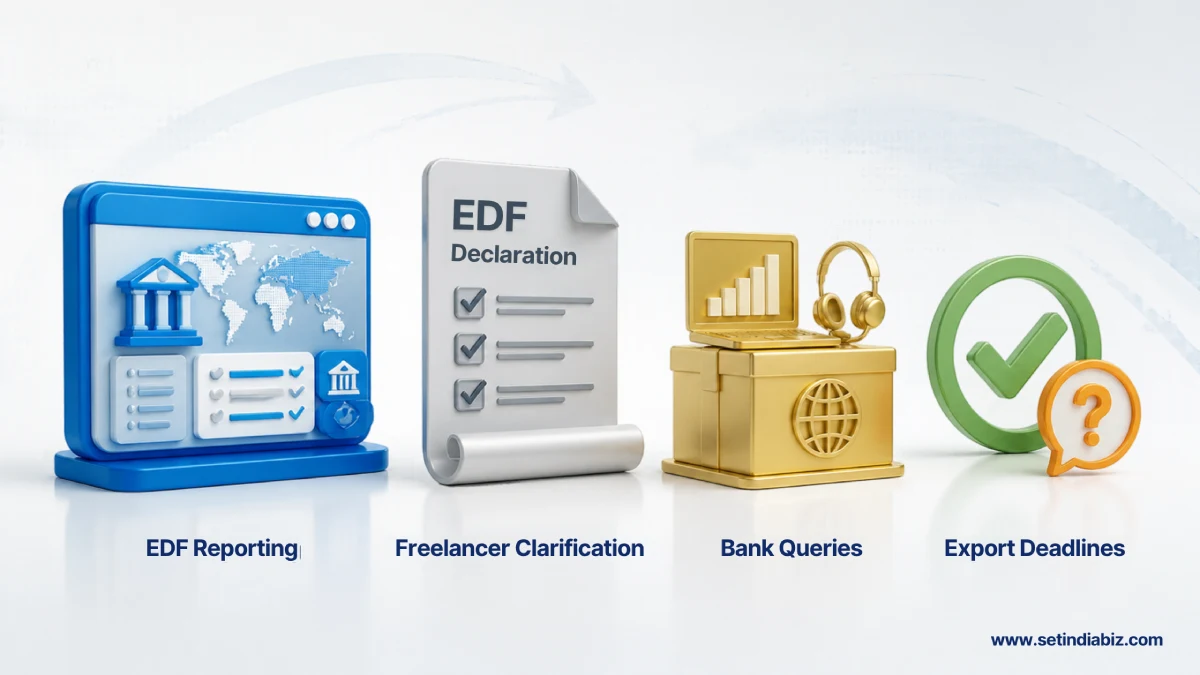
Banks have reportedly continued requesting EDFs from some individuals receiving overseas service payments, even after the Reserve Bank of India (RBI) Governor Sanjay Malhotra clarified the position. The issue has raised concerns among freelancers and small service-export businesses about the documents they must submit.
At the same time, revised FEMA regulations have shortened the period for realising export proceeds. IT agencies, consultancies and other service exporters must therefore review both their reporting procedures and payment deadlines.
RBI Clarifies Reporting for Individuals
The Foreign Exchange Management (Export and Import of Goods and Services) Regulations, 2026, took effect on 1st October. Regulation 3(2) requires service exporters to submit an EDF declaring the full export value of their services.
On 7th October, Malhotra said individuals undertaking transactions of a personal nature, including earnings from tutoring and small software assignments for overseas clients, would not need to report them. The statement followed concerns about additional paperwork for freelancers and content creators.
However, the regulations do not expressly define a general exemption for every freelancer or sole proprietor. Businesses should not assume that the clarification automatically covers every transaction conducted through a business account or registered entity.
Marketer Ramesh Srivats raised the issue on X after his bank requested an EDF for overseas consulting receipts. The episode brought attention to the difficulty customers face when bank procedures do not appear consistent with a public clarification.
EDF Filing and Bank Reporting
Under Regulation 3(2), the general deadline for submitting an EDF is within 30 days from the end of the month in which the service invoice is raised. A single declaration may cover services supplied to one or more recipients during a month. For services other than software, the EDF may also be submitted on or before receipt of payment. An authorised dealer bank may extend the filing period for justified reasons.
Authorised dealer banks handle the relevant reporting entries through the applicable RBI monitoring systems. Exporters must provide the transaction details and supporting documents requested by their banks.
For an IT agency or consultancy, invoices, contracts, service descriptions and remittance records should agree with the information submitted to the bank. Unmatched receipts or incorrect payment purpose codes can lead to additional queries.
The ₹10 Lakh Provision Simplifies Documentation
The RBI Governor also said small exporters could submit a self-declaration instead of uploading an invoice for transactions up to ₹10 lakh per bill. The threshold applies per bill, not to annual turnover.
This is an alternative documentation method, not a blanket exemption from EDF reporting. Businesses should confirm the applicable procedure with their authorised dealer bank before relying on it.
Export Realisation Deadlines Have Been Shortened
A separate amendment dated 22th September, 2026, changed Regulation 5(1), with effect from 1st October. The time allowed for realising and repatriating export proceeds has been reduced from 15 months to nine months. For exports invoiced or settled in Indian rupees, the period has been reduced from 18 months to 12 months.
For service exports, the applicable period runs from the invoice date. An authorised dealer bank may allow an extension if the exporter requests it and provides reasons for the delay.
Businesses must therefore track two separate obligations: EDF submission and realisation of export proceeds. Completing one does not remove the need to comply with the other.
Small Exporters Seek Simpler Procedures
India SME Forum has requested a 90-day suspension of recurring EDF filings for micro and small service exporters while a simpler reporting mechanism is developed. Its concerns include the administrative work involved in maintaining invoice details, customer information, service classifications and payment records.
The request reflects an industry proposal, not an approved relaxation. Exporters should continue following the applicable rules unless the RBI formally announces a change.
Practical Steps for Service-Export Businesses
IT agencies, consultancies and other service exporters should:
- Obtain written guidance from their authorised dealer bank on EDF requirements.
- Reconcile invoices with overseas receipts and bank remittance records.
- Check payment purpose codes and resolve unmatched entries promptly.
- Track the applicable nine-month or 12-month export realisation deadline.
- Keep foreign exchange documentation consistent with relevant GST records.
Businesses reviewing their wider export compliance requirements in India should also examine their GST position and supporting export documentation.
Setindiabiz Support
Service-export businesses must coordinate foreign exchange records with their wider regulatory obligations. Setindiabiz supports businesses with company registration, GST compliance, Letter of Undertaking (LUT) filing and related business compliance requirements.
Businesses establishing export operations should also review their registration and documentation needs, including Importer Exporter Code (IEC) requirements where applicable. For transaction-specific EDF reporting and bank reconciliation queries, the authorised dealer bank remains the appropriate point of contact.
FAQs
The RBI Governor clarified that individuals undertaking transactions of a personal nature, including tutoring and small software work, would not need to report them. Freelancers operating through a business structure should confirm how the clarification applies to their circumstances with their authorised dealer bank.
The general deadline is within 30 days from the end of the month in which the invoice is raised. For services other than software, the form may also be submitted on or before receipt of payment.
The Export Data Processing and Monitoring System is used by authorised dealer banks to monitor export transactions and their proceeds. Exporters must provide the transaction information and supporting documents required by their banks.
The general period is nine months from the invoice date. For exports invoiced or settled in Indian rupees, it is 12 months. An authorised dealer bank may allow an extension on a request supported by reasons.
The revised FEMA framework has introduced EDF reporting for service exports and shortened export realisation deadlines. Businesses should maintain consistent invoice and payment records, follow their bank’s reporting procedures and track the applicable deadlines. Any further relaxation will depend on formal regulatory guidance.
