
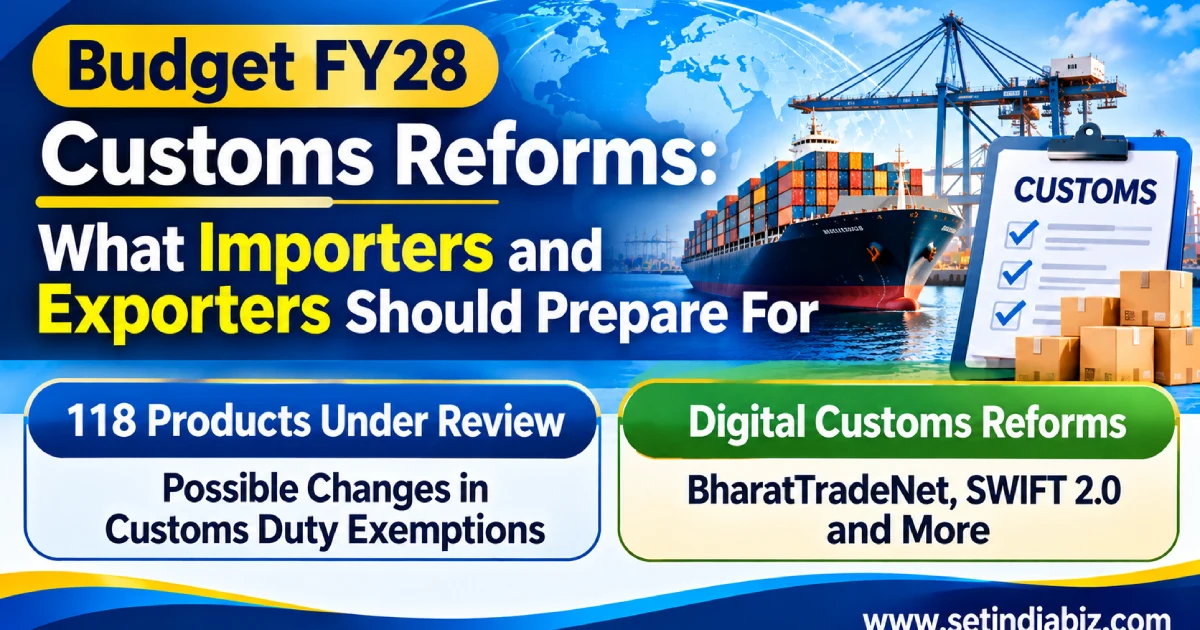
Overview: The Government has begun reviewing customs duty concessions and exemptions covering 118 products ahead of Budget FY28. The exercise may affect import costs across sectors, including textiles, renewable energy, pharmaceuticals and infrastructure. Alongside possible tariff changes, businesses should watch digital customs reforms, including SWIFT 2.0 and BharatTradeNet. Importers and exporters should also review their IEC, GST and export documentation before the next financial year.
Customs duty concessions directly affect the cost of imported machinery, raw materials and components. Their continuation or withdrawal can change manufacturing costs, pricing decisions and the competitiveness of finished products.
With preparations for the Union Budget 2027-28 underway, the Government has reportedly started reviewing customs duty concessions covering 118 products, according to a Hindu Businessline report. Businesses engaged in international trade should understand the possible impact and review their existing compliance arrangements.
Government Reviewing 118 Customs Duty Exemptions?
The Government is reportedly reviewing basic customs duty concessions and exemptions applicable to 118 products. Reported examples include textile machinery, battery scrap, photovoltaic cells, certain medicines, optical fibre cables and goods used in power projects.
The review covers concessions due to expire on 31st March and 30th September, 2027. Line ministries have reportedly sought industry feedback on whether these benefits should continue, be withdrawn or be allowed to lapse. The complete product list and final decisions should not be treated as officially confirmed.
The exercise also concerns inverted duty structures, where the customs duty on imported raw materials or components is higher than the duty on finished products. This can increase domestic manufacturing costs and put local producers at a disadvantage.
For businesses dependent on imported inputs, any change could affect procurement costs and production planning. Importers should identify the concessions they currently use and check their conditions and validity dates.
Key Digital and Procedural Customs Reforms to Watch
Apart from duty concessions, the Government is developing digital systems to simplify trade documentation and regulatory approvals.
1. BharatTradeNet for International Trade
The Union Budget 2025-26 announced BharatTradeNet as proposed digital public infrastructure for international trade. It is intended to support trade documentation and financing solutions while complementing the Unified Logistics Interface Platform (ULIP).
The initiative aims to improve the exchange of trade information and reduce fragmentation across different processes. However, businesses should check official implementation updates rather than assume that all trade documentation and financing services are already available through one platform.
2. SWIFT 2.0 for Customs Approvals
The Central Board of Indirect Taxes and Customs (CBIC) launched the upgraded Single Window Interface for Facilitating Trade (SWIFT 2.0) on 26th February, 2026.
The platform provides a common digital interface for regulatory approvals, licences, certificates and No Objection Certificates from Partner Government Agencies (PGAs). It aims to reduce repeated document submissions and the need to approach multiple government systems separately.
Agency integration is being carried out in phases. Businesses should check whether the relevant agency and approval process are available through the platform before relying on it for a particular transaction.
3. AEO Programme and Deferred Customs Duty
The Authorised Economic Operator (AEO) programme recognises businesses with sound customs compliance records and appropriate supply-chain security arrangements. Eligible entities receive facilitation benefits according to their certification tier.
Under the FY27 Budget measures, the deferred customs duty payment period for eligible AEO Tier 2 and Tier 3 importers was extended from 15 to 30 days with effect from 1st March, 2026. The amended rules provide for payment by the first day of the following month for most monthly clearing periods, with a separate due date for March.
The Government has also introduced the Eligible Manufacturer Importer (EMI) scheme. Approved manufacturers meeting prescribed conditions can use the deferred-duty facility from 1st April, 2026, until 31st March, 2028. Existing AEO Tier 1 entities, including eligible MSMEs, can also apply, but an AEO Tier 1 certificate alone does not guarantee approval.
How Importers and Exporters Should Prepare
Businesses should review the following requirements rather than wait for the next Budget announcement.
1. Check IEC details and annual updation
Every Importer-Exporter Code (IEC) holder must confirm or update its details electronically on the DGFT portal during April-June each year, even if nothing has changed. Failure to complete this exercise can result in IEC deactivation.
2. Maintain consistent trade documentation
Importers and exporters should keep commercial invoices, packing lists and product descriptions consistent. Businesses claiming preferential customs duty under a Free Trade Agreement (FTA) should verify the applicable rules of origin and obtain the required Certificate of Origin.
3. Keep GST LUT valid
Exporters supplying goods or services without payment of Integrated Goods and Services Tax (IGST) must furnish a Letter of Undertaking in Form GST RFD-11 for the relevant financial year before making exports under this facility.
4. Review applicable customs exemptions
Importers should check the notifications under which they claim concessional or nil customs duty. Product descriptions, end-use conditions, supporting documents and expiry dates all matter. A concession available in one financial year should not be assumed to continue in the next.
5. Examine eligibility for deferred-duty facilities
Manufacturers and regular importers can review whether they meet the separate eligibility requirements for AEO benefits or the EMI scheme. The applicable conditions and approval process should be checked before making business plans around deferred payments.
Setindiabiz Support for Importers and Exporters
International trade requires businesses to maintain their registrations, GST records and supporting documents alongside their commercial operations.
Setindiabiz provides business compliance services covering Import Export Code (IEC) registration, annual IEC updation, GST registration, GST return compliance and GST Letter of Undertaking (LUT) filing. Our experts also support businesses with relevant documentation and continuing statutory compliance, allowing management to concentrate on procurement, production and exports.
FAQs
The Government is reviewing customs duty concessions and exemptions covering 118 products. The review includes benefits due to expire in March and September 2027.
BharatTradeNet was announced in Budget 2025-26 as proposed digital infrastructure for trade documentation and financing. Its implementation and available facilities should be checked against official updates.
CBIC launched SWIFT 2.0 on 26 February 2026 to improve the digital interface between Customs and Partner Government Agencies.
Yes. An eligible manufacturing MSME can apply if it satisfies the prescribed conditions. An AEO Tier 1 certificate alone does not guarantee approval.
Yes. IEC holders must electronically confirm or update their details on the DGFT portal during April-June every year, even if there are no changes.
The review of 118 customs duty concessions could affect businesses dependent on imported inputs and machinery. Importers and exporters should review applicable exemptions, IEC details, GST compliance and export documentation while keeping track of the Government’s Budget FY28 decisions.
