
Overview: GST 2.0 is entering another phase, with the GST Council expected to consider a wide set of process reforms on 7th October 2026. The proposals cover input tax credit, refunds, GST registration, e-commerce sellers, multi-state audits and GST enforcement. If approved, they could reduce repetitive compliance work and make GST administration easier for businesses. These are still proposals and will apply only after the required decisions, amendments and notifications.
Introduction
Businesses are keeping an eye on the GST Council meeting on 7 October 2026. The Council is expected to consider several changes to the way GST compliance works. The focus is not another major rate change. Instead, the proposed GST 2.0 process reforms deal with Input Tax Credit, refunds, registration, returns, audits and enforcement.
For startups, Micro, Small and Medium Enterprises, exporters and businesses with GST registrations in several states, these changes could have a direct effect on day-to-day compliance and working capital.
GST 2.0: What Is Being Proposed?
The first phase of GST 2.0 brought the major rate rationalisation that took effect in September 2025. The next phase is focused more on how GST is administered.
Reports ahead of the 7 October meeting indicate proposals for wider ITC, faster refunds, simpler registration, easier compliance for small e-commerce sellers and more coordinated audits. Changes to penalties, prosecution and GST disputes are also under consideration.
Nothing should be treated as law yet. Businesses should wait for the Council’s recommendations and the amendments or notifications that follow.
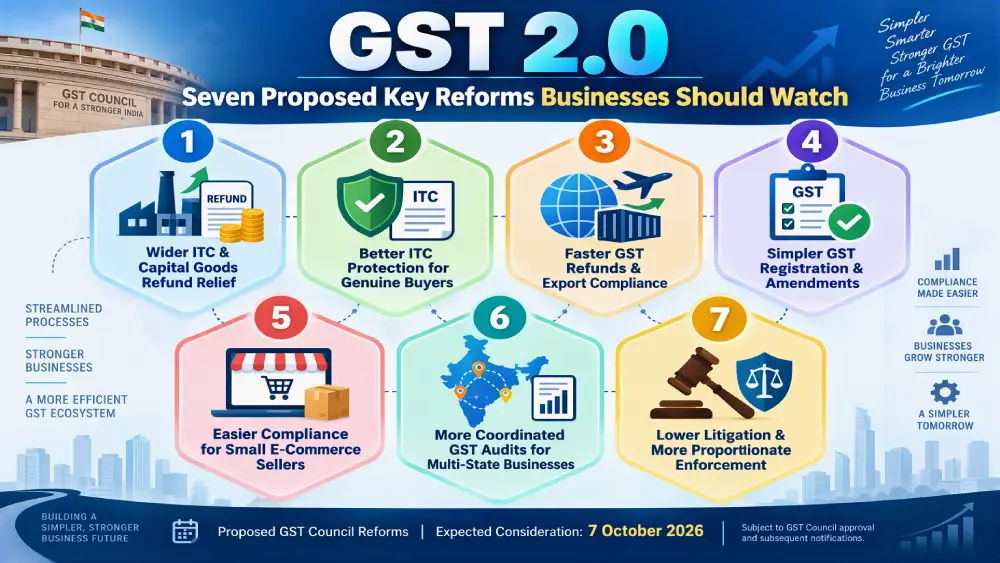
Seven GST 2.0 Reforms Businesses Should Watch
1. Wider ITC and Refund Relief for Capital Goods
One of the important proposals concerns the treatment of plant, machinery and other capital goods in GST refunds. The proposal may allow tax paid on certain capital goods to be brought into the refund framework, with the benefit spread over five years. The proposals also seek to widen the refund treatment for certain input services.
This is particularly relevant to exporters and businesses with large investments in machinery and equipment.
Businesses should keep their purchase invoices, fixed asset records, GST returns and export documentation properly matched. Good records will be important if the proposed refund mechanism is introduced.
The change could help release working capital that is currently locked into eligible business costs.
2. Genuine Buyers May Get Better Protection for ITC
Another major proposal seeks to protect a genuine buyer’s input tax credit where a supplier fails to pay the tax.
Under the reported approach, recovery could instead be directed towards the defaulting supplier, provided the buyer has acted genuinely and holds the required records.
This could reduce disputes for businesses that purchase goods or services from smaller or newer vendors.
For buyers, however, proper invoices, vendor records, payment details and GST reconciliation will remain important. The exact conditions for claiming such protection will depend on the final rules.
3. Faster GST Refunds and Easier Export Compliance
The refund processing can become more automated.
One proposal would require refund claims to be acknowledged within a specified period. If the claim passes the required risk checks, up to 90% of an eligible refund could be released provisionally, with the balance dealt with after verification. Export invoices may also be matched electronically with bank realisations.
The Council may also consider wider refund coverage for certain export-related costs and clearer GST treatment for transactions involving overseas branches and SEZs.
Exporters should therefore keep shipping documents, export invoices, bank realisation records, GST returns and transaction-level reconciliations in order.
Faster refunds could make a real difference to businesses where GST regularly locks up working capital.
4. Simpler GST Registration and Amendments
GST registration and changes to registration details may become more automated.
The proposals include clearer requirements for registration applications, more consistent instructions for tax officers and automated processing for certain amendments. The aim is to reduce unnecessary delays and officer intervention in routine cases.
This could benefit startups and growing businesses that need to register quickly or update their GST details after changes in their business.
Businesses should make sure their PAN, business address, ownership details and entity records remain consistent across GST and other statutory records.
5. Easier GST Compliance for Small E-Commerce Sellers
Small sellers using e-commerce platforms may get a significant compliance concession.
The proposal would allow eligible sellers to use an e-commerce platform’s warehouse as their registered place of business in states where they do not have their own premises. The reported framework may require the seller to have a genuine presence in at least one state, with physical verification and Aadhaar authentication there.
This could reduce the need for small sellers to establish separate premises in every state where their goods are stored.
The change could make interstate e-commerce easier for smaller businesses, but sellers will still need to meet the final registration and state-wise GST requirements.
6. More Coordinated GST Audits for Multi-State Businesses
Businesses with GST registrations in multiple states often deal with separate audit exercises and repeated requests for similar records.
The GST Council may consider a more coordinated audit framework for such businesses. One proposal is to create a common taxpayer-level information repository and audit protocol, with a nodal authority coordinating the process. The existing Central and state authorities would continue to retain their statutory powers.
This could reduce duplication for large businesses operating through multiple GSTINs under the same PAN.
Companies should therefore maintain consistent books, GST returns, invoices and reconciliations across all their GST registrations. A common data trail will become even more important if audits become more coordinated.
7. Lower GST Litigation and More Proportionate Enforcement
The proposed reforms also look at how GST disputes and enforcement are handled.
The Council may consider a minimum threshold below which GST notices would not be issued. Reports have also suggested changes to penalties, prosecution thresholds and the treatment of certain GST offences. A higher threshold for prosecution and changes to arrest provisions have also been reported as part of the proposals.
These changes could keep small reporting disputes away from lengthy litigation and reserve stronger enforcement measures for serious cases.
Businesses should not read this as a relaxation of GST compliance. Accurate returns, reconciled ITC, proper invoices and timely responses to GST communications will remain essential.
What GST 2.0 Could Mean for Businesses
The proposed reforms point towards a GST system that relies more heavily on data, automation and risk-based checks.
That may reduce paperwork, but it also increases the need for clean business data. GST registrations, invoices, ITC records, vendor information, export documents and financial records will need to match more closely.
Businesses operating in several states should also review their GSTIN-wise records before the new processes are introduced.
The practical lesson is simple: less manual compliance does not mean less compliance discipline.
Setindiabiz Support
GST reforms can make compliance easier, but businesses still need to prepare their records and processes before the changes take effect. Setindiabiz helps businesses review and manage GST compliance through GST registration and amendments, ITC reconciliation, GST refund documentation, vendor compliance checks, multi-state GST reviews and ongoing GST advisory.
Our experts review your GST structure, registrations, records and compliance processes to identify gaps before they become notices, refund delays or ITC disputes.
If the proposed GST 2.0 changes are approved, businesses with multiple GST registrations, significant ITC, export transactions or e-commerce operations may need to adjust their compliance processes. Preparing the underlying records now can make that transition much easier.
FAQs
What is GST 2.0?
GST 2.0 is being used to describe the next phase of GST reforms. The current proposals focus mainly on simplifying GST processes, ITC, refunds, registration, returns and enforcement rather than changing the GST rate structure.
Will the proposed GST 2.0 reforms apply immediately?
No. The proposals being discussed by the GST Council are not automatically effective. Businesses should wait for the Council’s recommendations and any required amendments, rules or notifications.
Which businesses could benefit from the proposed reforms?
Exporters, MSMEs, startups, e-commerce sellers, businesses with large capital investments and companies holding GST registrations in several states could see significant benefits if the proposals are approved.
Could genuine buyers retain ITC when a supplier defaults?
A proposal under consideration seeks to protect eligible ITC of genuine buyers where a supplier defaults on tax payment. The final conditions and safeguards will depend on the decision of the GST Council and subsequent legal changes.
Will GST audits become easier for multi-state businesses?
The Council may consider a coordinated audit framework for businesses with multiple GST registrations. The aim is to reduce duplicate audit work and repeated requests for the same information across states.
In This Article
Author Bio

Shivani Tyagi
Shivani Tyagi is a legal professional with background in legal research, drafting, and compliance analysis. Skilled in reviewing legal documents, statutory and case law research, she focuses on simplifying corporate legal topics and brings research-driven clarity to Setindiabiz's compliance-focused blogs.
