
Overview: Global Capability Centres (GCCs) in India are moving beyond traditional captive support work towards artificial intelligence (AI), engineering, innovation and business transformation. The TCS-Best Buy agreement is a current example: Best Buy’s India entity will transition to Tata Consultancy Services (TCS), while the centre moves towards an AI-native Capability Centre under a multi-year arrangement. The development also signals growing interest in partner-supported GCC models.
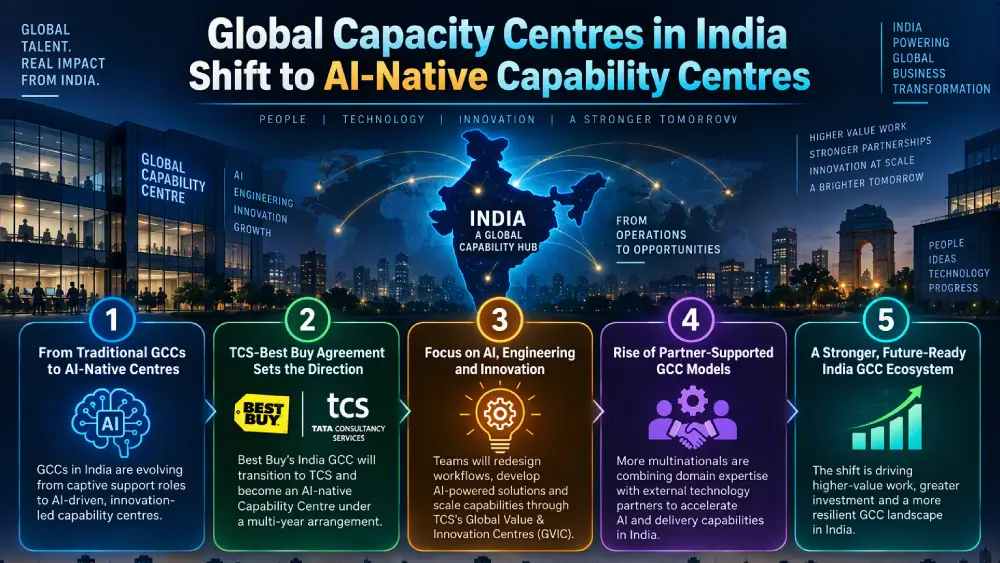
India’s Global Capability Centre (GCC) landscape is moving beyond traditional captive support functions towards AI, engineering, innovation and business transformation. The shift is changing how multinational companies think about ownership, operations and technology delivery in India. As GCCs evolve into more specialised and partner-supported models, entity structure, foreign investment, taxation and compliance become part of the business decision, not an afterthought.
GCC Model Enters a New Phase
Tata Consultancy Services (TCS) and Best Buy announced an agreement on 1st October, 2026, under which Best Buy’s Global Capability Centre (GCC) in India will move to TCS and be transformed into an AI-native Capability Centre. Under the multi-year arrangement, Best Buy’s India entity and its GCC operations will transition to TCS, while its employees will move into TCS’s global organisation.
The arrangement combines Best Buy’s retail and enterprise knowledge with TCS’s technology, engineering, AI and global delivery capabilities. Teams will redesign workflows, develop AI-powered experiences and solutions, and scale capabilities through TCS’s Global Value & Innovation Centres (GVIC) framework.
The development also brings partner-supported GCC models into focus. Instead of keeping every capability within a captive structure, a multinational can retain business and domain knowledge while bringing in an external technology partner for engineering, AI and delivery capabilities. The broader Indian GCC market is already moving towards higher-value work in AI, engineering, research and innovation.
GCC Setup and Compliance Considerations
A GCC transformation is not only a technology decision. A new setup, restructuring or transition can require review of:
- Indian entity and ownership structure
- Foreign investment and sector-specific requirements
- Tax and transfer-pricing arrangements
- Employment and employee-transition matters
- Contracts, intellectual property and data arrangements
- Corporate and statutory compliances
The exact requirements depend on the ownership structure, business activities and proposed operating model. International transactions between related entities may also create transfer-pricing obligations where applicable.
What Businesses Should Consider
Companies entering India can assess captive, managed or partner-supported GCC models based on control, talent, technology, tax and compliance requirements.
Existing GCCs considering a transition should separately review the legal entity, employee arrangements, contracts, intellectual property, data obligations and intercompany arrangements before implementing a new operating model.
The question is not only how AI will be deployed. Businesses also need clarity on who owns the Indian entity, who employs the workforce, who holds the intellectual property and how the Indian operation will meet its continuing legal and compliance requirements.
Setindiabiz Support
Setting up or restructuring a GCC can affect the Indian entity, ownership, foreign investment, contracts, employee arrangements and ongoing statutory compliance alongside the technology model. Setindiabiz supports multinational businesses with business structuring, company incorporation, foreign investment requirements and post-incorporation compliance for Indian operations.
Where an existing GCC is being transitioned or its operating model is changing, Setindiabiz experts help with related corporate documentation, regulatory requirements and compliance framework. The focus is to ensure that the legal and compliance structure keeps pace with the GCC’s commercial model as it is established, restructured or scaled.
FAQs
What is an AI-native Capability Centre?
An AI-native Capability Centre is a GCC model in which artificial intelligence is built into business workflows, technology development, analytics and innovation. Rather than using AI only for individual projects, the operating model integrates AI more broadly into technology and business processes.
How is the GCC model changing in India?
GCCs in India are moving beyond traditional captive support functions towards AI, engineering, research and development, advanced analytics and other higher-value activities. Some businesses are also exploring partner-supported models for operating or transforming existing GCC capabilities.
What should a foreign company consider when setting up a GCC in India?
A foreign company should assess the appropriate entity and ownership structure, applicable foreign investment rules, taxation, employment requirements, contracts, intellectual property, data-related obligations and ongoing corporate compliance. The exact requirements depend on the GCC’s activities, ownership and proposed operating structure.
India’s GCC landscape is evolving at both the technology and operating-model levels. The TCS-Best Buy agreement shows how an existing centre can transition to a technology partner while moving towards an AI-native capability model.
In This Article
Author Bio

Setindiabiz Editorial Team is a multidisciplinary collective of Chartered Accountants, Company Secretaries, and Advocates offering authoritative insights on India’s regulatory and business landscape. With decades of experience in compliance, taxation, and advisory, they empower entrepreneurs and enterprises to make informed decisions.
