
Overview: India’s defence startup ecosystem is moving beyond drones into underwater robotics, maritime surveillance, navigation and sensing. The Indian Navy’s engagement with private innovators is creating a path from prototype development to procurement. For startups and MSMEs, the opportunity extends to specialised hardware, electronics, software and marine systems. A working prototype, however, is only the beginning. Production capacity, testing, intellectual property, contracts and regulatory readiness will matter as these technologies move towards larger deployments.
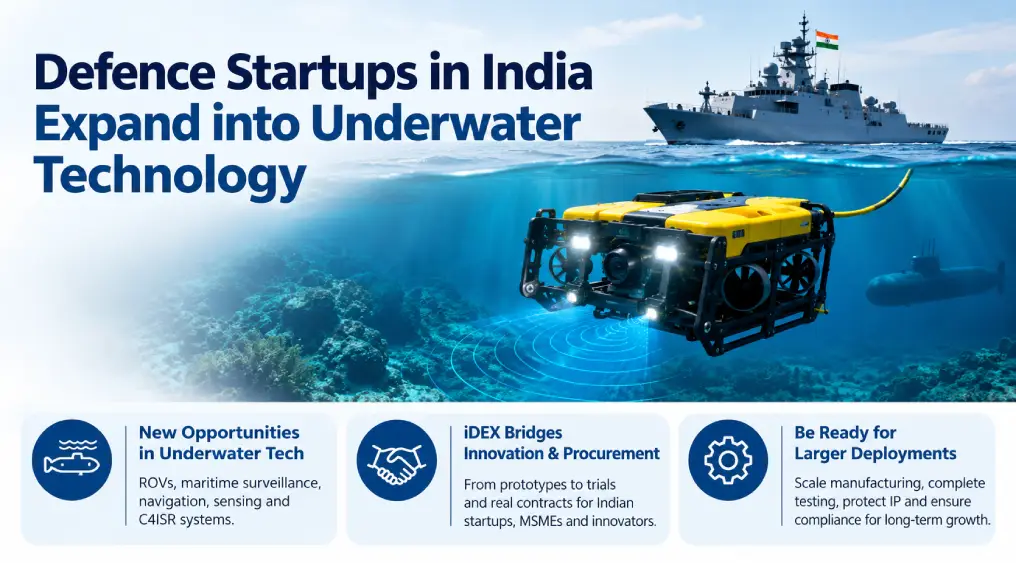
Indian defence startups are widening their focus from aerial systems to the underwater and maritime domain. The shift is creating new opportunities in robotics, navigation, sensing and surveillance, while making manufacturing, integration and compliance increasingly important. For startups and MSMEs, the opportunity extends to specialised hardware, electronics, software and marine systems.
Underwater Technology Opens New Area
Emerging opportunities include:
- Underwater remotely operated and autonomous vehicles.
- Maritime surveillance and mine-countermeasure systems.
- Navigation, sensing and marine awareness technologies.
- C4ISR and mission-critical electronics.
Underwater defence systems also rely on advanced command, sensing and information technologies. These include Command, Control, Communications, Computers, Intelligence, Surveillance and Reconnaissance (C4ISR) systems, which support situational awareness, coordination and mission decisions across maritime operations.
EyeROV’s ₹47 crore Indian Navy contract for remotely operated The Innovations for Defence Excellence (iDEX) framework is creating a route for Indian startups, MSMEs and individual innovators to develop technologies against defence requirements.
According to the Ministry of Defence, as of February 2026, around 676 startups, MSMEs and individual innovators had joined the defence innovation ecosystem through iDEX. The Ministry also reported 58 prototypes cleared for procurement worth about ₹3,853 crore, along with 45 procurement contracts worth nearly ₹2,326 crore.
The latest official iDEX information also confirms that its challenges cover Indian startups, MSMEs and individual innovators, with the programme aimed at developing and adopting innovative technologies for the Armed Forces, defence public sector undertakings and other nodal agencies.
underwater vehicles (ROVs) shows how indigenous technology can move from development and trials towards procurement. Its Trout ROV is rated for operations at depths of up to 300 metres. The Navy order followed its development and trials under the Innovations for Defence Excellence (iDEX) framework.
iDEX Is Linking Innovation with Procurement
| Stage | Business Significance |
|---|---|
| Prototype | Technology development |
| Trials | User validation |
| Procurement | Revenue opportunity |
| Repeat Orders | Production scale |
What Startups and MSMEs Need to Prepare
Defence opportunities require more than product development. Businesses should plan for:
- Scalable manufacturing and supply chains.
- Testing, qualification and integration.
- Contracts and intellectual property protection.
- Working capital and delivery commitments.
- Applicable procurement and regulatory compliance.
Eligible startups and Indian MSME companies can apply for relevant iDEX challenges, subject to the applicable eligibility criteria. iDEX also permits individual innovators to participate, with specific requirements applying if an individual is selected for subsequent grant and project execution.
FAQs
Which areas are emerging for defence startups in India?
Defence startups are expanding into underwater robotics, maritime surveillance, navigation, sensing, autonomous vessels and defence electronics, creating opportunities beyond drones and other aerial systems.
What role does iDEX play in defence startup growth?
iDEX enables startups, MSMEs and individual innovators to respond to defence challenges and develop new technologies. Selected applicants can receive grant support and access to testing and other programme resources, while procurement remains subject to applicable requirements and procedures.
Can MSMEs participate in the growing defence technology sector?
Yes. Eligible MSMEs can participate through complete systems as well as specialised components, sensors, software, electronics, robotics and navigation solutions, subject to the requirements of the relevant iDEX challenge or procurement route.
Setindiabiz Support
Moving from a defence prototype to commercial procurement brings a different set of business and compliance requirements. Setindiabiz helps defence-tech startups and MSMEs put the right business structure, contracts, intellectual property protection and statutory compliance in place before they scale or enter procurement arrangements.
This becomes particularly relevant when a business is dealing with government departments, defence organisations, technology partners or overseas investors, where entity structure, contractual terms, regulatory requirements and ownership of intellectual property can directly affect the transaction. Setindiabiz also assists businesses with post-incorporation compliance and can provide context on defence FDI policy where foreign investment is being considered.
India’s defence startup opportunity is expanding from aerial drones into underwater and maritime technologies. iDEX is helping create a pathway from defence challenges and prototype development to testing and procurement. The next commercial step for many businesses will be turning validated technology into reliable systems that can be manufactured, integrated and supported at scale.
In This Article
Author Bio

Setindiabiz Editorial Team is a multidisciplinary collective of Chartered Accountants, Company Secretaries, and Advocates offering authoritative insights on India’s regulatory and business landscape. With decades of experience in compliance, taxation, and advisory, they empower entrepreneurs and enterprises to make informed decisions.
