
Overview: The 30th meeting of the Financial Stability and Development Council (FSDC), chaired by Finance Minister Nirmala Sitharaman on 23rd October 2026, reviewed financial stability risks and financial sector reforms. Discussions covered digital lending infrastructure for MSMEs, simpler KYC processes, fintech innovation, cybersecurity and investment through GIFT CITY-IFSC. The Council also called for faster refunds of unclaimed financial assets and more frequent meetings amid global economic uncertainty.
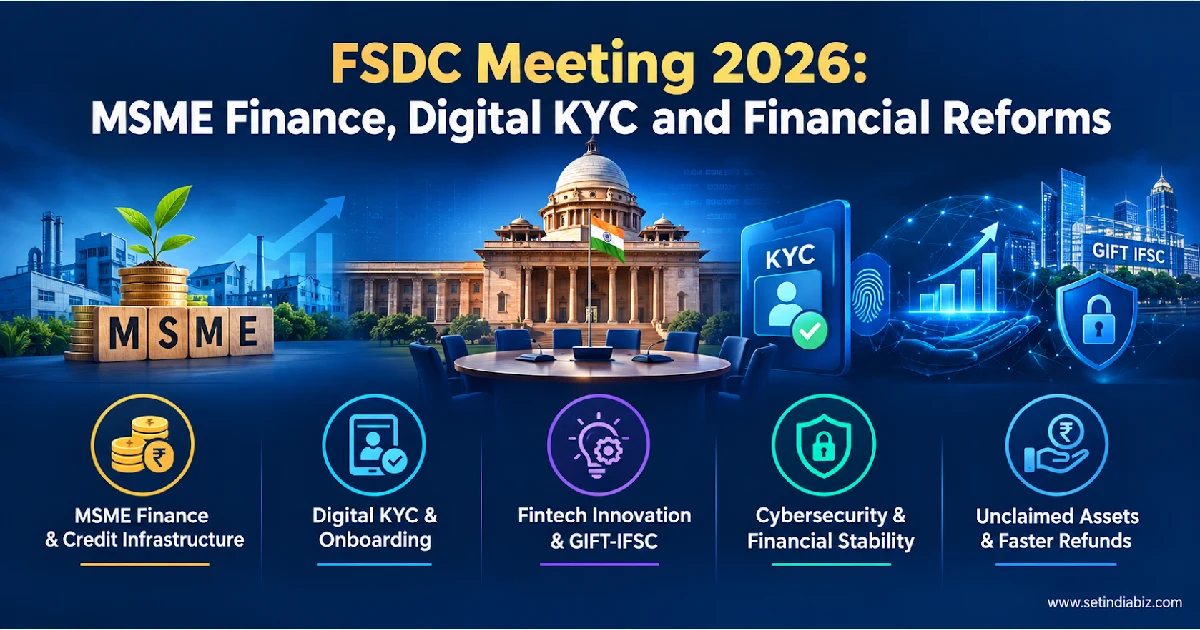
The Finance Ministry’s announcement following the 30th meeting of the Financial Stability and Development Council (FSDC) meeting highlights several areas under consideration, including MSME lending infrastructure, digital KYC and financial sector cybersecurity. The meeting, held in New Delhi on 23rd October, 2026, also addressed investment flows and coordination among financial regulators.
These discussions set out areas for further action rather than announcing a package of implemented reforms. Businesses should watch for subsequent regulatory directions to understand which proposals lead to changes in existing procedures.
Key Developments from the FSDC Meeting
The Finance Minister chaired the meeting amid geopolitical uncertainty, rapid developments in artificial intelligence and a sharp rise in global bond yields. The Council stressed the need for heightened vigilance and proactive measures to mitigate emerging risks to financial stability. It also called for stronger coordination among financial regulators.
The main areas discussed were:
- MSME finance: The Council discussed scaling up Digital Public Infrastructure (DPI), particularly the Account Aggregator framework and Unified Lending Interface (ULI), with a specific focus on MSMEs. It also considered reducing financial intermediation costs, improving regulatory responsiveness and rationalising credit guarantee schemes. These measures concern the infrastructure supporting business credit, but do not guarantee loan approval or lower borrowing costs.
- Digital KYC and onboarding: The Council discussed simplifying and digitising Know Your Customer (KYC) processes and enabling digital onboarding for non-resident Indians (NRIs) and foreign portfolio investors (FPIs). The practical effect will depend on the subsequent directions issued by the relevant authorities.
- Fintech and GIFT-IFSC: The meeting covered measures to promote fintech innovation and explore the tokenisation of financial and real-world assets. The Council also discussed strengthening India’s domestic investment ecosystem and improving investment flows, including through GIFT-IFSC.
- Cybersecurity: The Council reviewed the cyber resilience of India’s financial sector and took note of the Financial Sector Cyber Security Strategy (FSCSS). An Inter-Ministerial Group comprising financial sector regulators and cybersecurity agencies formulated the strategy in coordination with the Department of Economic Affairs (DEA), Department of Financial Services (DFS) and Ministry of Electronics and Information Technology (MeitY). The strategy’s implementation is expected to strengthen the financial sector’s overall resilience. Discussions also covered the protection of critical information infrastructure and cybersecurity preparedness among Regional Rural Banks (RRBs).
- Refund of unclaimed financial assets: Sitharaman urged regulators and relevant stakeholders to expedite refunds of unclaimed bank deposits, dividends, shares, post office accounts, insurance proceeds and pension funds to their rightful owners. The Council also noted the district-level “Your Money, Your Right” campaign and called for further efforts to return unclaimed assets promptly.
The Council also discussed a strategy for implementing its past decisions and Budget announcements. The Finance Minister called for FSDC meetings at more frequent intervals under a predefined schedule. The Council took note of the activities of its sub-committee, chaired by the Reserve Bank of India Governor, and action taken on pending decisions.
What Could These Discussions Mean for Businesses?
For MSMEs, wider use of the Account Aggregator and ULI frameworks could improve the infrastructure through which financial information is accessed and used in credit assessment. However, the meeting did not announce any automatic entitlement to credit, lower interest rates or guaranteed access to credit guarantee schemes.
Businesses dealing with overseas investors should monitor changes to KYC and digital onboarding requirements. Companies in the financial sector should also follow applicable cybersecurity directions and developments relating to the FSCSS.
The Finance Ministry’s announcement did not specify implementation dates for these discussion points. Businesses should therefore continue to meet their existing legal and regulatory obligations unless the competent authorities notify changes.
Setindiabiz Support
Setindiabiz supports businesses with company incorporation, MSME/Udyam registration, GST registration, ROC filings and ongoing corporate compliance. Businesses planning to establish an Indian presence can also use its India Entry Services for Indian subsidiary incorporation and related compliance requirements.
For foreign investment into Indian companies, our experts provide support with relevant FDI reporting under applicable requirements. This work helps businesses address their corporate and regulatory obligations when establishing or expanding operations in India.
FAQs
The FSDC is a forum for coordination among financial regulators and discussion of financial stability and financial sector development issues.
The Council discussed scaling up the Account Aggregator and Unified Lending Interface frameworks, reducing financial intermediation costs, improving regulatory responsiveness and rationalising credit guarantee schemes.
The meeting discussed simpler digital KYC and onboarding for NRIs and FPIs. The Finance Ministry’s announcement did not specify implementation dates for these discussion points.
GIFT-IFSC is India’s international financial services centre at GIFT City in Gujarat. The Council discussed strengthening investment flows, including through this centre.
It is a district-level initiative to help return unclaimed financial assets, including bank deposits, dividends, shares, insurance proceeds and pension funds, to their rightful owners.
The 30th FSDC meeting brought MSME finance, digital KYC and financial-sector resilience into focus. Businesses should watch for subsequent regulatory directions to understand which proposals lead to practical changes. Until then, existing compliance requirements continue to apply.
