
Overview: The government has changed Rule 49(2) of the Special Economic Zones (SEZ) Rules, 2006. Under the new rule, certain goods that domestic buyers fail to accept can be returned to SEZ units. The Amendment, which came into effect on 19th October, 2026, sets a 30-day deadline and conditions for resale and duty refunds. Units must establish that the buyer has not availed benefits, including input tax credit (ITC), and maintain auditable inventory records.
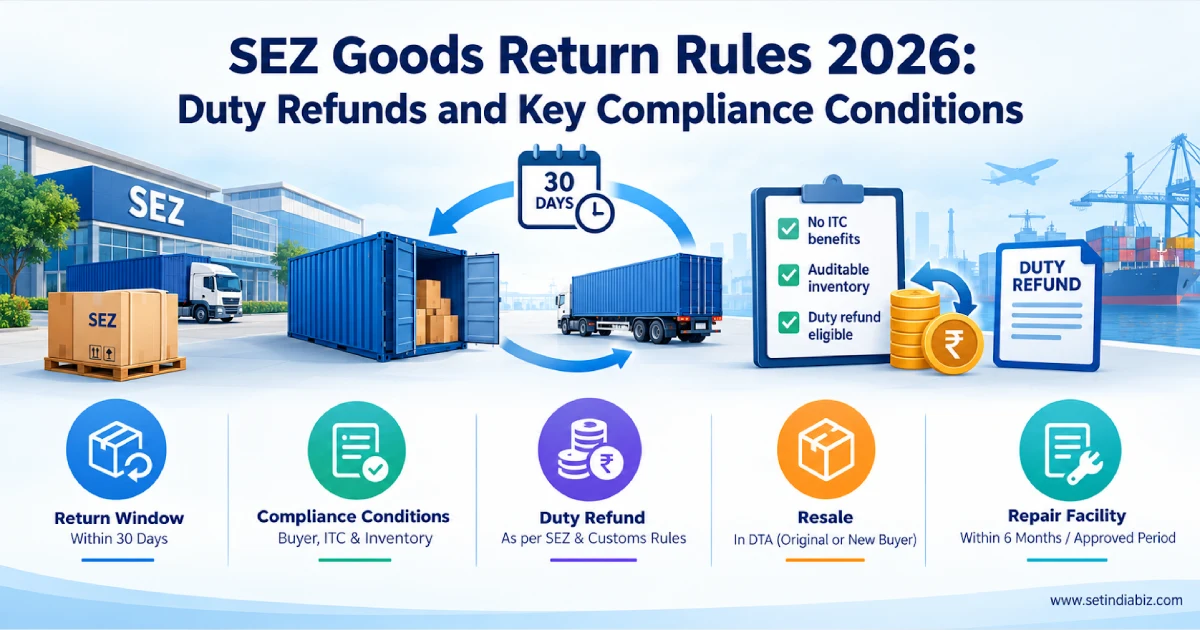
The government has changed the rules for goods that domestic buyers do not receive or collect after they are cleared from a Special Economic Zone (SEZ). The amendment sets conditions for returning these goods to the SEZ unit, including a 30-day deadline and checks on tax benefits claimed by the buyer.
For SEZ units, The change offers a defined route for handling certain failed deliveries. The businesses must meet the return conditions, maintain proper inventory records and check the applicable duty refund requirements before treating returned goods as eligible for resale.
Goods Can Be Returned to an SEZ Unit
The Ministry of Commerce and Industry has notified the Special Economic Zones (Third Amendment) Rules, 2026, through G.S.R. 893(E). The amendment, published in the Official Gazette on 19th October, 2026, substitutes Rule 49(2) of the SEZ Rules, 2006.
Under the revised rule, goods supplied by an SEZ unit to the Domestic Tariff Area (DTA) on payment of duty may be brought back when the buyer fails to take delivery because of:
- A change in fashion or market conditions.
- Default under the sale agreement.
The goods must return to the SEZ unit within 30 days from the date of clearance. The rule does not expressly provide an extension mechanism for this deadline.
The provision addresses failure to take delivery. It does not expressly clarify whether goods accepted by a buyer and rejected later qualify under the same facility.
The Refund and Record-Keeping Conditions
The SEZ unit must meet three conditions:
- Identification: The Specified Officer must be satisfied that the returned goods are identifiable.
- Buyer benefits: The unit must provide evidence that the buyer who failed to take delivery has not availed benefits, including ITC.
- Inventory: The unit must maintain a separate inventory of returned goods in an auditable format.
Rule 49(2)(c) distinguishes between two refund routes. The refund of duty paid at the original clearance must follow Rule 47(5) of the SEZ Rules, 2006. The refund of duties on goods received back is governed by the Customs Act, 1962. It is not automatic, either. Section 27 provides the general customs duty refund procedure, subject to applicable statutory conditions, evidence and time limits.
The amendment does not expressly clarify whether reversing previously claimed ITC satisfies the no-benefit condition. Businesses should retain invoices, duty-payment records and evidence relating to the buyer’s tax treatment.
Resale and Repair of Returned Goods
Eligible returned goods may be resold in the DTA to the original buyer or another buyer without alteration to their original condition. The resale is treated as a fresh DTA sale, with applicable duty payable under Section 30 of the SEZ Act, 2005.
The separate repair facility also remains available. Goods must return within six months of clearance, an extended period approved by the Specified Officer, or the warranty period, whichever is later. The goods must be identifiable, and duty is payable on the value of repairs.
Section 74 Drawback: What Remains Unresolved?
Section 74 of the Customs Act provides for drawback on eligible imported goods subsequently re-exported, subject to statutory conditions.
CBIC Instruction No. 06/2026-Customs, dated 27th April, 2026, has addressed drawback on goods cleared from an SEZ into the DTA and subsequently exported abroad. It recognises these goods as imported goods for Section 74 purposes, subject to applicable requirements.
However, the instruction does not expressly settle whether goods returned from the DTA to an SEZ qualify for drawback. SEZ Act recognises qualifying DTA-to-SEZ supplies as exports. This does not, by itself, establish eligibility under Section 74 of the Customs Act.
The October amendment does not expressly resolve earlier or separate drawback disputes involving DTA-to-SEZ movements. Such claims must be assessed under the applicable law and facts.
Setindiabiz Support
SEZ transactions require accurate records of clearances, duty payments, returned goods and tax treatment. Setindiabiz professionals support businesses with GST compliance, tax documentation and related regulatory filings. Businesses should reconcile invoices, retain duty-payment evidence and maintain auditable records for returned goods. Relevant GST input tax credit records should also be reviewed where ITC conditions affect a transaction. Disputed customs refund or drawback claims should be reviewed by a qualified customs-law professional.
FAQs
The SEZ amendment rules came into effect on 19th October, 2026, when the amendment was published in the Official Gazette.
The rule addresses failure to take delivery and does not expressly clarify post-delivery rejection.
The failed-delivery provision does not expressly provide an extension mechanism.
No. The amendment does not expressly settle all such disputes. Each claim requires assessment under the applicable law and facts.
The amendment provides a conditional route for returning certain goods that DTA buyers fail to take delivery of. Businesses must meet the 30-day deadline, establish the identity of returned goods and maintain the required records. Refunds and drawback claims remain subject to their respective legal conditions.
