
Private Limited Company Registration in India
Register your private limited company online with Setindiabiz. We prepare the SPICe+ form and documents, arrange certification and answer the Registrar’s (ROC) queries. Incorporation usually takes 7–10 working days after documents are complete, subject to approval; you then receive the Certificate of Incorporation, CIN, PAN and TAN.

Trusted By Leading Brands
























What is a Private Limited Company?
A private limited company (Pvt Ltd) is a separate legal entity registered under the Companies Act, 2013. Its articles restrict share transfers, limit membership to 200, subject to employee and former-employee exceptions, and prohibit public invitations to subscribe for securities (Section 2(68)). For a company limited by shares, each member’s liability is limited to the unpaid amount on their shares.
Two or more subscribers can form a private limited company by filing SPICe+, the integrated form, on the MCA portal (Section 3(1)(b)). The Registrar examines the application under Section 7. Setindiabiz prepares the documents and coordinates filing and certification.
Disclaimer: Setindiabiz is an independent consultancy, not a government body or law firm. Most work is handled by our own teams. Where the law requires a licensed professional, an independent CA, CS or advocate is engaged for the client and remains responsible for that work. We prepare and coordinate your application; only the Registrar can approve incorporation under Section 7(2).
Minimum Requirements & Eligibility
-
Two shareholders, up to 200
At least two subscribers must agree to take shares in the company. Membership is limited to 200, excluding eligible current and former employee-members (Section 2(68)). The same two people can be shareholders and directors, so two founders, or a founder and a relative, meet both minimums.
-
Two to fifteen directors
A private company needs at least two directors and may have up to fifteen, or more with a special resolution. Each director needs a Director Identification Number (DIN). SPICe+ allows up to three new DIN applications at incorporation; directors who already hold a DIN can also be included.
-
One director resident in India
At least one director must stay in India for 182 days or more during the financial year (Section 149(3)). For a new company, apply the test in proportion to the part of the year left. Other directors may live in India or abroad; nationality alone does not decide whether the residence test is met.
Foreign nationals and foreign companies setting up in India: see India Entry Services.
-
Capacity and qualification
Subscribers must be able to sign a valid contract. An eligible company or body corporate can subscribe through a person it authorises. Each proposed director must be an individual with a DIN and no disqualification under Section 164; check all prior directorships and filing defaults before appointing them.
-
No minimum capital
There is no statutory minimum paid-up capital. Founders choose how much to subscribe and must pay for those shares. Authorised capital sets the maximum the company may issue without increasing it. SPICe+ filing fees are nil up to ₹15 lakh authorised capital; stamp duty and other charges still apply.
-
Registered office in India
The registered office must be an address in India where communications can be received. A home, rented flat or shared office may qualify with the owner’s consent and valid occupancy documents. Keep a utility bill not older than two months. The company must show this address on its business letters and invoices.
-
A lawful object
The memorandum must state the company’s lawful business objects. Some activities need a licence before work can begin. Names with words such as Bank or Insurance need the relevant approval. Incorporation alone does not let an NBFC conduct financial business; check RBI registration first.
Company Registration Cost
Our Pricing Promise
- Nothing Hidden
- Stamp Duty at Actuals
- Fully Customisable
- GST Shown Separately
- Transparent & Itemised
- Written Estimate by Email
- Govt Fee at Actuals
- Cited Exclusions (if any)
What affects your total cost? Your State, authorised capital, digital signature (DSC) requirements and service scope determine the amount. Our professional fee starts at ₹2,499, whether we reserve the name first (SPICe+ Part A) or file the name and the application together (Parts A and B). Before you pay, we send an itemised estimate showing professional fees, DSC charges, government fees, stamp duty and GST, with inclusions and any additional compliance work identified. A worked example is in the Govt Fees tab.
Incorporation Cost
Government fees, State stamp duty and DSC charges are set out as separate items in your written estimate. Professional Fee From
₹2,499/-
Fee only; DSC, govt fees, duty & GST extra
Documents Required for Company Registration
Prepare clear identity, address and office documents before filing SPICe+. Names and addresses must agree with the application; discrepancies can prompt a resubmission request. The MCA SPICe+ FAQs explain the required attachments. For foreign subscribers, authentication depends on where documents are signed: notarisation, apostille or consular attestation may apply under Rule 13 of the Companies (Incorporation) Rules, 2014. We check the relevant country requirements before filing and confirm whether signed originals or translated copies are needed.
From each director & shareholder
-
PAN cardMandatory for every Indian director and subscriber. The name must match the PAN database, because SPICe+ entries are cross-checked against it.
-
Aadhaar cardFor Aadhaar-based DSC checks, keep your linked mobile active. Ask us about other permitted ways to verify identity.
-
Passport-size photographA recent photograph on a plain background, as a clear digital copy, for the digital signature application and the KYC record.
-
Identity proofOne of the following: passport, voter ID, or driving licence, self-attested, in the same name as the PAN.
-
Address proof (latest)Provide a recent bank statement or utility bill in your own name. It must be recent; we check its date before filing.
-
Digital Signature CertificateWe arrange a Class 3 DSC from a licensed Certifying Authority for each signatory to sign MCA forms online; you complete the video e-KYC.
For the registered office
-
Premises utility billAn electricity, water, gas or telephone bill showing the office address, not older than two months (Rule 25), matching the NOC and SPICe+ entries.
-
NOC from ownerObtain the owner’s consent and evidence of lawful use, such as ownership documents or a valid rent or lease agreement, as applicable under Rule 25.
-
📥 Download NOC formatOur template covers what MCA checks: the owner’s name and signature, the full address and the proposed company name.
You can start incorporation with a correspondence address before you have a permanent office. In that case, within 30 days of incorporation, the company needs a registered office in the same State and files Form INC-22 with the ROC to verify it (Section 12). If the registered office address is given in SPICe+ itself, no separate INC-22 is needed.
Step-by-Step Company Incorporation Process
You can register a private limited company online through SPICe+ on the MCA portal. The six steps below take you from the first document checks to the certificate. This is the usual route for Indian subscribers; documents signed abroad may need notarisation or attestation and physical copies. The MCA SPICe+ FAQs explain which forms and proofs to file. Times are estimates, some steps overlap, and the Registrar may ask you for more information.
-
Collect KYC and issue the digital signatures
We collect identity and address proofs, photographs and contact details from the proposed directors and subscribers, then check them against the application. Required signatories complete the permitted identity verification process before a licensed Certifying Authority issues their Class 3 digital signature (DSC). If a signatory already has a valid DSC, we check whether it can be used.
⏳ Turnaround: usually 1–2 working days once video e-KYC is done.
-
Search the name and reserve it in Part A
We check that your proposed name is not identical or too close to an existing company, LLP or registered trade mark, and we choose the activity (NIC) codes that describe your business. If you want the name approved before anything else, we file Part A on its own with two names in order of preference; otherwise one name goes in together with the full application in Part B.
⏳ Name validity: 20 days from approval; pay to extend under Rule 9A.
-
Draft the memorandum and the articles
We prepare the memorandum of association (MOA), setting out the company’s name, registered-office State, objects and capital, and the articles of association (AOA), governing its management. Eligible cases with up to seven subscribers use e-MOA and e-AOA, signed digitally. A corporate subscriber acts through its authorised representative. Overseas or special cases may need authenticated attachments instead.
⏳ Turnaround: drafting runs while the name is under approval.
-
File SPICe+ Part B with the linked forms
We file SPICe+ Part B with the required MOA, AOA, the INC-9 declarations of subscribers and directors, and the linked form AGILE-PRO-S. The linked process covers provident fund (EPFO) and employees’ insurance (ESIC) registration and an application for a bank account; the bank completes its own checks. An eligible independent practising professional certifies compliance for the client. GST and other registrations are included where applicable or separately requested.
⏳ Turnaround: filed once every subscriber and director has signed.
-
Answer the Registrar’s queries on the application
The Central Registration Centre (CRC), the Registrar’s office that processes incorporation applications, may ask for missing documents or clarification. We review each point raised in the notice, prepare the response and coordinate any fresh signatures before resubmission. Part A generally permits one resubmission and Part B two. Follow the due date in the notice and keep the name valid; the signed form must be uploaded within 15 days and the fee paid within 7 days of upload.
⏳ Turnaround: each resubmission adds time; the name clock keeps running.
-
Receive the certificate, CIN, PAN and TAN
Once approved, the Registrar issues the Certificate of Incorporation with the Corporate Identity Number (CIN); PAN and TAN are allotted through the linked process. A company with share capital must receive the subscription money, verify its registered office and file INC-20A before starting business or borrowing. The filing deadline is 180 days from incorporation.
⏳ Turnaround: usually 7–10 working days from complete documents.
Timeline for Private Limited Company Registration
Indicative working days after documents are complete. Queries from the Registrar’s office may add time, and the Registrar decides approval. Some steps overlap: drafting can start while the name is under review.
-
Day 1–2
Digital Signatures
🔏 Required signatories complete KYC, and a licensed provider issues Class 3 digital signatures. Existing valid DSCs may be used after checks.
-
Day 2–4
Name Reservation
📝 If reserved first, Part A holds the approved name for 20 days (extendable for a fee); otherwise it is filed with Part B.
-
Day 4–7
Drafting & Filing
📑 We draft the e-MOA and e-AOA, everyone signs them online with their digital signatures, and we file them with SPICe+ Part B and the linked forms.
-
Day 7–10
Certificate & CIN
🏢 The Registrar issues the certificate with the CIN, and the company’s PAN and TAN are allotted with it, ready for opening the company’s bank account.
Video Guide on Company Incorporation
Watch how a private limited company is registered online. This guide explains DSCs, name approval, SPICe+ filing and the certificate. The usual Indian-subscriber route needs no ROC visit; foreign-signed documents may need attestation. Clear steps, explained for founders across India. 100% Online Truly Digital Cost-Effective All-India Service
Company incorporation: full walkthrough
A walkthrough of Pvt Ltd registration through SPICe+: documents and eligibility, government fees, the benefits of the structure and compliance after incorporation.
From the Setindiabiz channel
Six benefits of a private limited company: separate legal entity, limited liability, equity funding, employee stock options, perpetual succession and openness to foreign investment.
Private Limited Company vs LLP vs OPC
Choose a business structure by considering ownership, funding plans and ongoing compliance, as well as registration costs. A private limited company can issue equity and offer employee stock options. An LLP has partners and contributions, rather than share capital. A one-person company allows a single member under Section 2(62). The comparison below explains the main differences; sector rules and individual circumstances may also affect your choice.
| No. | Point of difference | Private Limited Company | LLP | One Person Company |
|---|---|---|---|---|
| 1 | Governing law | Companies Act, 2013 | Limited Liability Partnership Act, 2008 | Companies Act, 2013, Section 2(62) |
| 2 | Owners | Two to 200 members under Sections 3(1)(b) and 2(68) | Two or more partners | One member, with a nominee whose consent is declared in SPICe+ |
| 3 | Management | Two directors; >15 needs a special resolution | Two or more designated partners, at least one resident in India | One director minimum, who may be the sole member |
| 4 | Equity funding | Shares can be issued to investors, including at a premium | No share capital; investors join as partners | Cannot raise equity from outside investors while it remains an OPC |
| 5 | Employee stock options | Available under Section 62(1)(b) | Not available | No bar, but exercise by anyone else ends the single-member form |
| 6 | Conversion | May become a public company (Section 14; special resolution and INC-27) | May convert to a company under Chapter XXI | May convert to private at any time (Rule 6) |
| 7 | Statutory audit | Compulsory every year under Section 139, whatever the turnover | Audit depends on Rule 24(8) thresholds; tax audit may also apply | Compulsory every year under Section 139 |
| 8 | Annual filings | AOC-4 and MGT-7 or MGT-7A | Form 8 and Form 11 | AOC-4 and MGT-7A |
| Which structure fits your plans? A private limited company suits founders seeking equity investment or employee stock options. An LLP may suit a professional or trading business funded by its partners. An OPC gives a solo founder corporate status, but it must convert before admitting another member. The old mandatory conversion thresholds of ₹50 lakh capital and ₹2 crore turnover were removed from 1 April 2021. Compare ongoing filings and future funding needs for your specific business before deciding.Related: LLP Registration | ||||
← Swipe sideways to compare all structures →
Benefits of Private Limited Company Registration
A private limited company separates the business from its shareholders and supports ownership through shares. It can suit founders who plan to raise equity, offer employee stock options or bring in new investors. These advantages come with annual filings, statutory audit and directors’ duties. The benefits below explain how the structure works in practice.
Separate legal entity
Under Section 9, the company is a legal person separate from its members. It owns property, holds bank accounts, enters contracts, sues and is sued in its own name, and a change in shareholders does not disturb any of it.
Limited liability
A shareholder’s liability is generally limited to the unpaid amount on their shares. Personal guarantees, fraud and liabilities imposed by law can still create personal exposure for the person concerned.
Equity funding
Under Sections 42 and 62(1)(c), shares can be issued to angel investors, venture funds and strategic partners at face value or at a premium (Section 52). Preference shares, convertible instruments and differential rights are also possible.
Employee stock options
Section 62(1)(b) and Rule 12 of the Share Capital Rules let the company grant options to employees and non-independent directors; promoters and directors holding over 10% are excluded, except in a recognised start-up for ten years.
Perpetual succession
Under Section 9, the company continues regardless of any member’s death, insolvency or exit. Shares transfer subject to the restrictions in the articles, and its contracts, property and business carry on without a break.
Open to foreign investment
Foreign investment is subject to sectoral caps, entry routes and FEMA conditions. Check the investor’s ownership, any approval and reporting duties before accepting funds; registration alone does not clear an investment.
Fees, Tax & Compliance
Government fees, State stamp duty, corporate tax, and the filings and due dates that follow incorporation. Pick a tab to see each table.
Government Fees for Company Registration
Government fees for a private limited company are fixed by the Companies (Registration Offices and Fees) Rules, 2014 and depend mainly on the authorised capital. You pay most together in one challan generated when you file SPICe+ Part B; a few apply only if you reserve the name first or add a director later. The figures below are the MCA fees; stamp duty, a State levy, is in the Stamp Duty tab.
| No. | Form/item | Applies to | Government fee | When paid | Source |
|---|---|---|---|---|---|
| 1 | SPICe+ filing fee | Capital up to ₹15 lakh | Nil | SPICe+ challan | Rule 38(2); MCA FAQ 26 |
| 2 | SPICe+ filing fee | Capital above ₹15 lakh | Slab in the Fees Rules | SPICe+ challan | Fees Rules, Table A |
| 3 | PAN | Every company | ₹66 | SPICe+ challan | MCA FAQ 25, 28 |
| 4 | TAN | Every company | ₹77 (₹65 + GST) | SPICe+ challan | MCA receipts |
| 5 | Name reservation | Part A filed first | ₹1,000 | With Part A | MCA FAQ 25 |
| 6 | Name extension | Name kept past 20 days | ₹1,000 (to 40 days); further ₹2,000 (to 60 days) | Before expiry | Rule 9A |
| 7 | DIN for a new director | Director added later | ₹500 (DIR-3) | With DIR-3 | Fees Rules |
Note: The SPICe+ challan can include fees for filing, PAN and TAN, along with State stamp duty. Take a Delhi company with two founders and ₹1 lakh authorised capital, filed in one go. Stamp duty is ₹360 (MOA and AOA ₹350, form ₹10) and PAN and TAN ₹143. Add two digital signatures at ₹1,800 each and our fee of ₹2,499 plus ₹450 GST: about ₹7,050 in all.
Stamp Duty on MOA and AOA by State
Stamp duty on the memorandum and articles is a State levy, paid through SPICe+ with the government fees. The figures below follow the MCA SPICe+ Part B rate schedule for companies with share capital. In most States, AOA duty depends on authorised capital; Uttar Pradesh and West Bengal use flat amounts, while Haryana, Kerala and Punjab use two slabs. These totals cover MOA and AOA duty only. State law in Maharashtra and Haryana now sets higher duty than this schedule, and Rajasthan adds surcharges; the challan shows what SPICe+ collects.
| No. | State | AOA duty and basis | MOA duty | ₹1 lakh | ₹10 lakh | ₹15 lakh |
|---|---|---|---|---|---|---|
| 1 | Punjab | ₹5,000 up to ₹1 lakh; ₹10,000 above | ₹5,000 | ₹10,000 | ₹15,000 | ₹15,000 |
| 2 | Karnataka | ₹5,000 per ₹10 lakh or part, max ₹1 crore | ₹5,000 | ₹10,000 | ₹10,000 | ₹15,000 |
| 3 | Madhya Pradesh | 0.15%, min ₹5,000, max ₹25 lakh | ₹2,500 | ₹7,500 | ₹7,500 | ₹7,500 |
| 4 | Rajasthan | 0.5% of authorised capital | ₹500 | ₹1,000 | ₹5,500 | ₹8,000 |
| 5 | Gujarat | 0.5% of authorised capital | ₹300 | ₹800 | ₹5,300 | ₹7,800 |
| 6 | Kerala | ₹2,000 to ₹10 lakh; ₹5,000 to ₹25 lakh | ₹1,000 | ₹3,000 | ₹3,000 | ₹6,000 |
| 7 | Maharashtra | ₹1,000 per ₹5 lakh or part, max ₹50 lakh | ₹200 | ₹1,200 | ₹2,200 | ₹3,200 |
| 8 | Telangana | 0.15%, min ₹1,000, max ₹5 lakh | ₹500 | ₹1,500 | ₹2,000 | ₹2,750 |
| 9 | Delhi | 0.15% of authorised capital, max ₹25 lakh | ₹200 | ₹350 | ₹1,700 | ₹2,450 |
| 10 | Uttar Pradesh | ₹500, flat | ₹500 | ₹1,000 | ₹1,000 | ₹1,000 |
| 11 | Tamil Nadu | ₹500 per ₹10 lakh or part, max ₹5 lakh | ₹200 | ₹700 | ₹700 | ₹1,200 |
| 12 | West Bengal | ₹300, flat | ₹60 | ₹360 | ₹360 | ₹360 |
| 13 | Haryana | ₹60 up to ₹1 lakh; ₹120 above | ₹60 | ₹120 | ₹180 | ₹180 |
Stamp Paper: Stamp duty on the MOA and AOA is paid through SPICe+, whether they are signed electronically or physically. Duty on the SPICe+ Part B form is extra: ₹10 in Delhi and ₹100 in Maharashtra under the MCA schedule. No stamp paper has to be bought. We confirm the duty on the challan in your written estimate.
Taxation of Indian Private Limited Companies (Tax Year 2026–27)
For Tax Year 2026–27, domestic companies are governed by the Income-tax Act, 2025, effective for income from 1 April 2026. Income for FY 2025–26 remains under the 1961 Act. Companies may use regular rates or opt for Section 200 if eligible; Section 201 covers qualifying manufacturing companies. Rounded effective rates include surcharge and 4% cess; compare the conditions before choosing. Special-rate income is taxed separately.
| No. | Tax regime | Base rate | Effective rate | Key points |
|---|---|---|---|---|
| 1 | Regular regime | 25% / 30% | 26–35% | 25% applies where turnover or gross receipts in FY 2024-25 did not exceed ₹400 crore; otherwise 30%, before surcharge and cess. Eligible deductions remain available under this regime. |
| 2 | Section 200 (concessional regime) | 22% | 25.17% | A newly incorporated company can opt for this regime and pay 22%. It is for eligible domestic companies that forgo specified deductions. Minimum alternate tax (MAT) does not apply; surcharge is 10%. The effective rate is 22%×1.10×1.04 = 25.168%, rounded to 25.17%. |
| 3 | Section 201 (new manufacturing companies) | 15% | 17.16% | Not available to a company incorporated now. It covers eligible companies registered from 1 October 2019 that began manufacturing by 31 March 2024. Effective rate: 15% × 1.10 × 1.04. |
← Swipe sideways to see all columns →
Key considerations
Companies opting for Sections 200 or 201 are outside MAT under Section 206. Exercise the option by the Section 263(1) return due date. Once validly exercised, the option continues for later years and cannot be withdrawn.
Choosing Section 200 means giving up specified deductions and related loss or depreciation benefits. These include additional depreciation, certain research and investment-linked deductions, and most Chapter VIII deductions, subject to the statutory exceptions. An eligible IFSC unit may retain the Section 147 deduction under Section 200(4). Compare the tax saved with the benefits forgone before opting in. Dividends are generally taxable in shareholders’ hands.
Compliance After Incorporation
After incorporation, plan the first board meeting, auditor appointment, share certificates and commencement filing. Some duties apply to all companies; others depend on their ownership and circumstances. BEN-2 and MGT-6 are required only where the relevant beneficial-interest rules apply. Each task has its own due date and consequences. Annual returns and accounts are in the “Every year” tab, and some first-year filings fall due after the financial year closes.
| No. | Filing | Form | When | Consequence of missing it |
|---|---|---|---|---|
| 1 | First board meeting | Board minutes | Within 30 days of incorporation (Section 173(1)) | ₹25,000 on the officer who fails to give notice of the meeting (Section 173(4)) |
| 2 | First auditor | ADT-1 | Board: within 30 days; members: within 90 days if it fails (Section 139(6)). ADT-1 is usually filed within 15 days of that board meeting. | Fine of ₹25,000 to ₹5 lakh on the company; ₹10,000 to ₹1 lakh on each officer in default (Section 147) |
| 3 | Share certificates | Certificates to subscribers | Within two months of incorporation (Section 56(4)(a)) | ₹50,000 on the company and on each officer in default (Section 56(6)) |
| 4 | Commencement of business | INC-20A | Within 180 days of incorporation, once subscribers have paid for shares | ₹50,000 on the company; ₹1,000 a day per officer up to ₹1 lakh; the Registrar may start action to remove the name |
| 5 | Registered office | INC-22 | Within 30 days, only if the office was not verified in SPICe+ (Section 12(2)) | ₹1,000 a day, up to ₹1 lakh, on the company and each officer in default (Section 12(8)) |
| 6 | Significant beneficial owner | BEN-2 | Within 30 days of receiving a BEN-1 declaration (Section 90(4)) | ₹1 lakh plus ₹500 a day, up to ₹5 lakh; each officer ₹25,000 plus ₹200 a day, up to ₹1 lakh |
| 7 | Shares held for another | MGT-6 | Within 30 days of receiving an MGT-4 or MGT-5 declaration (Section 89(6)) | ₹1,000 a day, up to ₹5 lakh for the company and ₹2 lakh per officer |
Quick Takeaway: Open the company’s bank account and collect the subscription money promptly. INC-20A is due within 180 days of incorporation, after the subscribers pay for their shares; until it is filed and the registered office is verified, the company cannot begin business or borrow. Section 10A provides penalties and possible strike-off. Keep payment evidence and track the deadline from the incorporation date.
Due Dates for a New Company
The first financial year sets the initial calendar; the first AGM and annual filings may fall after it ends. Dates below are general deadlines, subject to notified extensions. To be a small company, paid-up capital must not exceed ₹10 crore and turnover ₹100 crore, with both tests met. Section 2(85) excludes holding, subsidiary, Section 8 and special-Act companies, even if they meet both those limits.
| No. | Event | Due date | Consequence |
|---|---|---|---|
| 1 | Board meetings | Four a year, not more than 120 days apart; a small company holds one in each half of the calendar year, at least 90 days apart (Section 173) | ₹25,000 on the officer who fails to give notice of the meeting (Section 173(4)) |
| 2 | First AGM | Within nine months of the end of the first financial year (Section 96(1)) | Fine up to ₹1 lakh, plus up to ₹5,000 a day, on the company and each officer in default (Section 99) |
| 3 | Financial statements | AOC-4 within 30 days of the AGM (Section 137(1)) | Additional fee for late filing under the Fees Rules |
| 4 | Annual return | MGT-7, or MGT-7A for a small company, within 60 days of the AGM (Section 92(4)) | Additional fee for late filing under the Fees Rules |
| 5 | Income-tax return | 31 October; 30 November where a transfer-pricing report is due | As the Income-tax Act, 2025 provides |
| 6 | Return of deposits | DPT-3: 30 June if it applies | Additional fee for late filing under the Fees Rules |
| 7 | MSME dues | MSME Form-1: 30 April/31 October, if micro/small supplier dues stay unpaid beyond 45 days | ₹20,000 plus ₹1,000 a day, up to ₹3 lakh, on the company and each officer in default (Section 405(4)) |
| 8 | DIR-3-KYC (DIN KYC) | DIR-3 KYC Web is due by 30 June every third financial year under Rule 12A. Report prescribed mobile, email or address changes within 30 days. | ₹5,000 late fee |
Quick Takeaway: Eligible small companies and recognised start-ups pay not more than half the penalty under Section 446B, capped at ₹2 lakh for the company and ₹1 lakh for an officer in default. This relief does not reduce additional filing fees. Those fees depend on the form and period of delay, so they do not all accrue in the same way. Maintain a compliance calendar and check which duties apply to the company.
For the yearly calendar after the first year, see the compliance calendar.
Further Reading on Company Registration

Step-wise Process of Company Registration
A step-by-step guide to registering a private limited company in India, from DSC and name approval to SPICe+ and the filings after it.

Documents Required for Company Registration
The documents each director, shareholder and the registered office need to register a company in India, with formats you can download.

NOC Format for Registered Office Address
Why the owner’s NOC is needed for a company’s registered office, which documents go with it, and a Word format of the NOC you can use.

Minimum Requirements for Company Registration
The minimum a private limited company needs in India: shareholders, directors, a registered office and share capital, explained in plain terms.

Cost of Company Registration
What it costs to register a company in India: professional fees, government fees, stamp duty and digital signatures, and how to keep the total down.
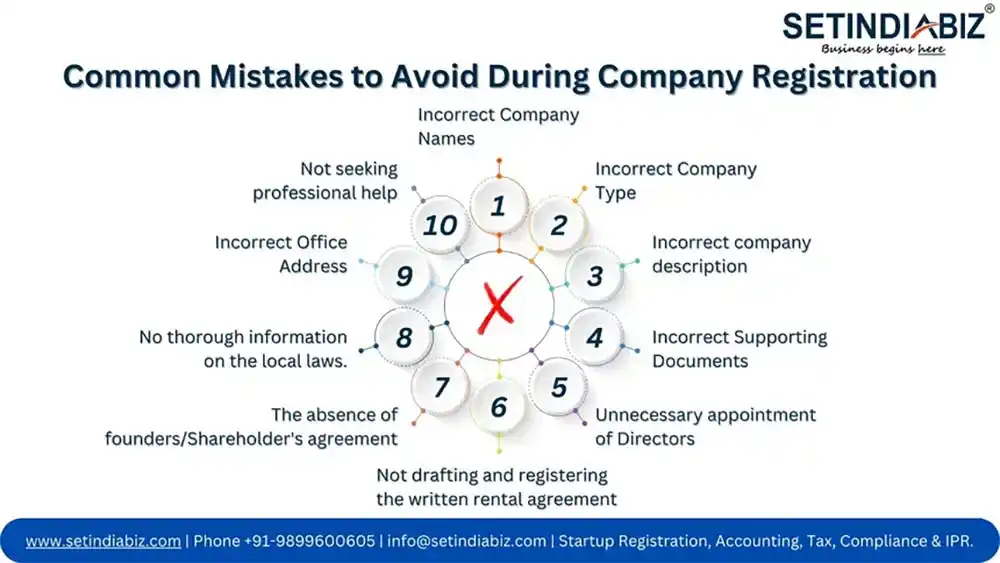
Common Mistakes to Avoid During Registration
The mistakes that lead to a resubmission or rejection of a company application, and how to avoid each one before filing the form.

Checklist for Company Registration
A pre-filing checklist for incorporating a private, public or one-person company, covering the people, the documents and the forms to file.

SPICe+ Form Guide for Company Registration
What the SPICe+ web form covers for a new Indian company, from name and incorporation to PAN, TAN, EPFO, ESIC and a bank account.

Company Name Approval Rules & Process
The rules the Registrar applies to company names in India, how to pick a name that gets approved, and how to reserve it online.
Frequently Asked Questions
These answers cover the decisions founders usually need to make for the business: who can own and manage the company, what registration costs, how documents are checked, and which duties arise afterwards. The relevant sections, rules and forms help you verify each point. Incorporation creates the company; it does not automatically complete every licence, tax registration or compliance task needed to run the business.
Basics & structure
No. You may start as a sole proprietor or partnership without incorporating a company, although tax registrations and business licences may still apply. A private company limited by shares creates a separate legal entity and limits members’ liability, subject to the law.
The Corporate Identity Number is the number the Registrar allots on incorporation and includes in the Certificate of Incorporation (Section 7(3)). Section 12(3)(c) requires it on the company’s letters, bills and notices with its name and registered office address. To check that a company is registered, search its CIN or name in View Company Master Data on mca.gov.in.
Authorised capital is the ceiling up to which the company may issue shares, stated in the capital clause of the memorandum (Section 4(1)(e)); paid-up capital is what shareholders have actually paid. Authorised capital sets the MCA fee above ₹15 lakh and, in most States, the stamp duty, and it can be increased later.
Yes, subject to eligibility and the prescribed procedure. A private company may convert to a public company under Section 14 or to an LLP where the LLP Act permits. An OPC must convert before admitting another member. Partnerships and LLPs can also register as companies under Section 366. Check tax and contractual consequences before choosing a route.
Registration usually takes 7–10 working days after receiving complete documents, subject to the Registrar’s approval and any queries. Professional fees start at ₹2,499. DSC charges, government fees, State stamp duty and GST are additional as quoted. Ask for a written estimate showing the scope and total before paying.
Directors & shareholders
The company-law test is 182 days in India during the financial year, with proportionate application in the incorporation year (Section 149(3)). The 120-day figure in the OPC rules concerns a different definition and does not replace this director requirement. At least one director must meet the applicable test; the other directors may be NRIs or foreign nationals.
A salaried person can be a director, because the Companies Act, 2013 does not bar it. Check the employment terms or service rules, which may forbid it (for example, for government servants), and note the duties every director owes under Section 166.
A DIN is the Director Identification Number, and no one can be appointed a director without one (Section 152(3)). SPICe+ allots up to three DINs at incorporation, so most founders need no separate application; a later director applies in Form DIR-3, and the DIN stays active through DIR-3-KYC filings (see the Every year tab).
You may include more than three directors if the additional directors already hold DINs. SPICe+ limits applications for new DINs to three, not the total number of directors. Others can obtain DINs and join after incorporation through the applicable appointment procedure, with Form DIR-12 filed for each appointment.
Generally, up to 20 companies, with no more than 10 public companies (Section 165). Directorships in dormant companies are not counted. Check all current directorships before appointing a new person.
A significant beneficial owner is an individual meeting the prescribed indirect-ownership, voting, distribution, influence or control tests under Section 90 and the SBO Rules. The ownership tests use a 10% threshold, with detailed tracing rules. Where applicable, the individual files BEN-1 and the company files BEN-2 within 30 days of receiving the declaration.
Process & documents
An approved name is reserved for 20 days from approval under Rule 9, and you must file SPICe+ Part B within that time. To keep it longer, pay the Rule 9A extension fee before it expires (see the Govt Fees tab); once it lapses, the name has to be applied for again in Part A.
Yes. A residential address may be used if the company can receive letters there. Provide the owner’s consent, a utility bill not older than two months, and ownership or occupancy documents as applicable (Section 12 and Rule 25). For rented premises, obtain the landlord’s consent.
AGILE-PRO-S covers EPFO and ESIC registration and a bank-account request, subject to bank KYC. It also supports optional GST and specified State registrations; Udyam is separate. EPFO and ESIC contributions become due only when the relevant coverage conditions apply. Check the current linked services and any separate State requirements before filing.
The Central Registration Centre emails the deficiency, and you correct it and resubmit within the time it allows. Part A can be resubmitted once and Part B twice (MCA FAQ 59), so answer every point in one go; the name clock keeps running meanwhile.
Some words require approval: words linked to the Central Government under Rule 8B, and words such as Bank or Insurance that need the sector regulator’s consent (MCA FAQ 78, 79). A name that matches a registered trade mark needs the owner’s consent (MCA FAQ 77).
Not while it is a small company, which most new companies are. Rule 9B of the Prospectus and Allotment of Securities Rules covers private companies other than small and government companies. If it applies, arrange demat facilities and follow the prescribed issue and transfer rules. The usual deadline is 18 months from the relevant year-end; check the company’s status and any extension before setting a date.
Cost, tax & compliance
A private company qualifies if paid-up capital is up to ₹10 crore and turnover for the preceding financial year is up to ₹100 crore. Both tests apply. Holding, subsidiary, Section 8 and special-Act companies are excluded. Eligible companies use MGT-7A and get relief on board meetings and penalties under the law.
GST registration is not automatic on incorporation. Thresholds generally are ₹20 lakh for services (₹10 lakh in specified States) and ₹40 lakh for eligible goods-only suppliers. Section 24 can require registration below these limits, subject to exemptions. Eligible e-commerce sellers may use enrolment for intra-State goods supplies, not inter-State sales (Notification 34/2023-CT).
The audit is compulsory even with no turnover: Section 139(1) applies to every company, with no threshold and no exemption for a dormant first year. The board appoints the first auditor within 30 days of incorporation (Section 139(6)).
Yes, if it meets DPIIT’s age, turnover and innovation or scalability conditions. The limits are 10 years and ₹200 crore; recognised DeepTech cases have 20 years and ₹300 crore limits (G.S.R. 108(E), 2026). Recognition is a separate application.
No questions in this category yet. Choose another category or select “All”.
Request a Call / Quote
Tell us your State, business activity, proposed capital and number of directors. We will send a written estimate showing professional fees, DSC charges, government fees, stamp duty and GST separately, with the scope, documents, timeline and exclusions. An estimate does not commit you.
Written estimate first
Fee, statutory charges and GST shown separately, upfront.
Free consultation
A process expert explains the scope and options. No obligation.
Quality you can check
Defined deliverables; qualified professionals where required.
Support through completion
One point of contact, status updates and a support portal.
Clear scope and timeline
Documents needed, working-day timeline, exclusions listed.
Online, across India
Online delivery from Noida, Mumbai, Bengaluru, Hyderabad.
📞 +91 98996 00605 📧 info@setindiabiz.com
🕒 Mon–Sat · 9:30 AM – 6:30 PM How we handle your details: read our privacy policy.
