
Overview :Private limited company is a business framework widely chosen by many businesses every year due to its attractive features. The blog provides better insight into the minimum requirements for Company Registration in India as per the Companies Act 2013. In this ever-changing business landscape, it’s essential to be aware of such requirements as they are crucial for a private limited company registration in India providing your business with a distinct legal identity for all practical purposes.
A Private Limited Company is a business registered under the Companies Act. This registration provides various essential features, including the transfer of ownership through shares, limited liability to shareholders, and perpetual existence for an indefinite period for a business. Since it is a distinct legal entity, the Companies Act makes private limited company registration mandatory by the Registrar of Companies (ROC), which can be done by fulfilling specific minimum requirements. Delving into the minimum requirements for pvt ltd company registration in India is necessary before undergoing the company registration process in India.
Minimum Requirements for Company Registration in India
The minimum requirements to initiate your private limited company registration in India are the prespecified conditions that must be fulfilled before starting a private limited company registration process . These requirements for pvt ltd company registration cover all the necessary prerequisites of a company registration, including its shareholders, directors, name, registered office, and capital. Moreover, the authorized director must possess a Class 3 DSC to authenticate the private limited company registration application and attest all the required forms and documents.
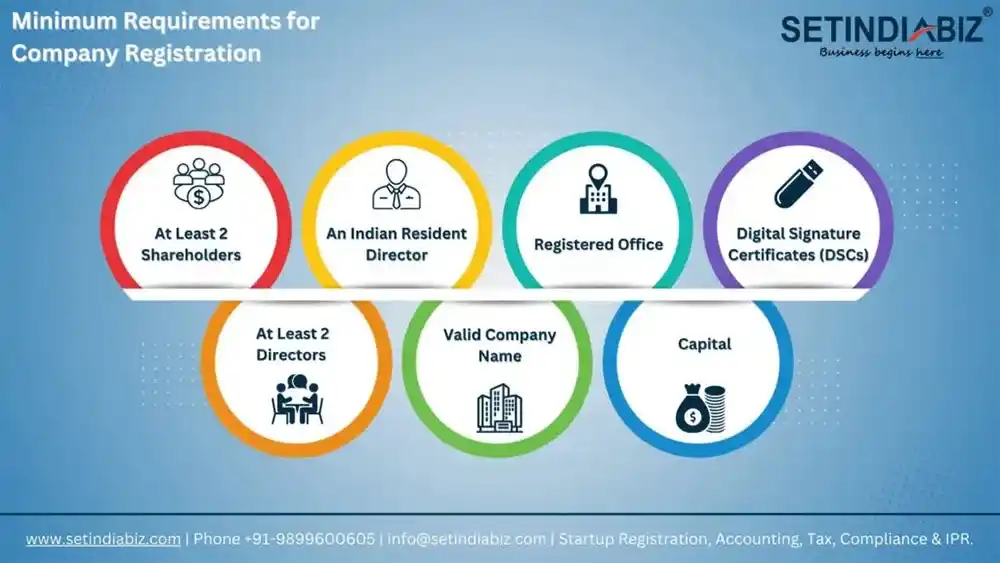
1. At Least 2 Shareholders
Shareholders are co-owners of a Private Limited Company. The percentage of their ownership is decided by the ratio of their shareholding portion in the company. In order to register a Private Limited Company in India, it is required to have at least 2 Shareholders, which can be extended to a maximum of 200. These shareholders can either be individuals or corporate entities, Indian or foreign in origin.
There is no requirement of nationality or residence restricted for the shareholders of a company. However, if the shareholder is a foreign citizen or a foreign corporate entity, then the FDI rules and regulations also need to be satisfied, and appropriate FDI reporting needs to be made to RBI in the form of FC-GPR. The first shareholders of a company are collectively known as its promoters. These promoters are free to make decisions regarding the shareholding ratio, and that becomes the basis on which the first shareholder subscribes to the number of equity shares.
2. At Least 2 Directors
Directors are the authorized individuals appointed by the shareholders to control the entire management of a company. The appointed directors are responsible for overseeing and managing the company’s day-to-day operations, thereby ensuring its compliance with various regulatory laws. If you are going to register a Private Limited Company in India, make sure to have at least 2 directors. Those directors must be non-minors and individuals, whether Indian or foreign. This number can be extended to 15 as specified under the Companies Act.
The shareholders can appoint more than 15 directors if needed, only by passing a resolution to this effect in the General Board Meeting. Moreover, he must not be disqualified under Section 164 of the Companies Act. Note here that the same individual can be appointed as the director as well as shareholder of the company. However, these are two separate designations in a company, and it is crucial to know the difference between a shareholder and director.
3. An Indian Resident Director
As mentioned in the earlier paragraph, the maximum number of directors in a company can be extended to 15, and there is no restriction on their nationality; they can be Indian or foreign citizens. However, the Companies Act restricts the resident status of at least one director in a private limited company. It prescribes that at least one of the directors appointed in a Pvt Ltd Company must be an Indian Resident.
An Indian Resident Director is one who has stayed in India for more than 120 days in the previous financial year. These days need not be continuous and can be counted as the overall days of stay.
4. Valid Company Name
One of the other essential minimum requirements for pvt ltd company registration in India is an approved name by the ROC. For this, a valid and appropriate name must be chosen as per the guidelines prescribed by the MCA. It must not be similar or identical to the name of an existing company or infringe an existing or applied trademark. Also, it must not contain words prohibited for use as per the Names & Emblems Act.
Upon choosing an appropriate name, the same needs to be proposed to the ROC for approval in the SPICe Plus application. The ROC, after examining the application either accepts or rejects the name. In case, the name is accepted, it shall be reserved in the name of the company for a period of 20 days, within which the company must get incorporated and gain a legal existence. On the other hand, if it gets rejected a fresh application for name approval will have to be filed.
5. Registered Office
One of the key requirements for pvt ltd company registration is that the companies need to maintain a Registered Office at all times as per section 12 of the Companies Act, 2013. A Registered Office is the office address with which a company gets incorporated. This address is maintained by the ROC in all its public records and is accessed by all government authorities and other private stakeholders for official communication and correspondence.
A Registered Office is the company’s primary point of official contact where the company maintains all its official documents and accounts for inspection by tax and regulatory authorities as well. A company’s Registered Office must be fully constructed and also lockable. Moreover, the registered office must be situated on commercial / residential land. It may be rented or self-owned by the company owner. In either case, a No Objection Certificate needs to be obtained from the office property owner.
6. Capital
Capital is the fund that a company receives from its shareholders in exchange for its equity shares. There are no minimum requirements for Company Registration in India when it comes to capital, and shareholders are free to contribute as per their will. However, it is always advisable that the capital deposited by the shareholders should be adequate to conduct its day-to-day business operations smoothly.
7. Digital Signature Certificates (DSCs)
The application process for incorporation of a Company is entirely digital. To complete it, a form is required to be filled and submitted online along with the prescribed set of documents authenticated and attested using the Class 3 Digital Signature Certificate of the authorized director or signatory. A Digital Signature is the electronic counterpart of a physical signature, encrypted for enhanced security, which makes it non-forgeable and unique.
Company Registration Cost
- Director DIN
- Company Name Approval
- Filing Incorporation Forms
- Company PAN & TAN
- Digital Signature
- Drafting MoA & AoA
- Certificate of Incorporation
- 100% Online Process


Conclusion
Understanding the minimum essential requirements for private limited company registration in India can be helpful in meeting the basic requirements prior to initiating the company registration process in India. It will ensure a seamless and legally sound company incorporation process. The blog has covered all the necessary requirements for incorporating a company in India. Adhering to such requisites ensures compliance with regulatory frameworks and lays a foundation stone for a sustainable business journey by providing it a distinct legal identity and the privileges it deserves as per the Companies Act.
FAQ’s
Can a foreign individual or company be a shareholder in a Private Limited Company?
Is it mandatory for each director of a Private Limited Company to be an Indian resident?
What is the significance of a DSC in the company registration process?
The Class 3 DSC of an authorized director or signatory is also used to authenticate and attest the required forms and documents submitted during the process of private limited company registration in India.
Can a Private Limited Company have more than two shareholders and directors?
Shareholders may also pass a resolution to increase the number of directors beyond 15 wherever necessary.
What happens if the ROC rejects the proposed company name?
Once approved, the company name will be reserved for 20 days during which the applicant must complete the registration process.
How long does it take to register a Private Limited Company?
What documents are required for foreign shareholders?
- For Individuals: Passport copy and Address Proof (apostilled/notarized).
- For Companies: Certificate of Incorporation, Board Resolution, and POA.
Is it possible to change the company name after registration?
What if a director doesn’t possess a DIN?
However, first-time directors can apply for DIN simultaneously during company registration via SPICe+ Part B; there is no need for a separate DIN application.
Can the same person be both a shareholder and director?
Related Articles :
In This Article
Author Bio

Setindiabiz Editorial Team is a multidisciplinary collective of Chartered Accountants, Company Secretaries, and Advocates offering authoritative insights on India’s regulatory and business landscape. With decades of experience in compliance, taxation, and advisory, they empower entrepreneurs and enterprises to make informed decisions.
