
Overview: The Central Board of Indirect Taxes and Customs (CBIC), through Instruction No. 02/2026-GST, has directed Central GST field formations not to make further arrests, restricted the interception of goods vehicles and barred show-cause notices involving less than ₹10,000. These interim directions implement recommendations of the 57th GST Council meeting pending legislative amendments proposed to take effect from 1 April 2027.
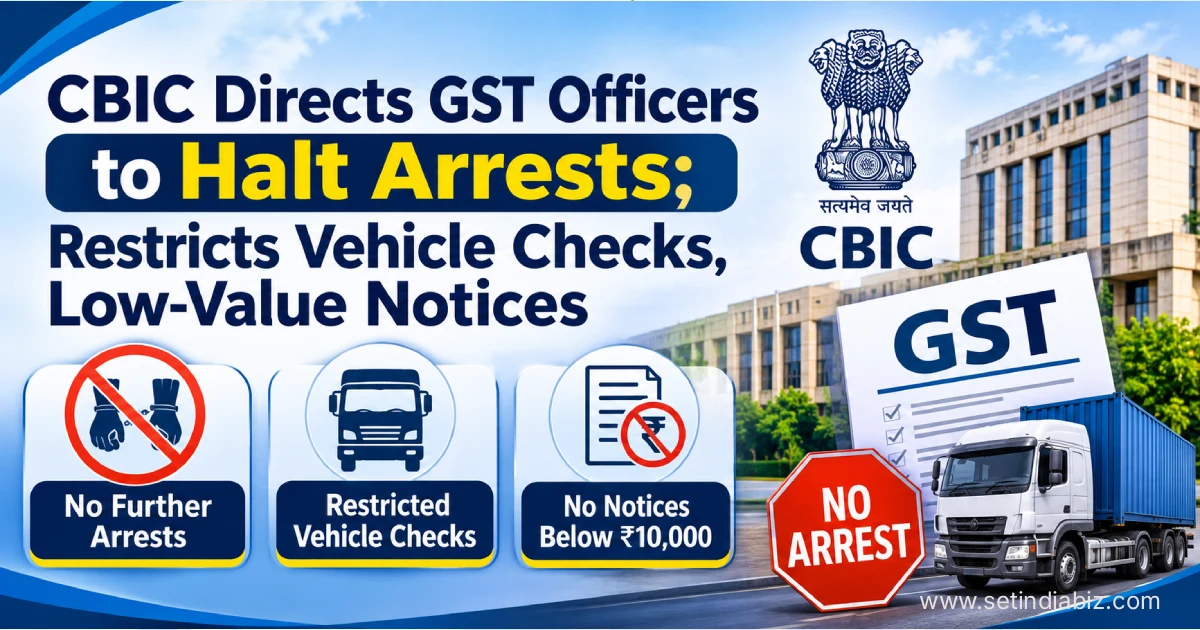
Businesses dealing with GST investigations, movement of goods and departmental notices have received an important relief. The Central Board of Indirect Taxes and Customs (CBIC) has issued fresh directions to Central GST officers, changing the way they can exercise certain enforcement powers.
The directions cover three areas – arrests under GST, interception and inspection of goods vehicles, and show-cause notices involving small amounts. Although the changes are intended to take effect through amendments to the CGST Act, 2017, the CBIC has directed its field formations to implement them immediately.
Key Changes under CBIC Instruction No. 02/2026-GST
The instruction, issued under File No. CBIC-20001/3/2026-GST on 30 October 2026, implements three major enforcement recommendations made at the 57th GST Council meeting, held on 8 October 2026.
1. Central GST Officers Directed Not to Make Further Arrests
The GST Council recommended withdrawing arrest powers under GST by omitting Section 69 of the Central Goods and Services Tax (CGST) Act, 2017.
Pending the required legislative amendment, CBIC has directed all Central GST field formations that no further arrests may be carried out under GST.
However, this direction does not mean that criminal prosecution under Section 132 of the CGST Act has been abolished. The GST Council separately recommended raising the prosecution threshold from ₹1 crore to ₹5 crore. This is a separate recommendation requiring legislative amendment.
Until the relevant statutory amendments take effect, the existing prosecution provisions under Section 132 remain applicable. The immediate CBIC direction concerns arrests by Central GST field formations under Section 69; it does not grant businesses or their directors immunity from prosecution.
2. GST Show-Cause Notices Below ₹10,000 Restricted
CBIC has also implemented the GST Council’s recommendation to prescribe a minimum threshold of ₹10,000 for issuing show-cause notices under Sections 73, 74 and 74A of the CGST Act, 2017.
Accordingly, Central GST officers have been directed not to issue such notices where the aggregate amount involved is below ₹10,000.
The threshold is calculated by adding the amounts under the following laws:
- Central Goods and Services Tax (CGST) Act, 2017
- State Goods and Services Tax (SGST) Act
- Integrated Goods and Services Tax (IGST) Act, 2017
- Union Territory Goods and Services Tax (UTGST) Act, 2017
- Goods and Services Tax (Compensation to States) Act, 2017
The restriction applies where the aggregate amount is strictly below ₹10,000. A case involving exactly ₹10,000 is not covered by this particular restriction.
This direction concerns the issue of show-cause notices under the specified provisions. It does not waive the underlying tax liability.
3. Goods Vehicle Inspections Restricted to Specific Cases
The CBIC has also changed the procedure for intercepting and inspecting goods vehicles during transit.
Section 68 of the CGST Act, 2017, provides for inspection of goods in movement, while Rule 138B of the CGST Rules, 2017, deals with verification of documents and conveyances. The CBIC instruction introduces stricter conditions for interception and inspection, pending amendments to Sections 68, 129 and 130 of the Act.
Conditions for Interception
A conveyance carrying goods may be intercepted only on the basis of specific intelligence. The interception must be authorised by an officer not below the rank of Joint Commissioner, who must record in writing the reasons to believe that the goods are being transported in contravention of the CGST Act or the rules made under it.
Inspection and Territorial Jurisdiction
If a conveyance is intercepted, inspecting the vehicle and its cargo is permissible only if the supplier or recipient holds GST registration within the officer’s territorial jurisdiction. If a party doesn’t have a registration, the governing criterion is whether they are located within that specific State or Union Territory.
If the inspection establishes a contravention of the CGST Act or its rules, the officer may detain or seize the goods in accordance with Section 129 of the Act.
Conveyances Outside the Officer’s Jurisdiction
Where verification of documents establishes that neither the supplier nor the recipient is registered or, where unregistered, located in the State or Union Territory of the authorising officer, the inspecting officer cannot hold up the conveyance merely on suspicion of a contravention.
In such cases, the officer must allow the goods and conveyance to proceed without hindrance and forward information about the suspected contravention to the proper officer having jurisdiction over the supplier or recipient.
The jurisdictional officer must then examine the information and take necessary action.
Exception for Missing Transport Documents
A separate exception applies where neither an e-way bill has been generated for the goods in the conveyance nor any document showing their origin or destination is produced.
Under these specific circumstances, the intercepting officer is authorised to inspect, detain, or seize the goods and conveyance regardless of whether the supplier or recipient falls within their territorial jurisdiction.
Apart from these specified circumstances, goods and conveyances in transit cannot be detained or seized for other reasons. The instruction also expressly prohibits confiscation of goods or conveyances in transit under Section 130 of the CGST Act, 2017.
When Do the New GST Enforcement Directions Take Effect?
Instruction No. 02/2026-GST, issued on 30th October, 2026, applies immediately to Central GST field formations.
The 57th GST Council meeting recommended that the relevant legislative amendments should come into force from 1 April 2027. However, CBIC has issued these interim directions so that its field formations implement the recommended enforcement changes without waiting for the statutory amendments.
The instruction will remain in force until the amendments to the CGST Act, 2017, recommended by the 57th GST Council come into effect.
There is also an important distinction concerning State GST authorities. CBIC has forwarded a copy of the instruction to the GST Council Secretariat, requesting it to circulate the directions to State GST formations. States may issue similar instructions within their respective jurisdictions if they consider it appropriate. Therefore, the present instruction should not be treated as automatically binding on every State GST formation.
Setindiabiz Support
GST enforcement restrictions do not remove the need for businesses to maintain accurate tax records, reconcile returns and comply with e-way bill requirements.
Setindiabiz provides businesses with end-to-end GST compliance support, covering GST registration, periodic GST return filing, and GST invoice and e-way bill requirements. Our services include the documentation and filing requirements associated with GST compliance, helping businesses maintain proper records and meet their statutory obligations.
FAQs
CBIC has directed all Central GST field formations not to carry out further arrests under GST. This is an interim administrative direction pending the proposed legislative omission of Section 69. It does not, by itself, abolish prosecution under Section 132.
Central GST officers have been directed not to issue show-cause notices under Sections 73, 74 and 74A where the aggregate amount involved, including the specified GST components and compensation cess, is below ₹10,000. The restriction does not cover an amount of exactly ₹10,000.
Yes. Interception is permitted on the basis of specific intelligence, with authorisation and written reasons recorded by an officer not below Joint Commissioner rank. Inspection and further action are also subject to the prescribed territorial jurisdiction conditions and the missing-document exception.
Generally, the inspecting officer must allow the conveyance and goods to proceed and forward information about the suspected contravention to the jurisdictional proper officer. However, where neither an e-way bill has been generated nor a document showing the origin or destination of the goods is produced, inspection, detention or seizure is permitted irrespective of jurisdiction.
Not automatically. The instruction directly covers Central GST field formations. The GST Council Secretariat has been requested to circulate it to State GST formations, which may issue similar directions within their jurisdictions.
CBIC Instruction No. 02/2026-GST marks a significant change in the enforcement approach followed by Central GST authorities. It restricts further arrests, places conditions on the interception of goods vehicles and introduces a ₹10,000 threshold for show-cause notices under specified provisions.
