
Overview: SEBI has revised the periodic KYC review requirements for Foreign Portfolio Investors (FPIs), effective 1st December 2026. Depending on their category, jurisdiction and regulatory status, eligible investors will undergo reviews every two or eight years. The regulator has also removed a separate information-change intimation or no-change declaration requirement at registration continuation. Existing arrangements for GS-only and SWAGAT-FI FPIs remain unchanged.
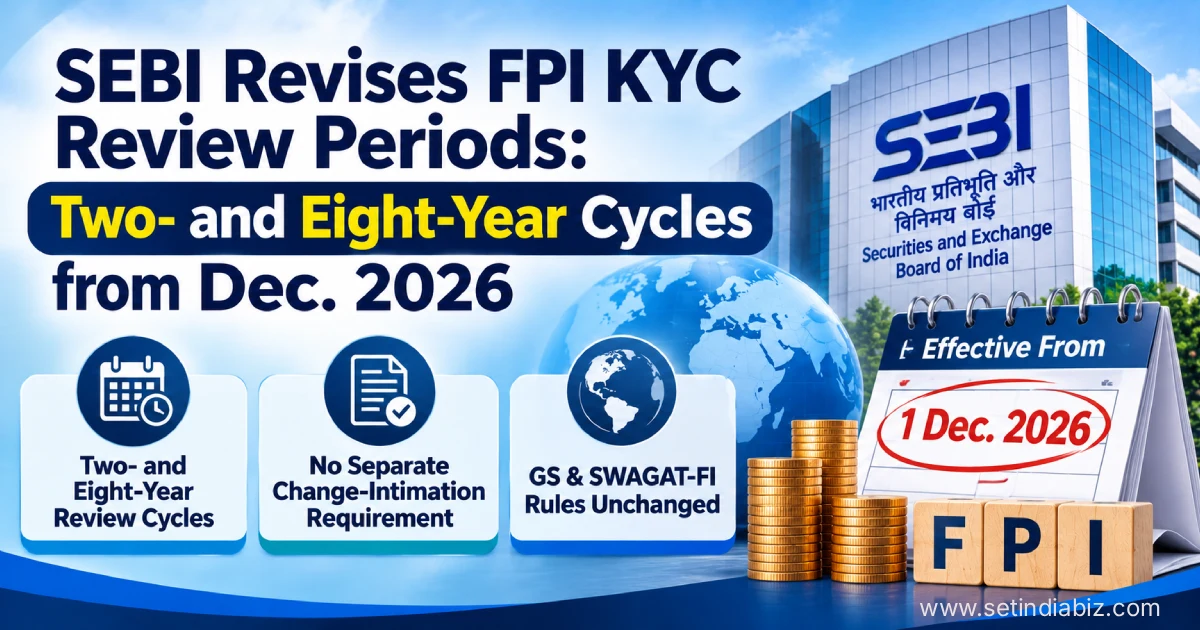
The Securities and Exchange Board of India (SEBI) has reduced the frequency of periodic Know Your Customer (KYC) reviews for specified categories of Foreign Portfolio Investors. Under the SEBI circular dated 30th October, 2026, some investors will move to an eight-year review cycle, while others will undergo reviews every two years. The revised requirements will take effect from 1st December 2026.
The changes also simplify the continuation of FPI registration by removing a separate requirement to report changes in previously submitted information or provide a no-change declaration at that stage. However, the revised review periods do not apply uniformly to all FPIs. Their classification, jurisdiction and regulatory status will determine the applicable cycle.
SEBI Extends FPI KYC Review Periods
SEBI’s earlier framework prescribed annual or three-yearly KYC reviews, depending on the FPI’s jurisdiction, category and regulatory status. The revised framework introduces two-year and eight-year cycles for specified categories.
Under the revised Table 6 of Part B of the Master Circular for FPIs, DDPs and Eligible Foreign Investors, the review schedule will be as follows:
| No. | Jurisdiction | FPI category and status | KYC review frequency |
|---|---|---|---|
| 1 | Non-high-risk | Category I | Every 8 years |
| 2 | Non-high-risk | Category II – regulated entities | Every 8 years |
| 3 | Non-high-risk | Category II – other entities | Every 2 years |
| 4 | High-risk | Category I – registered under Regulation 5(a)(i) | Every 8 years |
| 5 | High-risk | Category I – others | Every 2 years |
| 6 | High-risk | Category II | Every 2 years |
| 7 | All jurisdictions | GS-only FPIs | As per RBI KYC review cycle applicable to respective bank accounts |
| 8 | All jurisdictions | SWAGAT-FI FPIs | Every 10 years |
The eight-year review period is not available to every FPI. In high-risk jurisdictions, only Category I FPIs registered under Regulation 5(a)(i) qualify for this extended period. Other Category I FPIs and all Category II FPIs in such jurisdictions remain subject to two-year reviews.
For non-high-risk jurisdictions, Category I FPIs and regulated Category II entities qualify for the eight-year cycle. Other Category II entities will undergo KYC reviews every two years.
The existing arrangements for Government Securities-only FPIs (GS-FPIs) and SWAGAT-FI FPIs remain unchanged. GS-FPIs will continue to follow the KYC review periodicity prescribed by the Reserve Bank of India (RBI) for their respective bank accounts. SWAGAT-FI FPIs will retain their 10-year review cycle. The SWAGAT-FI framework provides a separate simplified route for eligible foreign investors.
SEBI Removes Separate Change-Intimation Requirement at Registration Continuation
SEBI has also removed the requirement for FPIs, other than GS-FPIs, to separately intimate changes in previously submitted information or provide a no-change declaration at the time of registration continuation.
This is a procedural relaxation linked specifically to the continuation process. It does not remove information-update or disclosure obligations arising under other applicable regulatory requirements. FPIs must continue to comply with the relevant reporting and disclosure provisions.
The change removes a separate documentation step when an FPI continues its registration for a subsequent period.
Changes in FPI Registration Continuation
Periodic KYC review and continuation of FPI registration are separate compliance requirements. The revised KYC schedule does not change the existing registration blocks.
Regular FPIs wishing to continue their registration must pay the applicable fee to their Designated Depository Participant (DDP) for the subsequent three-year block. SWAGAT-FI FPIs continue under 10-year registration blocks.
The continuation fee must be paid to the DDP at least 15 days before the current registration validity expires. This is a payment deadline for registration continuation, not a KYC review deadline.
The revised circular also requires depositories, custodians and DDPs to update their systems and processes and inform the affected FPIs. SEBI has amended the KYC Review/Update timelines in the Investor Charter for DDPs to reflect the revised periodicity.
Indian businesses and overseas investors can also refer to the requirements relating to FPI onboarding, SEBI and RBI compliance.
What the Revised SEBI Rules Mean for Foreign Investors
The longer review periods will reduce the frequency of repeat KYC checks for eligible FPIs. Investors in the two-year categories, however, will continue to undergo periodic verification at shorter intervals.
FPIs and their intermediaries should identify the applicable review cycle and update their compliance calendars before 1st December, 2026. Depositories, custodians and DDPs must also make the necessary changes to their systems and processes.
Setindiabiz Support
Foreign investment in India involves regulatory requirements that extend beyond an investor’s registration and KYC. Indian companies receiving foreign capital must assess the applicable investment route, ownership structure, FEMA requirements, RBI reporting and corporate filings.
Setindiabiz supports businesses with company incorporation, India-entry structuring, foreign investment documentation, FEMA-related compliance and ongoing corporate filings. These services help Indian businesses maintain the required compliance framework when bringing in overseas investment. FPI-specific KYC reviews and registration continuation remain within the scope of the concerned DDP and custodian.
FAQs
The revised KYC review periodicity takes effect from 1st December, 2026.
The eight-year cycle applies to Category I FPIs in non-high-risk jurisdictions, regulated Category II entities in non-high-risk jurisdictions, and Category I FPIs registered under Regulation 5(a)(i) in high-risk jurisdictions.
No. GS-only FPIs continue to follow the RBI-prescribed KYC review periodicity applicable to their respective bank accounts. SWAGAT-FI FPIs retain their 10-year KYC review cycle.
SEBI has removed the separate requirement to intimate changes in previously submitted information or provide a no-change declaration at the time of registration continuation. Other applicable information-update and disclosure obligations continue.
An FPI must pay the applicable fee to its DDP at least 15 days before the current registration validity expires.
SEBI’s revised framework gives specified categories of FPIs longer intervals between KYC reviews and removes a separate declaration requirement at registration continuation. FPIs should confirm their applicable review cycle and registration expiry with their DDP before 1 December 2026.
