
Overview: The 57th GST Council meeting, on 8th October 2026, recommended changes to GST refunds, input tax credit (ITC), registration, return filing, exports and tax enforcement. The proposals aim to ease working-capital pressure, reduce compliance disputes and simplify routine procedures for startups, micro, small and medium enterprises (MSMEs), exporters and e-commerce sellers. The Council also recommended targeted tax clarifications and relief for specified sectors. Most measures require amendments, notifications, rules or circulars before taking effect.
The GST Council has recommended a series of changes to India’s GST framework, covering refunds, input tax credit, registration, return filing and tax enforcement. Announced at Council’s 57th meeting on 8th October 2026, the proposals also address service exports, interstate e-commerce and the movement of goods. If implemented, the measures could ease compliance requirements and improve working capital management for businesses.
Businesses should review their GST records and compliance procedures to understand where the proposed changes could affect refund claims, credit eligibility, tax payments and filing obligations. Preparing now can help them respond more efficiently once the relevant measures are implemented.
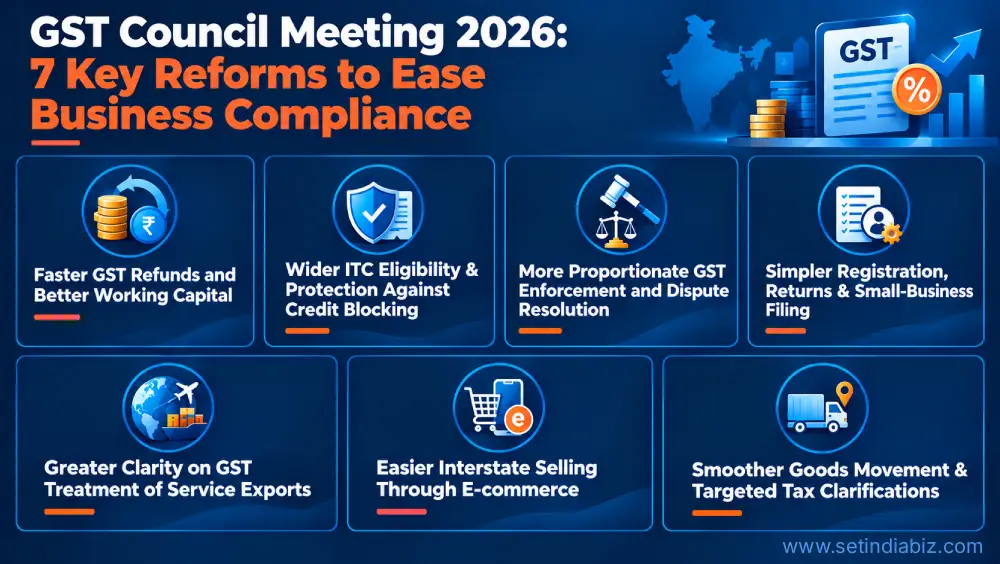
Important Recommendations and Their Impact
1. Faster GST Refunds and Better Working Capital
Recommendation: The Council proposed reducing the time for issuing a refund acknowledgement or deficiency memo from 15 days to 10 days. If neither is issued within that period, the system would provide deemed acknowledgement.
Eligible refund claims relating to zero-rated supplies and inverted duty structure would receive 90% provisional sanction through automated, risk-based processing. Excess balances in the electronic cash ledger would also be refunded automatically. The Council recommended further automation of refund processing in phases.
The Council also proposed allowing refunds of accumulated ITC on input services under the inverted duty structure for credit availed on or after 1st November, 2026. Refunds of eligible capital-goods credit relating to zero-rated supplies and the inverted duty structure would cover credit availed on or after 1st April 2027. These refunds would be disbursed over 60 months.
Impact: Faster refunds could free up money for businesses to invest in stock, pay salaries and expand operations. The proposed changes could also benefit businesses that pay more GST on their inputs than they collect on their sales. However, businesses must continue to follow the existing rules until the changes come into effect.
2. Wider ITC Eligibility & Protection Against Credit Blocking
Recommendation: The Council proposed easing restrictions under Section 17(5) of the Central Goods and Services Tax (CGST) Act, 2017, for specified expenses. These include outdoor catering, health and life insurance, telecommunication towers, pipelines laid outside factory premises, free samples, and goods destroyed or written off after expiry of their shelf life where destruction is required by law.
The Council proposed allowing taxpayers to challenge a decision to block money in their electronic credit ledger. Taxpayers would also get a chance to explain their position in a personal hearing before the tax officer decides on the objection. The Council also proposed clarifying the circumstances in which businesses can claim input tax credit (ITC) on demonstration vehicles.
Impact: Eligible businesses could reduce the tax cost of specified operating expenses. The proposed objection mechanism would provide an additional procedural safeguard if ITC is blocked. However, businesses should not assume that every expense in these categories will automatically qualify for credit; the final provisions and applicable conditions will determine eligibility.
3. More Proportionate GST Enforcement and Dispute Resolution
Recommendation: The Council proposed removing the provision that allows GST officers to authorise arrests under Section 69 of the CGST Act, 2017. It also recommended raising the prosecution threshold from ₹1 crore to ₹5 crore and reducing the maximum general penalty under Section 125 from ₹25,000 to ₹10,000.
The Council also proposed that a show-cause notice should only be issued when the disputed amount reaches ₹10,000, including the amounts under Central GST, State GST, Union Territory GST, Integrated GST and cess.
The Council also proposed capping the mandatory pre-deposit for appeals against penalty-only orders, where no tax is demanded, at ₹40 crore in total. This would comprise ₹20 crore under CGST and ₹20 crore under SGST/UTGST and would apply to appeals before the Appellate Authority and the Appellate Tribunal.
The Council also recommended a reduced penalty of 5% in specified non-fraud cases where tax and interest are paid within 30 days under Section 73 or 60 days under Section 74A after the adjudication order.
Impact: These measures could reduce the financial burden of certain disputes and make the enforcement process more proportionate. They do not amount to a blanket exemption from prosecution or penalties. Businesses must continue to maintain accurate records and meet their tax obligations.
4. Simpler Registration, Returns & Small-Business Filing
Recommendation: The Council proposed clearer GST registration requirements, prescribed document selections and a more user-friendly online application process.
Most registration amendments would be accepted automatically, except changes relating to the principal place of business. For taxpayers registered through the specified automatic route, amendments to all registration particulars, including the principal place of business, would be accepted automatically.
The Council also recommended automated registration cancellation in specified cases, subject to the filing of pending returns and payment of outstanding dues. Further changes would simplify cancellation and revocation procedures.
Return filing would be improved through better reconciliation between GSTR-1, GSTR-1A, the Invoice Furnishing Facility (IFF) and GSTR-3B. Proposed electronic statements would help taxpayers report reverse-charge payments, ITC claims, and credit reversals or reclaims more accurately. The revised mechanism for correcting liability and ITC mismatches is proposed from the April 2027 return period.
E-invoicing would extend to specified domestic supplies received from unregistered persons under the reverse charge mechanism and imports of services for taxpayers with annual aggregate turnover of ₹5 crore or mThe Council also approved in principle an optional Annual Return Quarterly Payment (ARQP) scheme for businesses with turnover of up to ₹5 crore in the preceding financial year that make only business-to-consumer (B2C) sales.
Impact: Clearer registration requirements and more automated processes could reduce avoidable queries and delays. Better reconciliation may also help prevent notices arising from mismatches between reported liabilities and ITC.
The Council additionally recommended waiving late fees for delayed returns under Section 39(1) for taxpayers with turnover up to ₹5 crore in the preceding financial year, provided the delayed return is filed by the end of the month in which it was due. Eligible small businesses should check the final conditions before relying on this relief.
5. Greater Clarity on GST Treatment of Service Exports
Recommendation: The Council proposed relaxing the rules so that services could qualify as exports even when the supplier and recipient are establishments of the same legal entity. The change could facilitate export-related benefits for Indian service providers supplying services to or through foreign offices and branches, subject to the applicable requirements.
It also recommended changing the place-of-supply rule for certain services where the recipient makes goods physically available to the Indian supplier. In these specified cases, the default rule would apply, generally linking the place of supply to the recipient’s location.
The Council also proposed clarifying the zero-rating of specified goods supplied to an overseas buyer but delivered to a Special Economic Zone (SEZ) or Free Trade Warehousing Zone (FTWZ). The benefit would be available only if the prescribed payment conditions are met.
Impact: These changes could reduce uncertainty for Indian businesses providing testing, research, engineering and other services to overseas customers. Manufacturers supplying goods through SEZ or FTWZ facilities could also gain greater clarity on zero-rating eligibility. Exporters should review their contracts, payment records and supporting documents before applying any revised treatment.
6. Easier Interstate Selling Through E-commerce
Recommendations: The Council proposed a simplified GST registration mechanism for small suppliers of goods selling through electronic commerce operators (ECOs). Eligible sellers could declare an e-commerce operator’s warehouse as their principal place of business in states or Union Territories where they have no physical presence.
The Council proposed automatic registration for eligible businesses, subject to certain conditions. These would include a monthly limit of ₹2.5 lakh on the input tax credit (ITC) passed on to buyers, excluding specified stock transfers between distinct persons.
The Council also recommended clarifying the GST liability of e-commerce operators for notified services, irrespective of their business models. A 5% GST rate without ITC was proposed for specified delivery services supplied through e-commerce operators and for delivery services relating to goods ordered through them.
Impact: The registration proposal could allow eligible small sellers to enter new state markets without setting up separate business premises in each location. The delivery-service clarification could provide greater consistency for platforms and suppliers operating under different commercial arrangements.
7. Smoother Goods Movement & Targeted Tax Clarifications
Recommendation: The Council proposed allowing goods-carrying vehicles to be stopped for inspection only when there is specific intelligence and the inspection is authorised by an officer of at least Joint Commissioner rank. Inspection and further action would generally be handled by the state where the supplier or recipient is located or registered, rather than through routine interception while goods are passing through other states.
Exceptions would apply where no e-way bill has been generated or the vehicle lacks the required document showing the origin or destination of the goods. The Council also recommended that confiscation provisions should not apply to goods and conveyances in transit.
Other proposals address reverse-charge treatment for specified waste and scrap transactions, the uniform treatment of transfers of intellectual property rights as services, and exemptions or clarifications for specified products and activities. These include psyllium (isabgol) seeds, retreaded tractor tyres, seed warehousing, coffee-curing services and certain highway concession arrangements.
Impact: Transporters and logistics businesses could face fewer routine interruptions during interstate movement. Businesses in affected sectors should review their invoices, contracts and tax treatment once the relevant provisions are notified. The proposed changes may also reduce uncertainty in transactions involving intellectual property and specified goods or services.
What Businesses Should Do Next
The recommendations point towards more automated GST administration, clearer procedures and broader eligibility for specified ITC and refunds. The actual benefits will depend on the final legal provisions, the nature of each transaction and the taxpayer’s compliance records.
Businesses should review accumulated ITC, pending refund claims, registration details, invoice records and return reconciliations. Exporters should examine payment arrangements and the documentation supporting zero-rated supplies. E-commerce sellers should assess whether they meet the proposed conditions before planning interstate expansion.
The Council’s recommendations must be distinguished from provisions already in force. Businesses should wait for the relevant amendments, rules, notifications and circulars before changing their GST treatment or assuming a new benefit is available.
SetIndiaBiz Supports
SetIndiaBiz experts support businesses with GST registration and amendments, GST return filing, e-way bill and invoice compliance, and export-related requirements such as GST LUT filing and merchant-exporter GST assistance.
Our team helps in managing the relevant documentation, filings and compliance requirements for your business, including the requirements that apply as GST rules change. We help businesses keep their records and filings in order so they can focus on operations while our team handles the compliance work.
FAQs
The meeting did not announce a broad revision of GST rate slabs. It did recommend targeted tax clarifications, exemptions and changes for specified goods and services, alongside procedural and compliance reforms.
The proposed refund of accumulated ITC on input services under the inverted duty structure would cover credit availed on or after 1st November, 2026. Refunds of eligible capital-goods credit for zero-rated supplies and inverted duty structure would cover credit availed on or after 1st April, 2027 and be spread over 60 months. Other measures require the relevant implementation steps.
Eligible MSMEs could benefit from simpler registration procedures, more automated amendments, improved return reconciliation, faster refunds and the proposed ARQP scheme for qualifying businesses with turnover up to ₹5 crore that make only B2C supplies. Eligible businesses may also benefit from the proposed late-fee waiver, subject to its final conditions.
No. The recommendations will take effect through the relevant legal amendments, notifications, rules or circulars. Businesses should verify the applicable provisions before changing their tax treatment or filing procedures.
