
Overview: The GST Council may consider five proposals to reduce tax costs and clarify GST treatment for agricultural inputs and services. The proposals cover bio-stimulants, seed storage, psyllium seeds, retreaded tractor tyres and coffee curing services. If approved, they could affect agricultural input manufacturers, seed traders, warehouse operators and farm-equipment businesses. The proposals are not yet law, so businesses should continue following the existing GST rules.
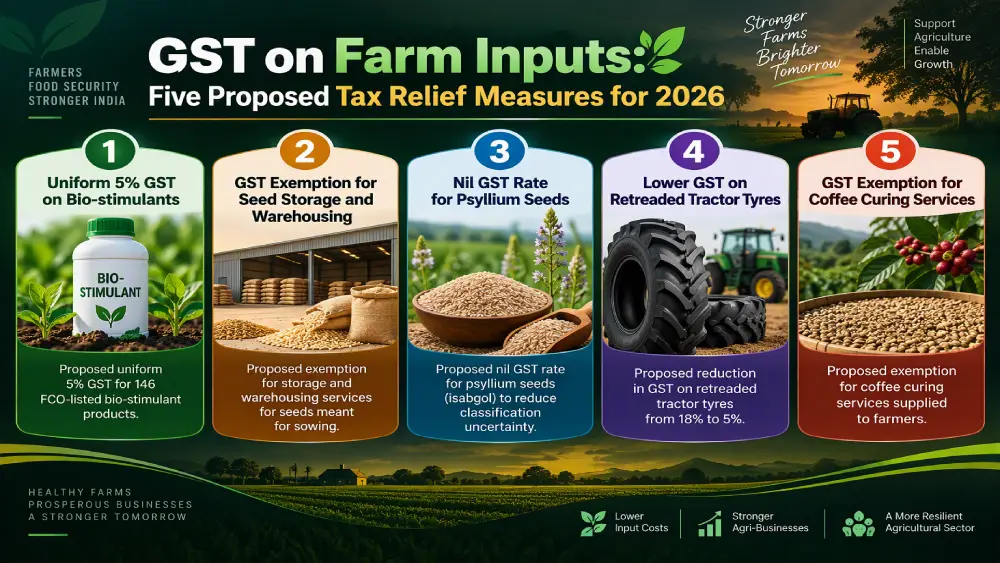
Agricultural businesses could see changes to the GST treatment of several farm inputs and related services, suggest media reports. The proposals expected to be considered at the GST Council meeting on the 7th October aim to reduce tax costs and address classification disputes.
The proposed changes cover five areas, from bio-stimulants and seed storage to tractor tyres and coffee processing. Businesses should understand the possible impact on pricing, invoicing and input tax credit (ITC) before making changes to their compliance processes.
Five GST Proposals for Farm Inputs and Agricultural Services
1. Uniform 5% GST on Bio-stimulants
The GST Council may consider a uniform 5% GST rate for 146 bio-stimulant products listed under the Fertiliser Control Order (FCO), 1985. These products have reportedly faced different GST rates of 5% and 18%, creating uncertainty for manufacturers and sellers. The Department of Agriculture has confirmed that 146 bio-stimulant products are included in Schedule VI of the FCO.
A uniform rate could simplify product pricing, invoicing and tax classification. Manufacturers and distributors should review their product details and FCO registrations before applying any revised rate.
2. GST Exemption for Seed Storage and Warehousing
The Council may consider exempting storage and warehousing services for seeds meant for sowing.
The proposed exemption could reduce storage costs for seed companies, traders and other businesses in the seed supply chain. However, the final wording will determine which services qualify. Businesses should not assume that every warehouse service involving agricultural goods will be exempt.
Seed companies and warehouse operators should review their service agreements, invoices and GST treatment once the final conditions are announced.
3. Nil GST Rate for Psyllium Seeds
Psyllium seeds, commonly known as isabgol, are another area where the proposed change could bring greater clarity.
The current dispute centres on whether particular supplies qualify for exemption as fresh or chilled seeds. The Rajasthan Authority for Advance Ruling has held that the supplies examined in its case were taxable at 5%. A Gujarat appellate ruling, however, accepted an exemption claim for psyllium seeds supplied in their fresh, unprocessed condition. These decisions show why the condition of the seeds and the facts of each transaction matter.
A separate nil-rate entry could reduce this uncertainty if the final measure clearly covers the relevant supplies. Traders, processors and exporters should review their HSN classification, procurement records and current tax treatment before changing their invoices.
4. Lower GST on Retreaded Tractor Tyres
The Council may consider reducing GST on retreaded tractor tyres from 18% to 5%. The proposal seeks to align their rate with the 5% rate reported for new tractor tyres following the September 2025 GST changes.
A lower rate could reduce costs for farmers and businesses that use agricultural machinery. It could also affect tyre retreaders, dealers and distributors.
Businesses should review their product classification, purchase costs and selling prices if the proposal is approved. The revised rate should be applied only after the relevant notification takes effect.
5. GST Exemption for Coffee Curing Services
The GST Council may also consider exempting coffee curing services supplied to farmers.
Coffee curing involves processing harvested coffee before it is marketed or used further. An exemption could reduce the tax cost of eligible services for farmers and businesses involved in coffee processing.
The final conditions will determine which services qualify. Coffee curing businesses should review their service descriptions, contracts and invoices once the official decision is announced.
How the Proposed Changes Could Affect Businesses
The proposals could affect businesses at different stages of the agricultural supply chain.
- Manufacturers and distributors: A uniform rate on eligible bio-stimulants could simplify pricing and tax classification.
- Seed companies and warehouse operators: An exemption for eligible seed-storage services could reduce warehousing costs.
- Psyllium traders and processors: Clearer tax treatment could reduce classification disputes and uncertainty in procurement.
- Farm-equipment dealers: A lower rate on retreaded tractor tyres could affect selling prices and margins.
- Coffee processors: An exemption for eligible curing services could change the GST treatment of service income.
The actual benefit will depend on the final rates, eligibility conditions and effective dates. Businesses must also assess the impact on ITC. An exemption or rate reduction can affect the credit available on related purchases and the overall tax cost.
What Businesses Should Do Now
Businesses should continue following the existing GST rules until the proposed changes are formally notified. They can prepare by taking three practical steps.
Review product and service classifications: Check the HSN codes used for bio-stimulants, psyllium seeds and tractor tyres. Service providers should also review the GST classification of warehousing and coffee curing services.
Check pricing and contracts: Identify products and services that could be affected by a rate change or exemption. Review purchase costs, selling prices, customer contracts and supplier agreements.
Assess ITC and invoicing changes: A lower rate or exemption may affect ITC, the tax charged on sales and the treatment of existing stock or contracts. Review these areas after the final notification and effective date are confirmed.
Setindiabiz Support
A change in GST rates or exemptions can affect more than the tax shown on an invoice. It may also change pricing, input tax credit, supplier arrangements and GST reporting. Setindiabiz helps businesses review GST classifications, reconcile ITC, assess the impact of tax changes and update their compliance processes. Our tax experts can review product and service classifications, check the GST treatment of business transactions and identify gaps in invoices, contracts and tax records.
For agricultural input manufacturers, seed traders, warehouse operators, tyre dealers and processors, a focused GST review can identify the changes required once the final notifications are issued. The proposed relief could reduce costs and clarify tax treatment in parts of the agricultural sector.
FAQs
Is the proposed 5% GST rate for bio-stimulants final?
No. The uniform 5% rate for the 146 listed bio-stimulant products is a reported proposal. Businesses should wait for the official decision and notification before changing their tax treatment.
Will all psyllium seeds become GST-free?
That will depend on the final wording and conditions. Advance rulings have reached different conclusions based on the condition of the seeds and the facts of the supplies. Businesses should follow the applicable rules until a change takes effect.
Will the proposed changes apply immediately after the GST Council meeting?
Not automatically. The Council’s decision and any required notifications will determine the final provisions and their effective dates.
How could these proposals affect input tax credit?
A rate reduction or exemption can affect the availability and treatment of ITC. Businesses should review the applicable rules and their credit position once the final provisions are notified.
Until the changes are notified, businesses should continue applying the GST rates and exemptions currently in force.
In This Article
Author Bio

Shivani Tyagi
Shivani Tyagi is a legal professional with background in legal research, drafting, and compliance analysis. Skilled in reviewing legal documents, statutory and case law research, she focuses on simplifying corporate legal topics and brings research-driven clarity to Setindiabiz's compliance-focused blogs.
