
Overview: Indian banks are pitching large corporates an alternative route to dollar funding: raise rupee debt in India and use a currency swap to create a dollar-linked liability. The structure may offer a lower all-in cost where domestic borrowing and hedging economics compare favourably with direct dollar borrowing
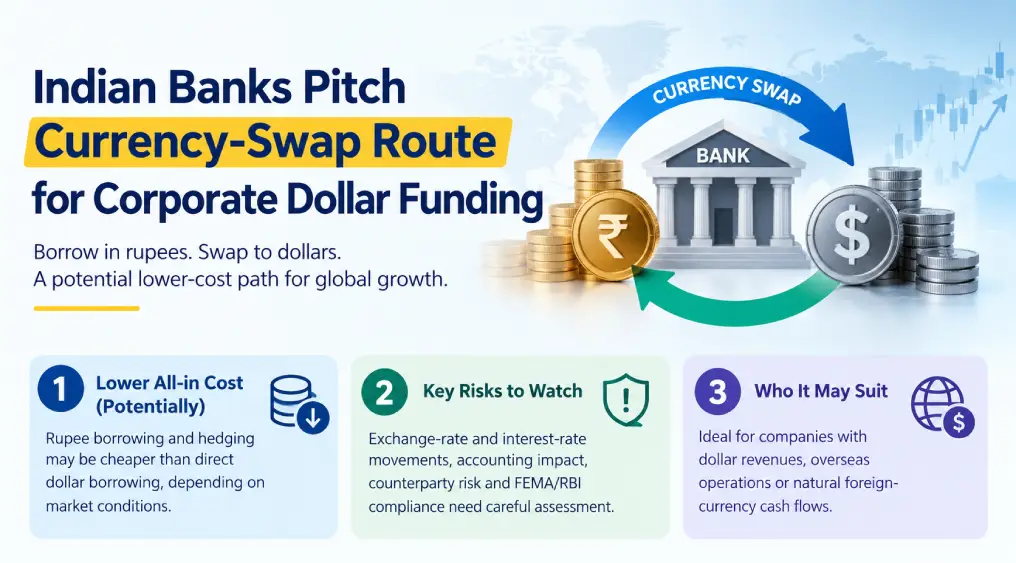
Indian banks are discussing a funding structure that allows large companies to borrow in the domestic bond market and then use a currency swap to exchange rupee cash flows for dollar cash flows. Discussions are under way for three-to-five-year transactions, although no deal had been executed as of now. The structure is mainly being discussed with companies that have dollar revenues or overseas operations.
How the Structure Works
The arrangement broadly involves four steps:
- Rupee borrowing: The company raises funds through domestic bonds or loans.
- Currency swap: It enters into a swap with a bank, exchanging rupee cash flows for dollar cash flows.
- Dollar-linked liability: The rupee borrowing is economically converted into a foreign-currency liability without directly borrowing dollars from an overseas lender.
- Cost comparison: If swap pricing is favourable, the resulting dollar funding cost may be lower than direct offshore borrowing.
An AAA-rated corporate could borrow at around 6%-6.20% for five years in the US market, compared with 8%-8.25% in India, Mint reported. After the swap and forward premium, the reported effective dollar cost could be around 4.75%-5%. However, these are market illustrations, not assured funding costs.
Why Banks Are Pitching the Route
The economics have become more favourable as higher US Treasury yields and dollar borrowing costs have increased the cost of direct dollar funding, while changes in forward premiums have improved the relative economics of rupee borrowing followed by a swap. Reports suggest that recent RBI dollar-rupee FX swap activity has affected cross-currency funding conditions for Indian firms.
The structure may be particularly relevant to companies with dollar revenues, overseas operations or other natural foreign-currency cash flows, as these can help manage the currency exposure created by the swap.
Key Risks and Compliance Considerations
A potentially lower funding cost does not eliminate the risks.
- Market risk: Changes in exchange rates and interest rates can affect the value and cost of the swap.
- Accounting impact: Unless applicable hedge-accounting requirements are met, mark-to-market gains or losses may affect the company’s profit and loss.
- FEMA and RBI compliance: The company must assess the applicable foreign-exchange, derivative and risk-management requirements for the proposed transaction.
- Counterparty risk: The company should review the swap bank’s obligations, collateral terms and termination provisions.
The reported structure is priced using Mumbai Interbank Forward Outright Rate (MIFOR), making the final economics dependent on prevailing market conditions.
FAQs
What is dollar funding through a currency swap?
It involves raising rupee debt and entering into a currency swap with a bank to create a dollar-linked liability.
Which companies may consider this structure?
It may be relevant to companies with dollar revenues, overseas operations or natural foreign-currency cash flows.
What are the main risks?
Key risks include exchange-rate and interest-rate movements, derivative valuation, accounting treatment, counterparty exposure and applicable FEMA/RBI requirements.
Setindiabiz Support
Setindiabiz supports businesses with regulatory documentation, FEMA compliance and ongoing corporate compliance. For companies evaluating foreign-currency funding structures, our support can include reviewing the proposed structure, identifying applicable regulatory requirements and assessing documentation before execution.
Rupee borrowing combined with a currency swap is being pitched by Indian banks as an alternative funding structure for corporates with foreign-currency exposure. Its attractiveness depends on the all-in cost after hedging, the company’s underlying exposure and the applicable accounting and regulatory requirements. Businesses should therefore compare the complete funding cost rather than rupee and dollar interest rates alone.
In This Article
Author Bio

Setindiabiz Editorial Team is a multidisciplinary collective of Chartered Accountants, Company Secretaries, and Advocates offering authoritative insights on India’s regulatory and business landscape. With decades of experience in compliance, taxation, and advisory, they empower entrepreneurs and enterprises to make informed decisions.
