
Overview: GST collections remained strong in the first half of FY 2027, but GST revenue from imports rose 27.1%, much faster than domestic GST revenue. The trend is relevant for importers because import transactions create compliance records across customs and GST systems. Businesses need to keep Bills of Entry, import IGST, GSTIN details, GSTR-2B and eligible ITC properly aligned.
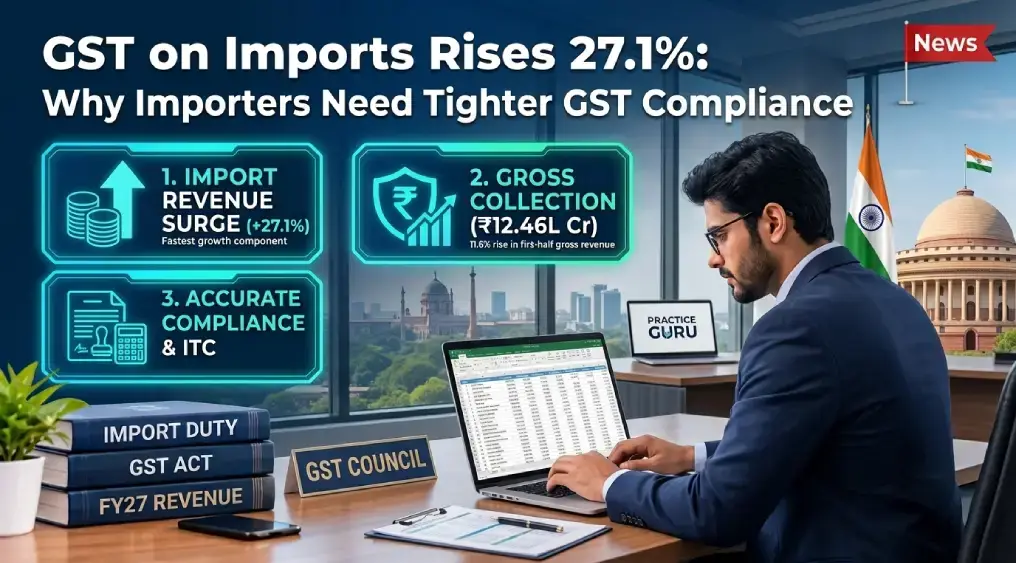
India’s Goods and Service Tax collections grew strongly during April-September 2026, with GST on imports emerging as a significantly faster-growing component. While overall gross GST collections increased 11.6%, revenue from imports rose 27.1% during the period.
The difference matters for businesses that regularly import goods. Payment of IGST at customs is only one part of the process. The corresponding Bill of Entry, GSTIN, import IGST and GST records must also remain aligned when eligible input tax credit is claimed.
GST on Imports Grows Faster in H1 FY27
India’s gross GST collections rose 11.6% year-on-year to ₹12.46 lakh crore during April-September 2026. GST revenue from imports increased 27.1% to ₹3.72 lakh crore, while domestic gross GST revenue grew 6.1%.
The faster growth in GST on imports made it a significant contributor to the increase in overall GST collections during the first half of FY27.
The trend continued in September. Gross GST collections increased 14.7% to ₹2.04 lakh crore, while GST revenue from imports rose 25.9% to ₹65,525 crore. Domestic GST collections increased 10.1% to ₹1.38 lakh crore.
For importers, these figures also bring greater attention to the compliance trail created by each import transaction.
Why GST Compliance Matters for Importers
Businesses importing machinery, components, raw materials or finished goods need to track more than the tax paid at customs. The Bill of Entry, GSTIN, import IGST and GST records should remain properly aligned when eligible ITC is claimed.
Common areas requiring attention include:
- GSTIN on the Bill of Entry: The correct GSTIN should be linked to the import transaction.
- IGST paid on imports: The amount should be reconciled with the relevant Bill of Entry.
- GSTR-2B records: Import information received from Indian Customs Electronic Gateway (ICEGATE is reflected in the import section of GSTR-2B.
- Bill of Entry amendments: Relevant changes to import records need to be tracked and reconciled.
- ITC eligibility: Import IGST should be claimed only where the applicable GST conditions are satisfied.
GSTN states that GSTR-2B contains import information received from ICEGATE and includes original as well as amendment records for Bills of Entry. Taxpayers are advised to reconcile GSTR-2B with their own records and books of account.
From Bill of Entry to Import-Related ITC
Imports of goods are treated as inter-State supplies under the GST framework.
IGST is levied and collected on imported goods through the customs process, as applicable. The importer files the Bill of Entry (BoE) through the customs process and pays the applicable customs duties and IGST required for clearance.
For a registered business, eligible IGST paid on imports can generally be claimed as Input Tax Credit, subject to the applicable GST conditions and documentation. The Bill of Entry is an important document for import-related ITC.
Import information is received by the GST system from ICEGATE and reflected in the relevant section of GSTR-2B. Where a Bill of Entry does not appear, the GST Portal provides a Search BoE facility through which taxpayers can search the record and, where required, raise a query with ICEGATE.
The GST Portal also provides an “Import of Goods” section in the Invoice Management System (IMS), where taxpayers can view Bills of Entry and relevant amendments, including specified value and GSTIN amendments.
For businesses with frequent imports, customs clearance and GST compliance therefore need to be viewed as connected processes. Regular reconciliation can help identify mismatches before they create reconciliation issues or affect the management of eligible import-related ITC.
Watch
Setindiabiz Support
Setindiabiz supports import-oriented businesses with the compliance work connecting GST registration, import documentation, import IGST and ITC reconciliation. This includes:
- GST registration and ongoing GST compliance for businesses engaged in importing goods.
- Import IGST and ITC reconciliation with Bills of Entry, ICEGATE and GSTR-2B.
- Review of GSTIN, Bill of Entry and tax-credit mismatches that may require correction or reconciliation.
- Support with GST return filing, ITC management and refund-related documentation, wherever applicable.
- Ongoing compliance support for MSMEs, manufacturers, traders and businesses importing machinery,, components, raw materials or finished goods.
For an import-oriented business, GST compliance does not stop when goods are cleared through customs. The Bill of Entry, import IGST, GSTIN, GSTR-2B and eligible ITC need to remain properly documented and reconciled. Setindiabiz supports businesses in managing this compliance chain across their regular import transactions.
FAQs
Can a business claim ITC on GST paid on imported goods?
Yes. A GST-registered importer can generally claim eligible IGST paid on imports as Input Tax Credit (ITC) , subject to the applicable GST conditions and proper documentation. The Bill of Entry is an important document for import-related ITC. Basic Customs Duty is not available as GST ITC.
What should an importer do if import IGST is not appearing in GSTR-2B?
Import IGST information is received by the GST Portal from ICEGATE. The taxpayer can use the GST Portal’s Search BoE facility to check the relevant Bill of Entry and, where required, raise a query with ICEGATE. The Bill of Entry, GSTIN and IGST amount should also be reconciled before claiming the corresponding eligible ITC.
Which records should regular importers reconcile?
Importers should regularly reconcile their Bills of Entry, GSTIN details, import IGST, ICEGATE records and GSTR-2B , while tracking relevant amendments to Bills of Entry. This is particularly important for businesses handling frequent imports or multiple customs transactions.
Conclusion
The latest GST data shows that GST revenue from imports is growing considerably faster than domestic GST revenue, making imports an important contributor to India’s overall GST revenue growth. For businesses engaged in importing goods, the trend reinforces the need for accurate Bill of Entry details, correct GSTIN reporting, timely reconciliation and proper utilisation of eligible import-related ITC.
In This Article
Author Bio

Setindiabiz Editorial Team is a multidisciplinary collective of Chartered Accountants, Company Secretaries, and Advocates offering authoritative insights on India’s regulatory and business landscape. With decades of experience in compliance, taxation, and advisory, they empower entrepreneurs and enterprises to make informed decisions.
