
Overview: Securities Exchange Board of India has approved a new framework for portfolio management services (PMS), replacing the 2020 regulations. The PMS Regulations 2026 broaden the investment avenues available to portfolio managers, including foreign securities, Initial Public Offerings (IPOs), primary-market debt and specified unlisted debt. The framework also introduces the Portfolio Managers Route for Investing in Mutual Fund units (PRIM).
The portfolio management landscape is set for a wider investment canvas. SEBI’s approval of the PMS Regulations 2026 opens up additional avenues for portfolio managers, from overseas securities and IPOs to primary-market debt and eligible unlisted debt. The new PRIM route also brings direct mutual fund investments into the PMS framework.
SEBI’s approval of the new PMS framework gives portfolio managers more investment choices. The key changes include foreign securities, IPOs, primary-market debt, eligible unlisted debt and the new PRIM route for direct mutual fund investments. PMS firms now need to focus on understanding the new provisions and preparing for the operational and compliance requirements that will follow.
SEBI Approves New PMS Framework
SEBI has approved the SEBI (Portfolio Managers) Regulations, 2026 at its Board meeting on 24th September, 2026. The revision supersedes the 2020 regulations. SEBI said the review is aimed at developing the PMS industry, easing compliance, consolidating the regulatory framework and removing redundant provisions.
The changes are relevant to existing PMS firms as well as financial businesses exploring new investment strategies or expansion into portfolio management.
Key Changes Under PMS Regulations 2026
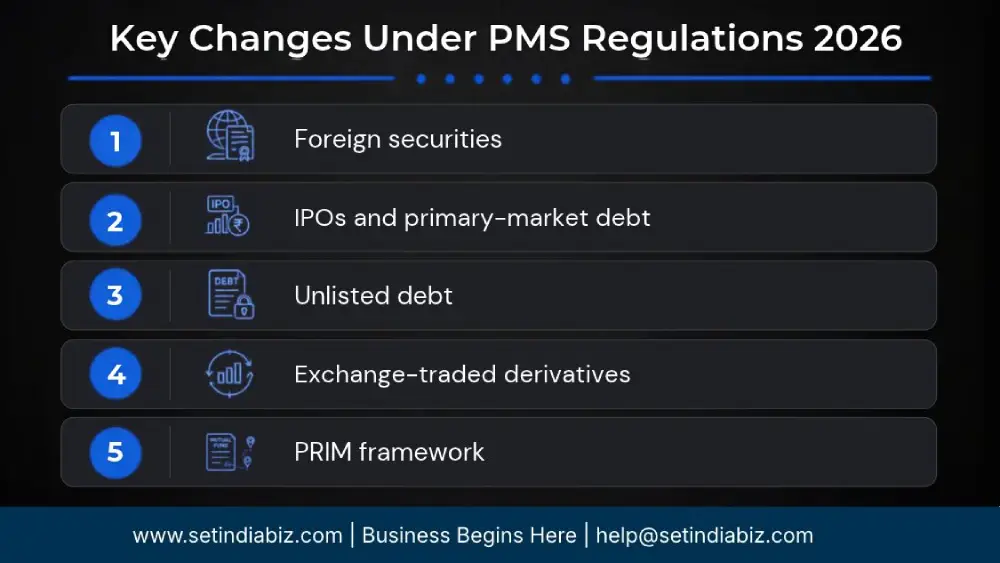
The approved framework broadens the investment avenues for portfolio managers.
Foreign securities
Both discretionary and non-discretionary PMS can invest in specified foreign securities, including listed equity and debt, REITs, overseas mutual funds, ETFs, index funds and foreign government debt, subject to applicable FEMA, RBI and other regulatory requirements. Watch: ODI vs OPI – 3 Tests to Classify Overseas Investments (FEMA Rules)
IPOs and primary-market debt
Portfolio managers will be permitted to invest client funds in IPOs and primary-market debt issuances.
Unlisted debt
Discretionary PMS can invest up to 10% of a client’s AUM in eligible unlisted debt securities, subject to the prescribed conditions and client consent.
Exchange-traded derivatives
The framework provides greater flexibility for investment in exchange-traded derivatives, with exposure permitted up to 1.25 times the client’s AUM, subject to the applicable conditions.
PRIM framework
The new Portfolio Managers Route for Investing in Mutual Fund units (PRIM) will allow portfolio managers to invest client funds in direct plans of eligible mutual fund schemes, including ETFs, index funds and Specialised Investment Funds (SIFs). The minimum investment under this route is ₹25 lakh.
PMS Framework: Key Changes at a Glance
| Area | Approved Changes |
|---|---|
| Overseas investment | Specified foreign securities permitted, subject to applicable conditions. |
| IPOs | Portfolio managers permitted to invest in IPOs. |
| Primary-market debt | Portfolio managers permitted to invest in primary-market debt issuances. |
| Unlisted debt | Up to 10% of client AUM under eligible discretionary PMS investments, subject to conditions. |
| Mutual funds | PRIM route introduced for eligible direct mutual fund plans. |
| Derivatives | Greater flexibility, with exposure up to 1.25 times client AUM. |
Operational Impact for PMS Firms
PMS firms will have more investment options, but each new avenue brings its own operational and compliance requirements.
For example, overseas investments will require firms to manage foreign-exchange rules, currency exposure and applicable regulatory requirements. Unlisted debt will require proper due diligence and monitoring, while derivatives will need appropriate exposure and risk controls.
The new investment avenues will involve more than changes to investment strategies. PMS firms may also need to review their policies, client documentation, internal controls, risk-management systems and compliance processes.
The PRIM route also creates a new operating model for PMS businesses that want to offer direct mutual fund investments, ETFs, index funds or SIFs through the permitted route.
The ₹25 lakh threshold makes this category distinct from the existing PMS investment threshold, so firms will need to understand the specific conditions applicable to PRIM before offering it to clients.
What PMS Firms Need to Review
The new framework gives PMS firms more investment options, but those changes will also affect how portfolios are managed and monitored. Firms looking to use the new provisions may need to review:
- Investment and risk-management policies
- Overseas investment and currency-exposure processes
- Client agreements, disclosures and consent requirements
- Due diligence and monitoring for unlisted debt
- Controls around derivatives exposure
- Existing compliance processes and documentation
The 2026 framework has been approved by SEBI. However, the 2020 PMS Regulations continue to appear in SEBI’s regulations database. Firms should therefore track the formal notification and implementation requirements before putting the new provisions into practice.
PMS Operations: What Changes
The new framework changes more than the list of investments available to PMS firms. It also affects how firms handle investments, risk and compliance.
Overseas investments will bring foreign-market and currency considerations. Unlisted debt and derivatives will require appropriate due diligence, monitoring and exposure controls. The PRIM route will have its own operating and disclosure requirements.
The framework also introduces Independent Fund Managers (IFMs), which can manage and operate client portfolios in association with a registered portfolio manager, while the registered portfolio manager remains responsible for the relevant activities.
FAQs
What are the PMS Regulations 2026?
The PMS Regulations 2026 are the new framework approved by SEBI to replace the existing 2020 regulations governing portfolio managers. The framework expands the permissible investment avenues for PMS, including specified foreign securities, IPOs, primary-market debt and certain unlisted debt securities. It also introduces PRIM for investment in eligible direct mutual fund plans.
Can PMS firms invest in foreign securities under the new framework?
The approved framework enables both discretionary and non-discretionary portfolio managers to invest in specified foreign securities. These include listed overseas equity and debt, REITs, overseas mutual funds, ETFs, index funds and foreign government debt, subject to applicable FEMA and RBI requirements.
What is PRIM under the PMS Regulations 2026
PRIM stands for Portfolio Managers Route for Investing in Mutual Fund units. Under the approved framework, portfolio managers can invest client funds in direct plans of eligible mutual fund schemes, including ETFs, index funds and SIFs. The minimum investment threshold under PRIM is ₹25 lakh.
What is the limit for unlisted debt investments under the new PMS framework?
Under discretionary PMS, portfolio managers can invest up to 0% of a client’s Assets Under Management (AUM) in investment-grade, non-convertible, unlisted debt securities, subject to client consent and other applicable conditions.
What should PMS firms prepare for under the new framework?
PMS firms should review their investment policies, risk controls, client documentation, consent mechanisms, due-diligence processes and regulatory compliance systems. Firms planning to use overseas securities, unlisted debt, derivatives or PRIM should also assess the specific conditions applicable to those activities before implementation.
Setindiabiz Support
The PMS Regulations 2026 give portfolio managers a wider investment universe, but taking advantage of these provisions will require corresponding attention to documentation, internal controls and regulatory processes.
Setindiabiz experts support PMS and financial businesses with:
- Regulatory compliance assessment: Reviewing existing processes against applicable PMS requirements and identifying areas that may need updating.
- Documentation and compliance support: Regulatory documentation, internal records and processes connected with new investment activities.
- Business and investment structuring: Supporting businesses in assessing structures and documentation when expanding their PMS activities or investment offerings.
- Overseas investment readiness: Compliance considerations reviews connected with foreign securities and international investment activities.
The PMS Regulations 2026 approved by SEBI broaden the investment universe for portfolio managers through foreign securities, IPOs, primary-market debt, eligible unlisted debt, derivatives and the new PRIM route.
For PMS businesses, the opportunity comes with corresponding operational responsibilities. Firms considering these avenues should review their investment policies, documentation, risk controls and compliance processes, while keeping track of the formal notification and implementation requirements.
In This Article
Author Bio

Setindiabiz Editorial Team is a multidisciplinary collective of Chartered Accountants, Company Secretaries, and Advocates offering authoritative insights on India’s regulatory and business landscape. With decades of experience in compliance, taxation, and advisory, they empower entrepreneurs and enterprises to make informed decisions.
