
Transitioning to 24×7 operating cycles to fulfill international export targets in manufacturing or to handle continuous global client workflows in tech demands a sophisticated approach to shifts and scheduling. A critical focus area for HR departments during round-the-clock expansion is managing late-night staffing.
The modern labour framework significantly improves workplace inclusivity by allowing women to work all shifts. The Occupational Safety, Health and Working Conditions (OSH) Code pairs this openness with strict, non-negotiable female employee safety standards, with particular directives for night shifts.
Simplify Payroll Compliance. 👉 Payroll Services
From an HR and corporate risk perspective, managing night shifts requires rigorous documentation and proactive logistics. Organizations cannot rely on verbal agreements or implied shift rosters.
Operating late-night windows (between 7:00 PM and 6:00 AM) without formal written consent, automated transit solutions, or an active Internal Committee (IC) violates fundamental compliance rules. Any such violation leaves the business vulnerable to heavy fines or license suspensions during labour department checks.
Quick Reference Matrix
| Safety Parameter | Non-Compliant Practice | Statutory OSH Standard |
|---|---|---|
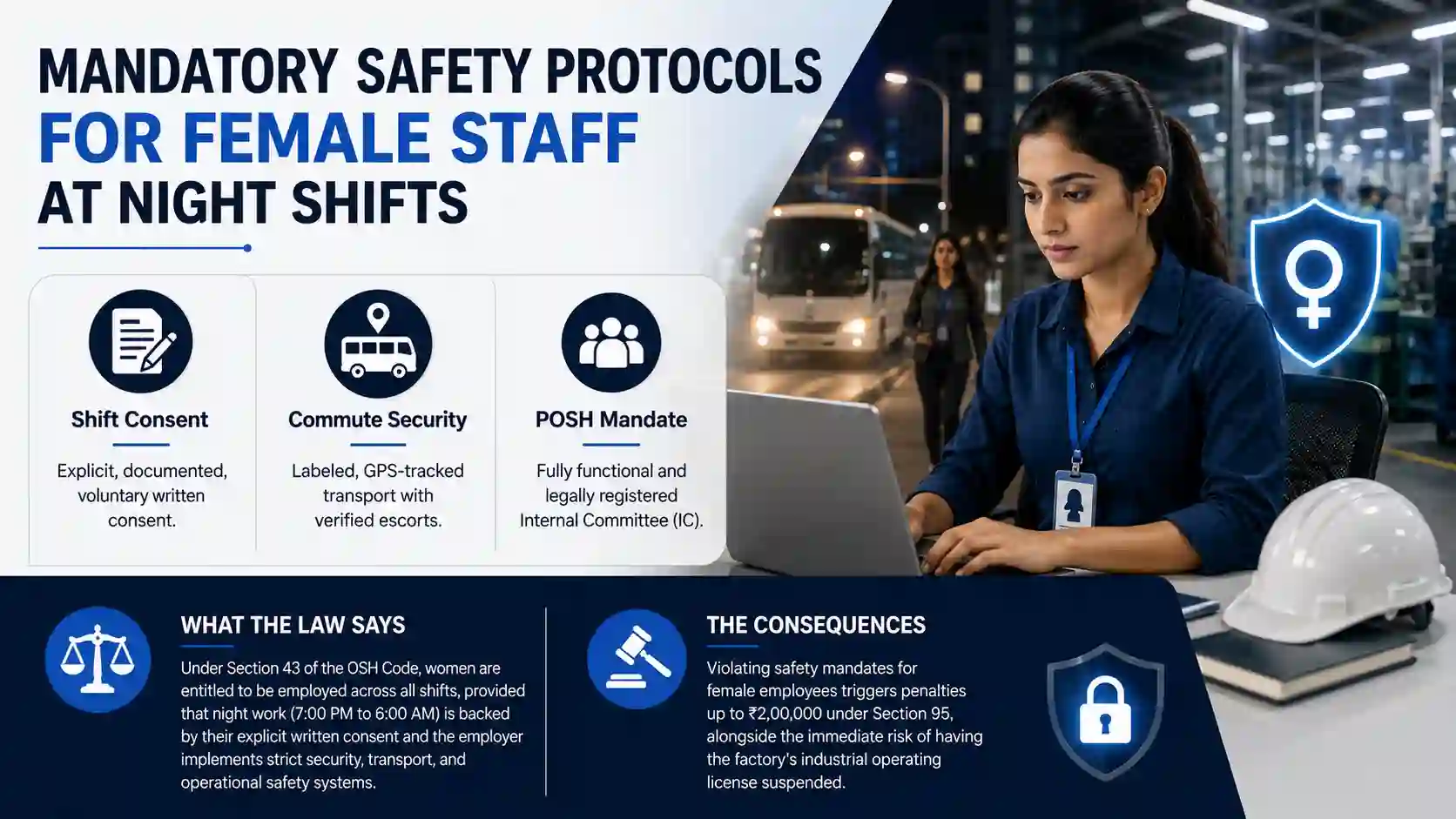
| Shift Consent | Verbal agreements or implied rosters | Explicit, documented, voluntary written consent. |
| Commute Security | Self-managed or unmonitored transit | Labeled, GPS-tracked transport with verified escorts. |
| POSH Mandate | Non-existent or unregistered cell | Fully functional and legally registered Internal Committee (IC). |
Law Points & Consequences
- What the Law Says: Under Section 43 of the OSH Code, women are entitled to be employed across all shifts, provided that night work (7:00 PM to 6:00 AM) is backed by their explicit written consent and the employer implements strict security, transport, and operational safety systems.
- The Consequences: Violating safety mandates for female employees triggers penalties up to ₹2,00,000 under Section 95, alongside the immediate risk of having the factory’s industrial operating license suspended.
FAQs
Is digital or verbal consent sufficient for women working night shifts?
What transport safety features are compulsory?
SETINDIABIZ is your end-to-end single window solution for all compliance and company needs.
In This Article
Author Bio

Vipin Pathak
