
Managing payroll in India requires a delicate balance between optimizing corporate cash flows and maintaining competitive take-home packages for employees. For decades, a standard HR practice involved skewing the Cost to Company (CTC) structure – keeping the basic salary lower (often at 25% to 30%) while expanding uncapped allowances like house rent, travel, and special allowances to minimize statutory contributions toward the Employees’ Provident Fund (EPF) and gratuity.
The implementation of the unified Code on Wages changes this operational reality entirely. The central framework removes the flexibility to split allowances arbitrarily, making older payroll setups non-compliant.
The legal core of this shift lies in how the term “wages” is calculated. If structural allowances of an employee outpace the statutory limit, the organization faces an immediate financial and compliance risk.
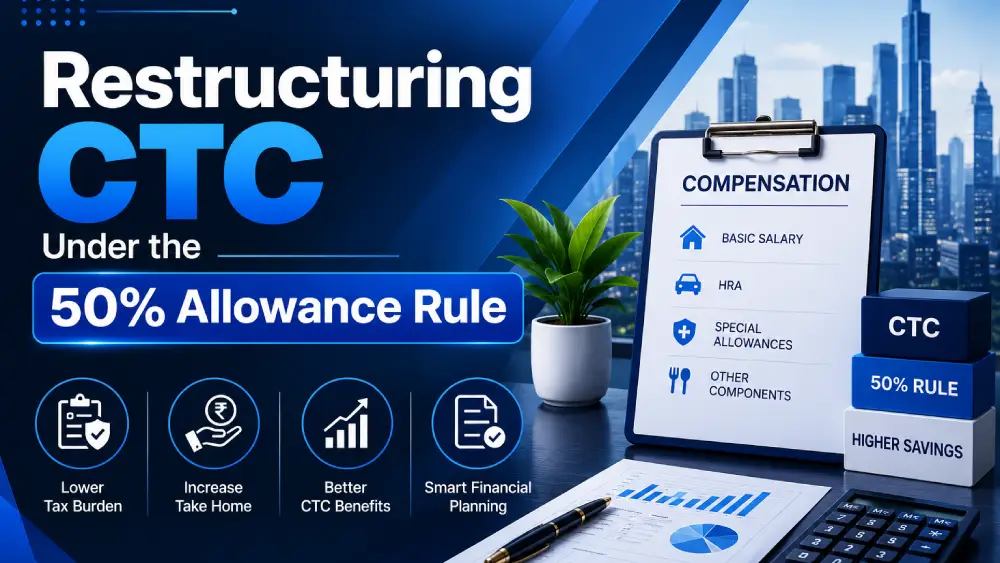
Quick Reference Matrix
| Component | Legacy Payroll Rules | Code on Wages Framework |
|---|---|---|
| Allowance Cap | No statutory limit (often up to 75–80%) | Excluded allowances capped at 50% of total CTC. |
| Deemed Wages | Only nominal basic salary counted for PF/Gratuity | Allowances exceeding 50% automatically become “wages”. |
| Corporate Risk | Low regulatory scrutiny | High audit risk, retroactive dues, and interest liabilities. |
Law Points & Consequences
- What the Law Says: Under Section 2(y) of the Code on Wages, the aggregate of specified excluded allowances cannot exceed 50% of the total remuneration. If it does, the excess amount is legally treated as “wages,” inflating the base used to calculate EPF, ESIC, and Gratuity.
- The Consequences: Non-compliance triggers retroactive payment demands for unpaid statutory dues plus interest. Under Section 54, employers face a fine of up to ₹50,000 for first-time wage-definition violations.
FAQ
Is HRA included in the 50% wage calculation?
The Setindiabiz assists organizations in executing thorough payroll audits, calculating necessary allowances accurately, and systematically redesigning your CTC templates. We help cap excluded allowances at precisely 50% of total remuneration, ensuring your business meets the statutory floor without disrupting your talent’s net compensation structures.
SETINDIABIZ is your end-to-end single window solution for all compliance and company needs.
In This Article
Author Bio

Setindiabiz Editorial Team is a multidisciplinary collective of Chartered Accountants, Company Secretaries, and Advocates offering authoritative insights on India’s regulatory and business landscape. With decades of experience in compliance, taxation, and advisory, they empower entrepreneurs and enterprises to make informed decisions.
