
Balancing variable labor demands with permanent headcount costs is a primary challenge in industrial and manufacturing HR. To optimize balance sheets, many establishments have historically relied heavily on third-party contract labor agencies to staff primary functions – often relabeling core production jobs as “auxiliary support” or “packaging services” to bypass statutory obligations linked to permanent payrolls.
The Occupational Safety, Health and Working Conditions (OSH) Code tightens boundaries around these staffing structures, drawing a firm legal line between core and non-core business activities.
The HR mandate here requires a precise structural distinction. Under the modern codes, utilising contractual workers for an organization’s core business functions is explicitly restricted, unless the company operations are navigating short-term, intermittent spikes or seasonal volume surges. Misclassifying these roles to save on long-term benefits leaves establishments highly vulnerable during labour audits, risking immediate show-cause notices and potential halts to industrial operating licenses.
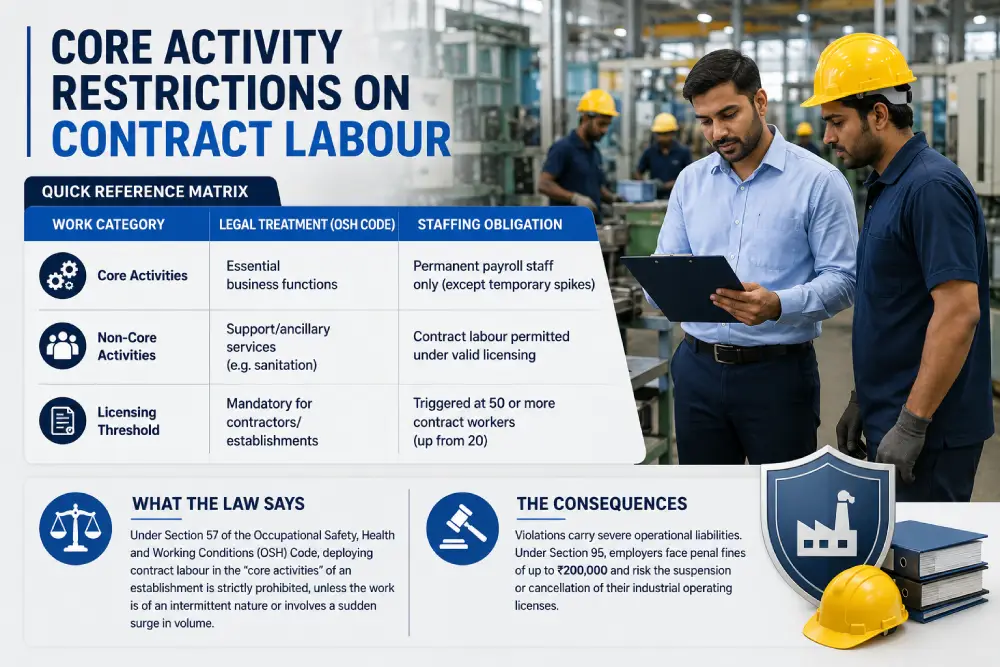
Quick Reference Matrix
| Work Category | Legal Treatment (OSH Code) | Staffing Obligation |
|---|---|---|
| Core Activities | Essential business functions | Permanent payroll staff only (except temporary spikes) |
| Non-Core Activities | Support/ancillary services (e.g. sanitation) | Contract labor permitted under valid licensing |
| Licensing Threshold | Mandatory for contractors/establishments | Triggered at 50 or more contract workers (up from 20) |
Law Points & Consequences
- What the Law Says: Under Section 57 of the Occupational Safety, Health and Working Conditions (OSH) Code, deploying contract labour in the “core activities” of an establishment is strictly prohibited, unless the work is of an intermittent nature or involves a sudden surge in volume.
- The Consequences: Violations carry severe operational liabilities. Under Section 95, employers face penal fines of up to ₹200,000 and risk the suspension or cancellation of their industrial operating licenses.
FAQs
What qualifies as a “core activity” under the OSH Code?
Has the contract labour licensing threshold changed?
Setindiabiz helps manufacturing and commercial organizations navigate this transition through expert workforce restructuring. Our industrial compliance team conducts an exhaustive “Activity Mapping Exercise” to split core operations from genuinely auxiliary support workflows (such as facility security, catering, and sanitation).
We construct structured payroll absorption models for your core workforce while systematically acquiring unified Contractor Licenses for non-core workflows, keeping your business fully compliant.
SETINDIABIZ is your end-to-end single window solution for all compliance and company needs.
In This Article
Author Bio

Setindiabiz Editorial Team is a multidisciplinary collective of Chartered Accountants, Company Secretaries, and Advocates offering authoritative insights on India’s regulatory and business landscape. With decades of experience in compliance, taxation, and advisory, they empower entrepreneurs and enterprises to make informed decisions.
