
Overview: NBFC-MFIs are widening their lending beyond traditional microfinance as repayment stress and a shrinking microfinance portfolio push lenders to diversify. A Reserve Bank of India rule change in June 2025 reduced the qualifying-assets requirement from 75% to 60%, giving these institutions greater flexibility to finance other borrowers, including micro, small and medium enterprises (MSMEs).
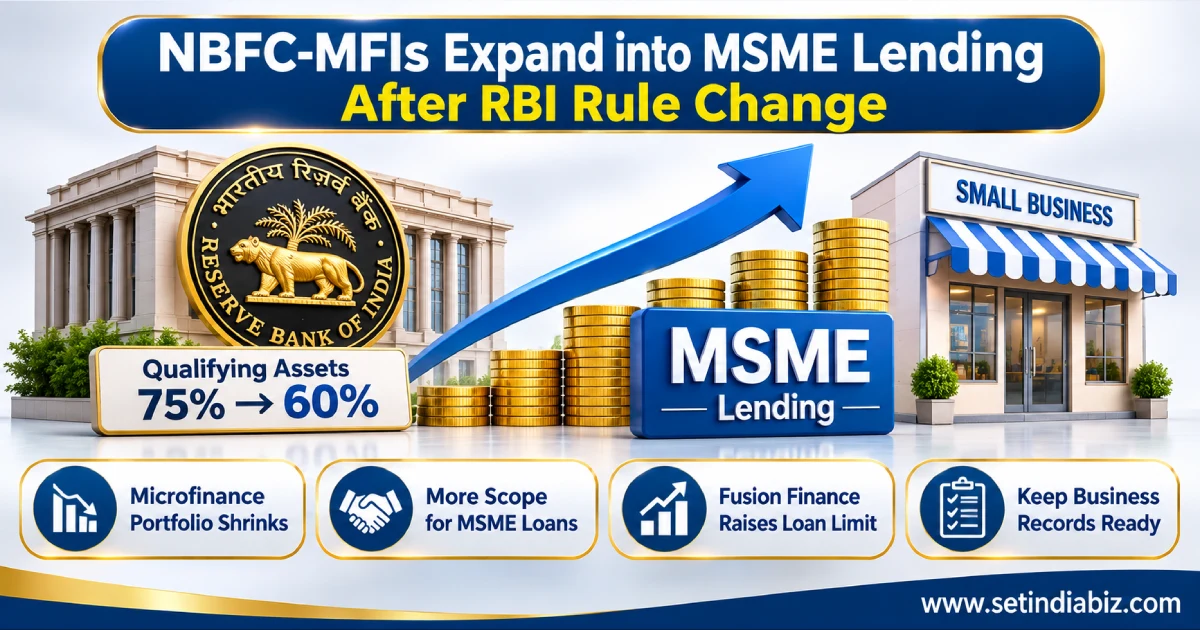
The shift is beginning to show in lenders’ products. In November 2026, Fusion Finance announced that it had raised the maximum ticket size of its MSME loans from ₹25 lakh to ₹50 lakh. The move reflects a wider change in the microfinance sector, where lenders are looking beyond small group-based loans and exploring a larger role in business lending.
The change comes against a difficult backdrop for microfinance. Data from CRIF High Mark shows that the sector’s portfolio and borrower base have contracted over the past year. For NBFC-MFIs, expanding into MSME lending offers another source of business, although it also brings different credit-assessment and documentation requirements.
What changed in the RBI’s qualifying-assets rule
The Reserve Bank of India (RBI) issued a circular, on 6th June, 2025, reviewing the qualifying-assets criteria for NBFC-MFIs. The earlier requirement was that qualifying assets should account for at least 75% of an NBFC-MFI’s total assets, after deducting intangible assets. The revised threshold is 60%.
Qualifying assets are aligned with the RBI’s definition of microfinance loans. The revised rule therefore gives NBFC-MFIs more room to hold assets outside this category, including loans to businesses that do not qualify as microfinance borrowers.
The reduction does not mean that the remaining 40% must, or will, be used for MSME lending. Each lender decides its lending mix based on its business strategy, funding, risk appetite and regulatory requirements.
The 60% threshold must be maintained on an ongoing basis. If an NBFC-MFI fails to meet it for four consecutive quarters, it must approach the RBI with a remediation plan. The revised requirement took effect immediately from the date of the circular.
Microfinance contraction adds to the pressure to diversify
CRIF High Mark’s Microlend Quarterly – November 2026 report, based on data up to September 2026, points to a contraction in the sector.
The gross loan portfolio stood at ₹3.284 lakh crore, down 5% year-on-year. Active loans fell 22.4% to 9.6 crore, while the live customer base declined 15% to 6.4 crore.
At the same time, portfolio-at-risk (PAR) indicators improved. Loans overdue by 31-90 days accounted for 0.8% of the portfolio, compared with 1.8% a year earlier. The 91-180-day PAR also fell from 2.7% to 0.8%.
These figures show two developments: the microfinance portfolio has reduced, while the reported early and later overdue indicators have improved. Lenders are therefore assessing opportunities beyond their traditional borrower base rather than relying only on conventional microfinance products.
Fusion Finance increases its MSME loan limit
Fusion Finance provides a recent example of this shift. The company expanded its secured MSME loan offering in FY 2025-26, increasing the ticket-size range from ₹1-15 lakh to ₹1-25 lakh. It introduced the ₹15-25 lakh segment in October 2025.
On 2nd November, 2026, the company’s board approved a further increase in the maximum MSME loan ticket size, from ₹25 lakh to ₹50 lakh.
The company’s diversification plans extend beyond MSME loans. In a November 2026 interview, its Managing Director and CEO, Sanjay Garyali, said non-microfinance products could account for 35% of the company’s disbursements over the next three years. These products include MSME loans, individual loans and premium joint liability group loans.
This is a company-specific business target, not a projection for the entire NBFC-MFI sector. However, it illustrates how lenders are using the regulatory flexibility to broaden their product mix.
What MSMEs should prepare before approaching lenders
A wider range of lenders and loan products does not remove the need for proper business records. An MSME seeking a loan should be ready to explain how the business operates, earns revenue and manages its cash flow.
The Ministry of MSME’s Know Your Lender, Grow Your Business handbook identifies documents commonly relevant to loan applications. These include:
- Business identity: PAN, Aadhaar details of the proprietor or relevant persons, Udyam Registration and business-address proof.
- Tax records: GST registration and returns, where applicable, along with income-tax returns.
- Financial information: Bank statements, financial statements and details of existing loans and repayment obligations.
- Business details: Ownership information, business activity, sales records and details of the purpose for which the loan is required.
These records help lenders check the identity and operations of the business, compare declared sales with bank and tax records, and assess its ability to repay.
Setindiabiz Support
MSMEs should keep their Udyam details, GST records and books of account accurate and up to date. Setindiabiz provides business registration and compliance services, including Udyam Registration, GST registration and accounting-related support. Businesses preparing for larger borrowing requirements may also need structured financial information, such as a CMA report or a project report for a bank loan. The lender will determine which documents are required for a particular application.
FAQs
Qualifying assets must account for at least 60% of an NBFC-MFI’s total assets after deducting intangible assets. The earlier threshold was 75%.
No. The rule gives NBFC-MFIs greater flexibility to diversify their assets. Individual lenders decide whether to offer MSME loans and assess applications according to their own lending policies.
Commonly requested records include business identity and address documents, Udyam details, GST returns where applicable, income-tax returns, bank statements and financial statements. Requirements vary by lender and loan type.
The RBI’s revised qualifying-assets threshold has given NBFC-MFIs more room to diversify, while contraction in the microfinance portfolio has added to the business case for exploring other lending segments. The extent of this shift will depend on lenders’ ability to assess business borrowers and manage credit risk. For MSMEs, reliable financial records, tax compliance and clear business documentation will remain important when seeking finance.
