
Overview: The Centre is considering a 2% transaction-linked contribution from aggregators to fund social security benefits for gig and platform workers. The proposed calculation may focus on revenue directly attributable to gig activity rather than an aggregator’s entire turnover. The National Social Security Board is expected to discuss the scheme in November 2026. The proposal is not yet notified.
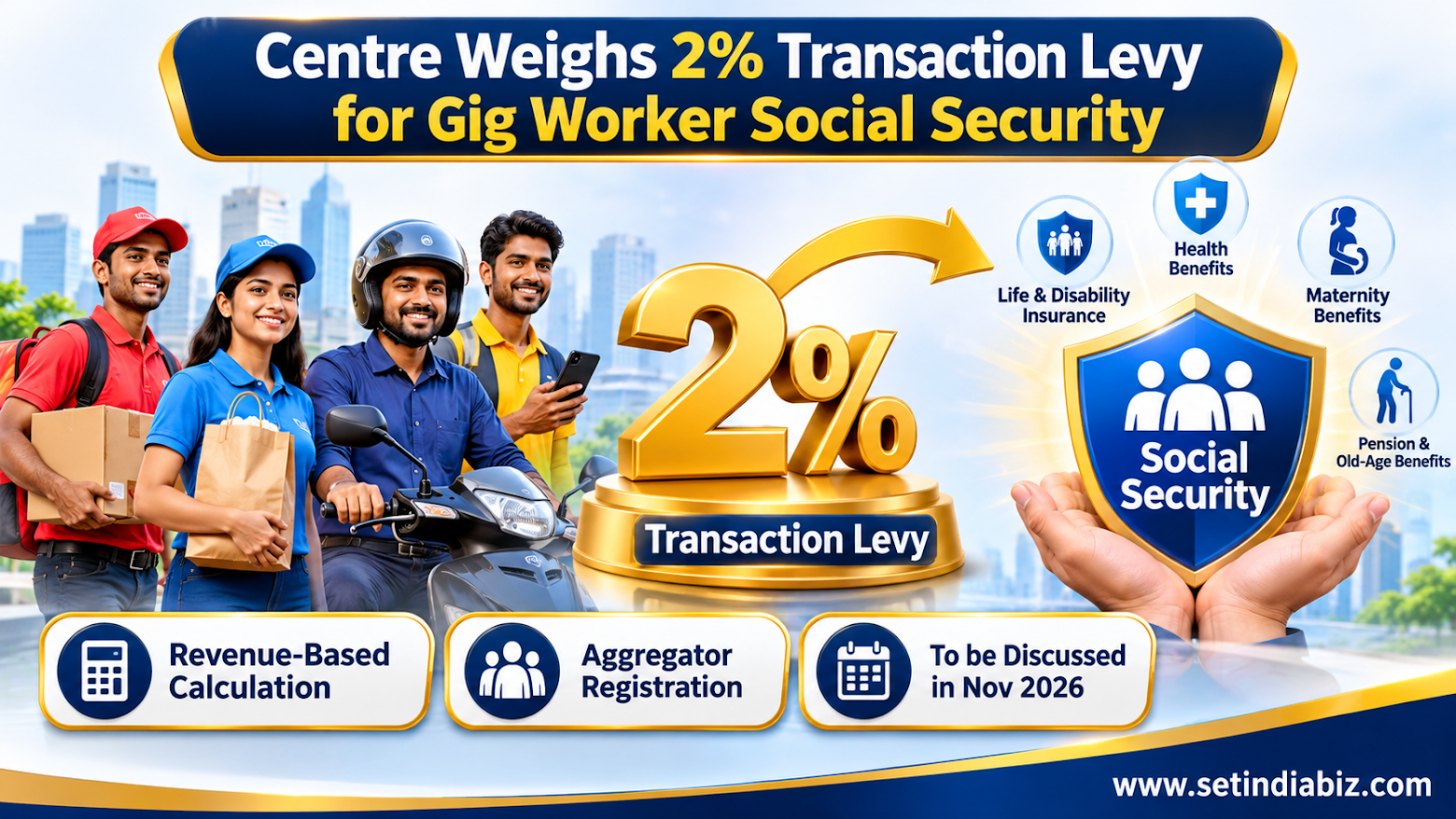
The Union Government is considering a 2% transaction-linked contribution from aggregators to finance social security benefits for gig and platform workers. The proposal is expected to be discussed by the National Social Security Board in November 2026. While the proposed levy is yet to be finalised, aggregators already have worker registration and reporting obligations under the Social Security (Central) Rules, 2026.
The proposed levy could change how digital platforms contribute towards social security for delivery partners, drivers and other platform-based workers. While the financial contribution remains under discussion, aggregator registration and worker-data reporting are already covered by the Social Security (Central) Rules, 2026.
Proposed 2% levy and its calculation
The proposed approach may focus on revenue directly attributable to gig activity. This is intended to prevent one business segment from bearing the social security cost of another where an aggregator operates multiple business verticals.
The reported proposal envisages funding the Social Security Fund entirely through aggregator contributions, without contributions from gig workers or the Centre, according to an Economic Times report. However, the final rate, calculation method and funding arrangement are yet to receive government approval.
Existing legal framework under Section 114
The proposed levy must be distinguished from the existing contribution framework under Section 114 of the Code on Social Security, 2020.
Section 114(4) provides for a contribution of at least 1% and not more than 2% of annual turnover for aggregators falling within the categories specified in the Seventh Schedule. The contribution cannot exceed 5% of the amount paid or payable to gig and platform workers. Central Government taxes, levies and cess are excluded from the turnover calculation.
However, this statutory contribution is not yet payable. The Central Government must notify the applicable rate and the commencement date under Sections 114(4) and 114(5), respectively. The proposed transaction-linked method is therefore a separate policy development and should not be treated as an amendment to the existing statutory formula.
Benefits proposed for gig workers
The proposed scheme is expected to cover:
- Life and disability insurance.
- Accident insurance.
- Health benefits.
- Maternity benefits.
Pension, provident fund and other old-age benefits may be considered later, depending on workers’ association with platforms.
The Economic Survey 2025-26 reported that India’s gig workforce increased from 7.7 million in FY21 to 12 million in FY25, a rise of 55%. The growing workforce highlights the need for a sustainable social security funding arrangement.
Aggregator registration and reporting requirements
The Social Security (Central) Rules, 2026, notified on 8 May 2026, already prescribe aggregator responsibilities under Rule 48.
Key requirements include:
- Existing workers: Details had to be shared through the designated Central Government portal within 45 days of commencement of the Rules.
- New workers: Details of newly engaged workers must be submitted in real time or daily through an application programming interface (API) or other electronic means.
- Worker exits: Exit details must also be updated in real time or daily.
- Periodic updates: Worker particulars must be shared electronically every month or at another frequency specified on the portal.
These requirements also cover workers engaged through associate, holding or subsidiary companies, LLPs and third parties. Rule 49(5) separately requires every aggregator to register on the designated portal.
For eligibility under social security schemes, Rule 48 provides for at least 90 days of engagement with one aggregator or 120 days across multiple aggregators in the preceding financial year. A day counts when the worker earns income from an aggregator. If a worker is engaged with three aggregators on the same calendar day, it counts as three days.
The initial 45-day reporting period has passed. Aggregators should review their portal registration, worker records and ongoing reporting arrangements. The expiry of the initial period does not, by itself, establish the compliance status of every aggregator.
National Social Security Board and next steps
The Ministry of Labour and Employment constituted the National Social Security Board through Notification S.O. 5884(E), dated 28 October 2026 and published on 29 October 2026. The Board will also function for gig and platform workers under Section 114(6).
The Board is reportedly expected to discuss the proposed scheme in the second half of November. A possible rollout in 2027 has been reported, but no implementation date has been officially announced.
Setindiabiz Support
Platform businesses must maintain proper corporate records and meet their applicable statutory obligations. Setindiabiz supports companies with corporate compliance, statutory filings and employer-side payroll, EPF and ESI compliance for their employees.
FAQs
No. It is still under consideration. The existing Section 114 framework provides for a 1%-2% annual-turnover contribution, subject to a 5% cap on payments to gig and platform workers. Its applicable rate and commencement are yet to be notified.
The proposed benefits include life and disability insurance, accident insurance, health and maternity benefits. Pension and other old-age benefits may be considered later.
Rule 48 provides for at least 90 days with one aggregator or 120 days across multiple aggregators in the preceding financial year, subject to applicable scheme conditions.
The proposed levy could establish a new funding arrangement for gig-worker social security. Until the government finalises and notifies the scheme, aggregators should continue meeting existing worker registration, reporting and record-keeping requirements.
