
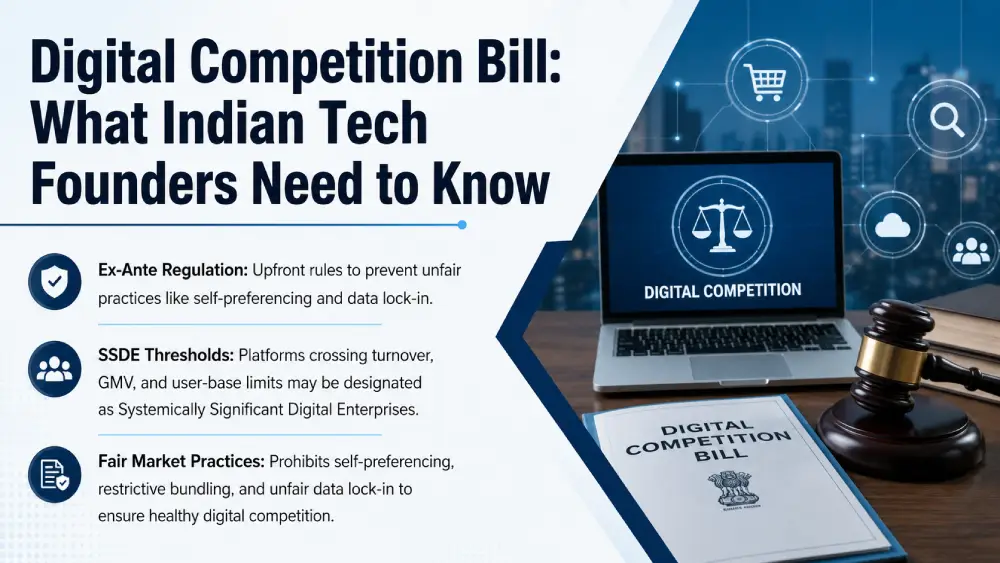
Overview: The Ministry of Corporate Affairs, Government of India, is introducing the Digital Competition Bill to implement preventive regulation for prominent tech platforms. The law establishes a Systemically Significant Digital Enterprise (SSDE) designation based on turnover, merchandise value, and active user thresholds. While designed to curb self-preferencing and data lock-in, revised criteria aims to shield domestic startups from heavy burdens. Tech founders must proactively evaluate platform operations to ensure seamless statutory compliance under evolving corporate governance norms.
India’s digital commerce landscape is on the brink of significant regulatory restructuring. The Ministry of Corporate Affairs (MCA) is preparing to table the Digital Competition Bill (DCB), which introduces preventive (ex-ante) oversight for prominent tech platforms. Designed to curb anti-competitive practices before market tipping occurs, the framework establishes stringent operational benchmarks that scaling Indian digital ventures and aggregators must monitor closely.
Core Regulatory Highlights
- Ex-Ante Regulatory Shift: Moving away from standard post-violation investigations (ex-post), the proposed legislation sets upfront conduct rules to prevent unfair market practices, such as self-favouritism and algorithmic bias.
- Systemically Significant Digital Enterprises (SSDEs): Entities providing Core Digital Services (such as e-commerce platforms, app repositories, search engines, and cloud networks) will face SSDE designation if they meet prescribed turnover, gross merchandise value, or user-base benchmarks.
- Statutory Conduct Demands: Designated entities are prohibited from preferencing their own product lines, bundling disparate services restrictively, or locking in user data away from fair portability.
- Refining Enterprise Thresholds: To prevent premature compliance burdens on domestic startups and expanding tech firms, regulators are reviewing quantitative limits to ensure the scope predominantly governs large, global market gateways.
Frequently Asked Questions
How does ex-ante regulation differ from traditional competition law enforcement?
Are all domestic software and app startups subject to SSDE obligations?
How SetIndiaBiz Can Help
Adapting to shifting MCA frameworks requires proactive legal alignment and structured corporate governance. SetIndiaBiz assists corporate directors, legal leads, and tech founders with tailored advisory services:
- Regulatory Impact Assessments: Evaluating platform models against statutory metrics to determine impending SSDE applicability.
- Corporate Legal Advisory: Drafting commercial contracts, auditing data-sharing agreements, and restructuring vendor terms to ensure full alignment with Indian competition norms.
- Secretarial & Statutory Compliance: Managing mandatory filings, corporate records, and ongoing regulatory reporting seamlessly under one roof.
In This Article
Author Bio

Setindiabiz Editorial Team is a multidisciplinary collective of Chartered Accountants, Company Secretaries, and Advocates offering authoritative insights on India’s regulatory and business landscape. With decades of experience in compliance, taxation, and advisory, they empower entrepreneurs and enterprises to make informed decisions.
