
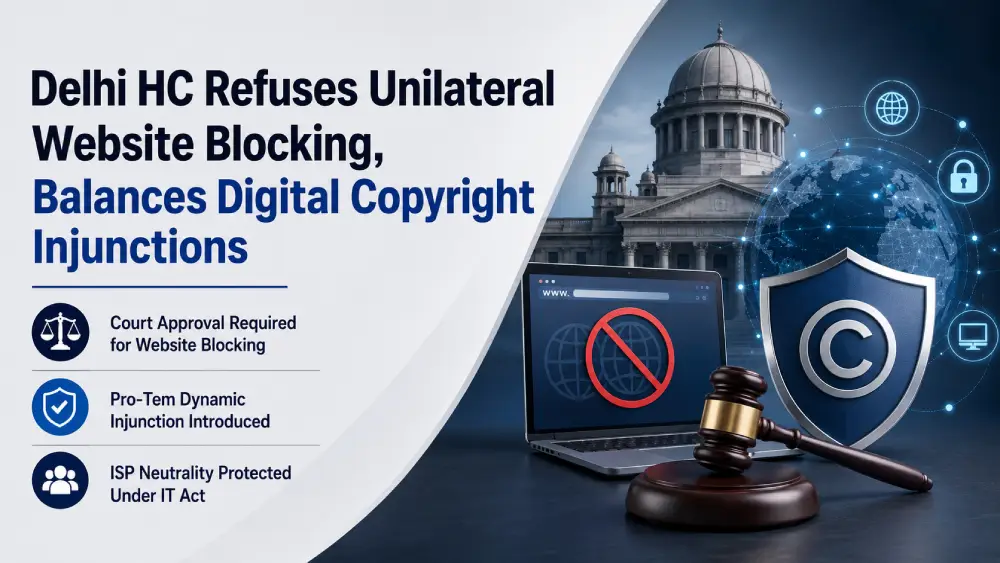
Overview: In a significant copyright ruling (HBO v. Streamzy.to), the Delhi High Court held that neither copyright owners nor intermediaries can unilaterally block “rogue websites” without judicial oversight. To counter recurring piracy, the court established a “pro-tem dynamic injunction” mechanism—allowing temporary technical blocking by ISPs upon affidavit, provided the rights holder simultaneously seeks formal court approval.
In a landmark digital copyright ruling (Home Box Office Inc. & Ors. v. Streamzy.to & Ors.), the Delhi High Court has clarified that neither copyright holders nor internet service providers can independently label a website as “rogue” to block access without judicial approval.
Hearing the commercial suit, Justice Anup Jairam Bhambhani issued an ad-interim injunction preventing 30 illegal streaming platforms from broadcasting copyrighted movies and television shows. The bench noted that these websites functioned as Flagrantly Infringing Online Locations (FIOL), hiding their registrant details behind privacy proxies.
However, the bench cautioned against giving rights owners unchecked blocking powers or turning Internet Service Providers (ISPs) and Domain Name Registrars (DNRs) into pseudo-judges.
Justice Bhambhani stressed that intermediaries must stay neutral under Section 79 of the Information Technology Act, 2000; assigning them decision-making duties could jeopardize their statutory safe-harbour protection.
To tackle the recurring issue of piracy platforms popping up under fresh mirror domains, the court established a pragmatic pro-tem (temporary) dynamic injunction workflow:
- Affidavit Notice: The copyright owner alerts the intermediary about a newly discovered mirror domain with supporting evidence.
- Technical Checking: The ISP or DNR executes a technical check to confirm if the domain is a direct mirror, redirect, or variation of a previously injuncted site.
- Pro-Tem Blocking & Petition: Once verified, the intermediary places a temporary block on the domain while the rights holder simultaneously petitions the court to formally add the site to the suit.
Frequently Asked Questions (FAQs)
Can copyright owners or ISPs block suspected “rogue websites” on their own?
How does the “pro-tem dynamic injunction” process work in practice?
Why is intermediary neutrality so crucial under Indian IT law?
Setindiabiz Help for For IP & Compliance Issues
Handling intricate IP enforcement, dynamic court injunctions, and trademark or copyright protection doesn’t have to be overwhelming. Setindiabiz is India’s premier techno-legal platform, offering end-to-end online legal, tax, compliance, and IPR solutions tailored for startups, enterprises, and international businesses.
In This Article
Author Bio

Setindiabiz Editorial Team is a multidisciplinary collective of Chartered Accountants, Company Secretaries, and Advocates offering authoritative insights on India’s regulatory and business landscape. With decades of experience in compliance, taxation, and advisory, they empower entrepreneurs and enterprises to make informed decisions.
