
Overview: The Union Ministry of Labour and Employment has officially reconstituted the Central Advisory Board under Section 42 of the Code on Wages, 2019, through Gazette Notification S.O. 3985(E). Replacing the previous order from 2019, this statutory step serves as a catalyst for unifying India’s fragmented wage architecture. Chaired by an appointed independent member, the board brings together independent officials, state government delegates, corporate industry bodies, and trade union leaders.
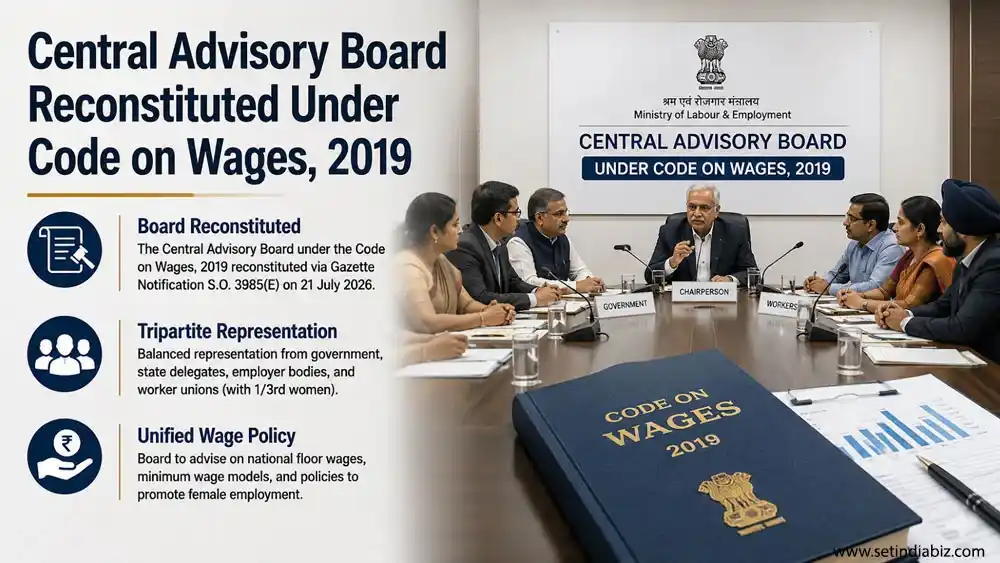
In an essential move towards standardising nationwide wage policy, the Union Ministry of Labour and Employment has reconstituted the Central Advisory Board under Section 42 of the Code on Wages, 2019. The updated Gazette Notification (S.O. 3985(E)), which came into force on 21 July 2026, supersedes the earlier administrative notification issued in January 2019.
The advisory body acts as the primary advisory authority to the Central Government on setting national floor wages, standardising minimum wage calculation models, and developing policies to expand female employment opportunities across sectors.
Tripartite Stakeholder Representation
Chaired by an appointed independent member, the newly structured panel ensures balanced representation across governance, industry, and labour bodies (with women comprising at least one-third of total members):
- Independent & Ministry Members: Senior representatives from the Ministry of Labour & Employment, the Ministry of Micro, Small and Medium Enterprises (MSME), and independent experts.
- State Delegations: Nominated policy delegates from five states (Uttar Pradesh, Odisha, Maharashtra, Andhra Pradesh, and Assam).
- Employer Associations: Industry delegates from bodies including Laghu Udyog Bharati, CII, ASSOCHAM, and the Council of Indian Employers (AIOE).
- Worker Unions: Representatives from prominent labour organisations, including BMS, HMS, SEWA, and UTUC.
Enterprise & Compliance Implications
This reconstitution establishes the foundation for calculating uniform national floor wages. Central sphere establishments, including banking institutions, telecommunications, railways, and mining operations, will need to evaluate their existing compensation structures to align with the forthcoming statutory floor rates.
Frequently Asked Questions (FAQs)
What is the primary function of the Central Advisory Board?
When did this notification take effect?
How does the Central Advisory Board impact private employers?
In This Article
Author Bio

Setindiabiz Editorial Team is a multidisciplinary collective of Chartered Accountants, Company Secretaries, and Advocates offering authoritative insights on India’s regulatory and business landscape. With decades of experience in compliance, taxation, and advisory, they empower entrepreneurs and enterprises to make informed decisions.
