
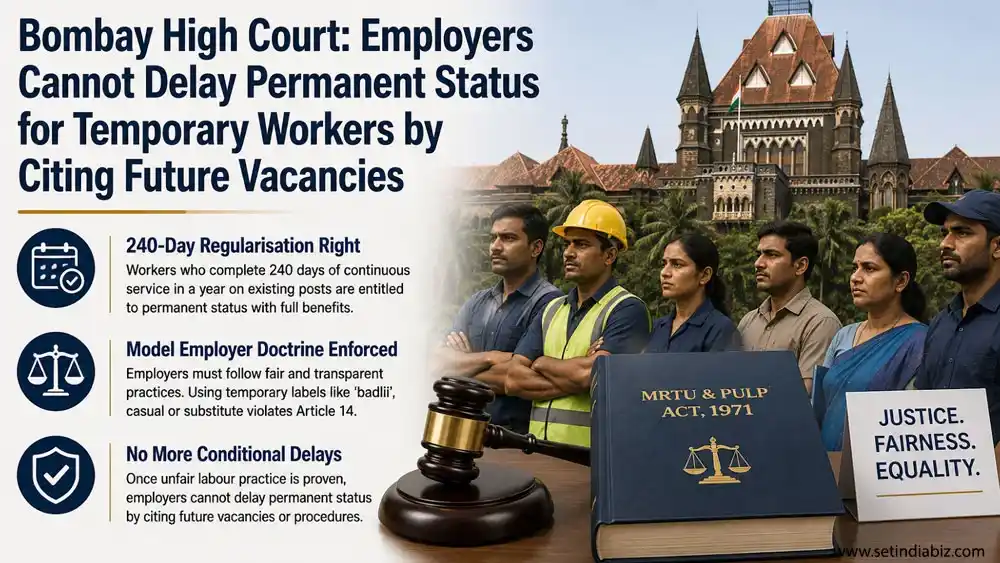
Summary: In a landmark legal precedent under the Maharashtra Recognition of Trade Unions and Prevention of Unfair Labour Practices (MRTU & PULP) Act, 1971, the Bombay High Court (2026 LLR WEB 912) has ruled that once an enterprise engages in unfair employment practices, granting permanent status to eligible staff cannot be deferred by linking it to future vacancy availability or internal reservation recalculations.
The Bombay High Court’s ruling establishes a clear precedent that employers cannot use administrative delays or structural vacancies as a shield against statutory worker rights. By reinforcing the Model Employer Doctrine, the court sends a strong message to both public and private sectors: core operational needs must be reflected in fair, permanent employment terms. For corporate leaders, this serves as a critical call to action to review workforce models and mitigate potential back-pay and litigation risks.
The judgment strongly reinforces that statutory workplace rights supersede administrative delays, penalising the practice of retaining personnel on temporary or daily-wage arrangements indefinitely.
Key Principles Established by the High Court
- Mandatory 240-Day Regularisation Standard: Personnel performing continuous duty for 240 days or more within a single annual cycle on existing roles are entitled to full regular benefits.
- Strict Application of the Model Employer Doctrine: Corporate establishments and public institutions are legally required to maintain transparent employment practices. Using temporary titles like ‘badli’, casual, or substitute worker to circumvent statutory employee entitlements violates constitutional equality protections under Article 14.
- Removal of Conditional Barriers: Once an industrial tribunal or court verifies an unfair labour practice, the employer cannot condition or postpone the worker’s permanent absorption based on procedural excuses or future administrative approvals.
Enterprise Risk & Action Items for Corporate Leadership
Using long-term temporary, contract, or daily-wage staff for core operational roles presents significant legal and financial risks for businesses:
- Workforce Restructuring Under Labour Codes: As India transitions toward unified Labour Codes, maintaining clear employee classifications is critical to avoiding labour tribunal litigation and operational disruptions.
- Back-Pay & Financial Liability: Courts can compel organisations to pay retroactive salary differentials, statutory bonuses, Provident Fund (EPFO), and ESIC contributions for the entire period of temporary engagement.
- Compliance Recommendation: Corporate HR teams should audit their engagement models, worker logs, and service agreements to ensure every long-term resource aligns with statutory definitions and labour welfare norms.
Frequently Asked Questions (FAQs)
What qualifies as an “Unfair Labour Practice” regarding temporary employees?
Does completing 240 days automatically guarantee permanent status?
How does this ruling impact private companies and corporate employers?
SETINDIABIZ Helps Employers Maintain Statutory Compliance
Navigating India’s evolving labour legal framework requires proactive HR governance and rigorous documentation. SETINDIABIZ provides complete, technology-driven legal and corporate advisory services to keep your enterprise audit-ready.
In This Article
Author Bio

Setindiabiz Editorial Team is a multidisciplinary collective of Chartered Accountants, Company Secretaries, and Advocates offering authoritative insights on India’s regulatory and business landscape. With decades of experience in compliance, taxation, and advisory, they empower entrepreneurs and enterprises to make informed decisions.
