
Overview: Closing a business or ending GST registration need not involve a lengthy cancellation process. From 1st December, 2026, revised Rule 20 of the CGST Rules provides for electronic cancellation through the GST portal when prescribed returns have been filed and outstanding dues have been paid. The change removes the earlier ₹2.5 lakh B2B output-tax condition and three-day GSTR-10 requirement for automatic cancellation.
GST registration does not end automatically when a business closes, stops making taxable supplies or becomes ineligible for registration. The registered person had to apply for cancellation, settle the applicable tax liabilities and complete the required returns.
The Central Board of Indirect Taxes and Customs (CBIC) has introduced a two-stage change to this process through Notification No. 05/2026–Central Tax dated 26 October 2026 and Notification No. 08/2026–Central Tax dated 25th November, 2026.
The first notification substituted Rule 20 from 1st November, 2026. The second notification makes a further change to its electronic cancellation mechanism from 1st December, 2026, making the process less dependent on specific turnover-related conditions.
What Changed Under Notification No. 08/202
Notification No. 08/2026–Central Tax, published as G.S.R. 1006(E), introduces the Central Goods and Services Tax (Second Amendment) Rules, 2026.
It substitutes sub-rules (5) and (6) of Rule 20, which govern electronic cancellation and referral to the proper officer.
Under the revised provision:
- Where the prescribed returns have been furnished within their applicable deadlines and all outstanding tax, interest, fees, penalties and other payable amounts have been cleared, the GST portal will cancel the registration electronically.
- The cancellation will take effect from the date requested in the application and will be communicated through FORM GST REG-38.
- Where the prescribed returns or CMP-08 statements, wherever applicable, have not been furnished, or the applicable dues remain unpaid, the application will be forwarded to the proper officer for examination.
This makes electronic cancellation the prescribed route for applications meeting these conditions, rather than restricting it through the earlier special eligibility tests.
₹2.5 Lakh B2B Limit & Three-Day GSTR-10 Rule Dropped
The distinction between the two notifications is important.
Under the version of Rule 20 introduced by Notification No. 05/2026–Central Tax from 1st November, 2026, electronic cancellation was subject to additional conditions. These included:
- The output tax liability on supplies to registered persons, as declared in GSTR-1, amended GSTR-1A, where applicable, or through the Invoice Furnishing Facility, could not exceed ₹2.5 lakh in any month from registration up to the cancellation application. The calculation covered central tax, State or Union territory tax, integrated tax and compensation cess.
- Alternatively, where applicable, the registered person could qualify by filing FORM GSTR-10 within three days from the due date for the remaining returns under Rule 20(3).
Notification No. 08/2026 removes these specific conditions by replacing sub-rules (5) and (6).
The new provision instead focuses on timely filing of the prescribed returns and payment of all outstanding liabilities. The ₹2.5 lakh B2B threshold and the three-day GSTR-10 test are therefore no longer conditions for electronic cancellation from 1 December 2026.
Filing FORM GST REG-16 and Clearing Returns Before Exit
A registered person seeking voluntary cancellation under Section 29(1) of the CGST Act must apply in FORM GST REG-16.
Under the substituted Rule 20, the application must generally be submitted within 30 days of the event requiring cancellation. This 30-day limit does not apply in the event of the death of a sole proprietor.
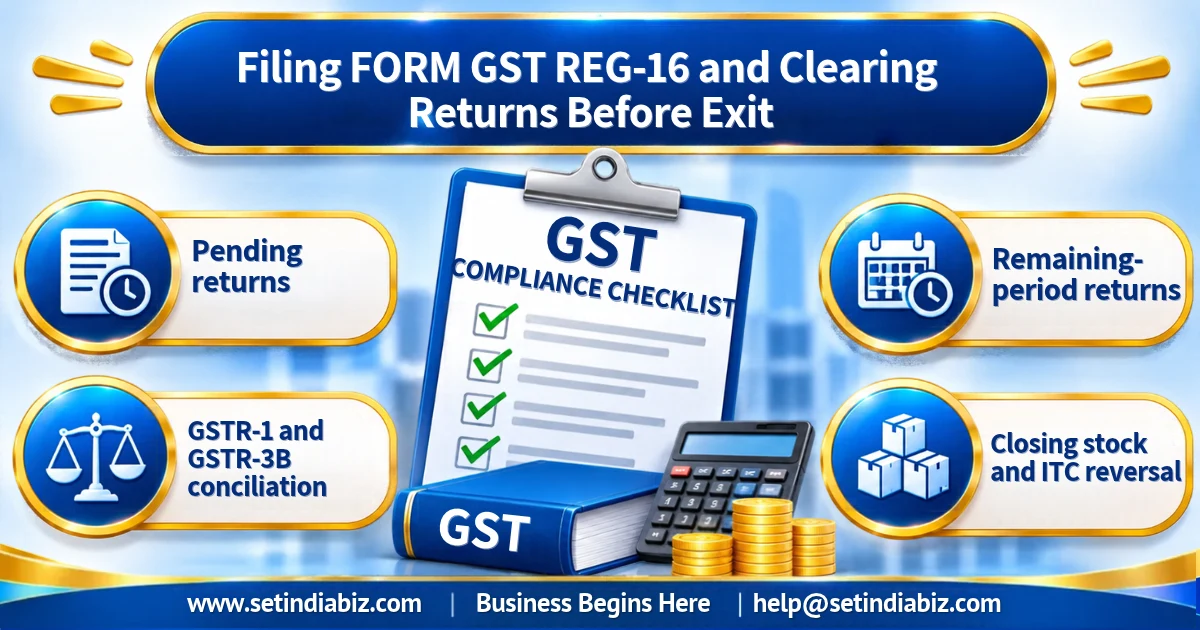
Before filing, businesses should check the following:
- Pending returns: All returns, including FORM GST CMP-08 wherever applicable, due for periods ending on or before the requested cancellation date must be furnished.
- GSTR-1 and GSTR-3B reconciliation: If outward supply details have been furnished in GSTR-1 or through IFF for a tax period, the corresponding GSTR-3B must also be filed before applying.
- Remaining-period returns: Returns for the remaining period up to the application date or the requested cancellation date, as applicable, must be furnished by their respective due dates.
- Closing stock and ITC reversal: The application requires details of inputs held in stock, inputs contained in semi-finished or finished goods, and capital goods or plant and machinery. The associated tax liability must also be calculated and reported.
Under Section 29(5), the amount payable generally involves the relevant input tax credit attributable to such stock or the output tax payable on the goods, whichever is higher. Capital goods are subject to the prescribed reduction for their period of use or the applicable tax on their transaction value, whichever is higher.
From 1st December, 2026, the revised FORM GST REG-16 also provides more detailed stock disclosures and payment particulars.
When the Application Goes to the Proper Officer?
Referral to the proper officer does not automatically mean rejection. Under Rule 20, the officer examines the application and may cancel the registration through FORM GST REG-19 if the application is in order.
If information or documents are missing, the officer can issue a notice in FORM GST REG-03. The applicant must respond through FORM GST REG-04 within 15 days of receiving the notice.
The officer can approve the application through FORM GST REG-19 or reject it through FORM GST REG-05. Failure to submit a reply within the prescribed period can result in deemed rejection through FORM GST REG-05A.
There is also a deemed-approval provision: if the proper officer takes no action within the prescribed 15-day period after receiving the application or the applicant’s reply, as applicable, the application is deemed approved and communicated through FORM GST REG-19.
A further safeguard concerns the effective date. Even after cancellation, the proper officer can initiate proceedings under Rule 20(14) to change the cancellation date to an earlier date where the conditions under Section 29(3) are met.
Final Return (FORM GSTR-10) Rules After Cancellation
Removing the three-day GSTR-10 condition does not remove the obligation to file the final return.
Under Section 45 of the CGST Act, a registered person required to furnish returns under Section 39(1), whose registration has been cancelled, must file the final return in FORM GSTR-10 within three months from the date of cancellation or the date of the cancellation order, whichever is later.
This is a separate statutory obligation. Businesses must also ensure that applicable closing-stock tax and ITC reversal liabilities are properly reported and paid.
Other GST Cancellation Changes to Watch
The 2026 amendment package contains changes with different commencement dates.
- 1st November, 2026: The substituted Rule 20 and revised Rule 21 framework came into force. A corrigendum dated 25th November, 2026, also inserted two additional cancellation grounds under Rule 21: not conducting business from the declared place of business and issuing invoices without an actual supply in violation of the Act or Rules.
- 1st December, 2026: The revised Rule 20(5) and (6), changes to FORM GST REG-16 and related Rule 44 amendments take effect.
- 1st April, 2027: Further changes to Rules 21A, 22 and the new Rule 23A concerning suspension, cancellation and system-based revocation of registration take effect.
Businesses should therefore avoid treating the entire 2026 amendment package as a single change effective from November or December.
GST Compliance Support from Setindiabiz
Closing a business involves more than submitting a GST cancellation application. Pending GSTR-1 and GSTR-3B mismatches, unfiled returns, closing-stock valuation and incorrect ITC reversals can delay cancellation or lead to further scrutiny.
Setindiabiz assists businesses with GST registration and compliance requirements, including return-related compliance, reconciliation and documentation. During business closure or restructuring, the focus should be on settling the GST position correctly, preparing FORM GST REG-16, accounting for stock-related liabilities and completing the final return within the statutory deadline.
For companies undergoing closure, merger or restructuring, GST cancellation should also be coordinated with the applicable corporate and other statutory compliance requirements.
FAQs
No. Electronic cancellation applies where the prescribed returns have been filed within the specified time and all applicable dues have been paid. Applications involving outstanding returns or unpaid liabilities are referred to the proper officer.
November, 2026. Notification No. 08/2026 removes this condition from 1st December, 2026.
No. Rule 20(2) requires applicable pending returns to be furnished before the application. It also requires GSTR-3B to be filed for a tax period where GSTR-1 or IFF details have already been furnished.
The applicable liability under Section 29(5) must be calculated for inputs in stock, inputs contained in semi-finished or finished goods and capital goods. The amount payable is determined under the prescribed provisions, including the higher-of calculation and special treatment for capital goods.
Yes, wherever Section 45 applies. The final return must be filed within three months from the cancellation date or the cancellation order date, whichever is later. The removal of the three-day condition does not remove this obligation.
The Rule 20 provisions in force on the date of filing govern the application at that stage. Notification No. 08/2026 expressly takes effect from 1st December, 2026, but does not separately specify how applications already pending on that date are to be transitioned. Businesses with pending applications should check the applicable portal procedure and the treatment adopted by the proper officer.
The December 2026 amendment makes GST cancellation more straightforward by removing the special B2B output-tax and three-day GSTR-10 tests for electronic cancellation. However, businesses must still complete their returns, settle outstanding dues, account for closing-stock liabilities and file the statutory final return. A properly reconciled GST position remains essential for a smooth exit.
