
Overview: India’s expanding network of Free Trade Agreements (FTAs) offers MSMEs opportunities to enter new markets and access lower import duties on eligible products. Yet many Indian exporters are not making full use of these benefits. RBI Governor Sanjay Malhotra has urged MSMEs to explore relevant trade agreements and improve their readiness for international markets. For businesses, this means understanding product eligibility, meeting origin requirements and putting the right export and compliance arrangements in place.
Introduction
India has signed several Free Trade Agreements (FTAs) in recent years, opening up preferential access to markets across the world. These agreements can give Indian businesses an advantage by reducing or removing customs duties on eligible products. However, having an FTA with a trading partner does not automatically mean that every Indian product qualifies for lower duties.
The low use of FTA benefits by Indian exporters needs closer attention. Speaking at the SME Finance & Investment Summit, Reserve Bank of India (RBI) Governor Sanjay Malhotra said that only around 20-30% of eligible Indian exports take advantage of lower tariffs available under FTAs. The corresponding figure for eligible exports from partner countries to India is around 60-70%.
The figures point to an opportunity for Indian exporters, particularly MSMEs. Businesses need to identify the agreements relevant to their products and understand what is required to claim the benefits.
FTA Benefits for Indian MSMEs
An FTA can reduce or remove customs duties on specified products traded between participating countries. This may make an Indian product more competitive in the destination market by reducing the import duty paid by the overseas buyer.
The benefits can extend beyond access to new customers. Businesses may also be able to source certain inputs from partner countries at lower cost. Some agreements include provisions specifically intended to support small and medium enterprises. They can also create opportunities for MSMEs to supply components, materials and specialised products to larger businesses operating in global value chains.
Labour-intensive sectors may find opportunities in overseas markets where Indian manufacturers can compete on product quality, price and reliable delivery. The actual benefit, however, depends on the product, destination country and terms of the relevant agreement.
Why Indian Exporters Not Using FTA Benefits Fully?
Limited awareness is an important factor. An exporter may know that India has an FTA with a particular country but may not know whether the agreement covers the product being exported or what preferential duty applies to it.
Another challenge is the rules of origin. These rules determine whether a product qualifies as originating in a country that is party to the agreement. Depending on the FTA and product, the test may involve the source of materials, the extent of processing carried out in India, a change in tariff classification or a specified level of domestic value addition.
An exporter cannot claim preferential duty merely because a product is manufactured, packed or shipped from India. The product must satisfy the origin criteria in the relevant agreement, and the exporter must be able to support the claim with the required records.
The process may involve additional documentation and verification. For a small business unfamiliar with the agreement, these requirements can make the benefit difficult to access.
What Should an MSME Check Before Exporting?
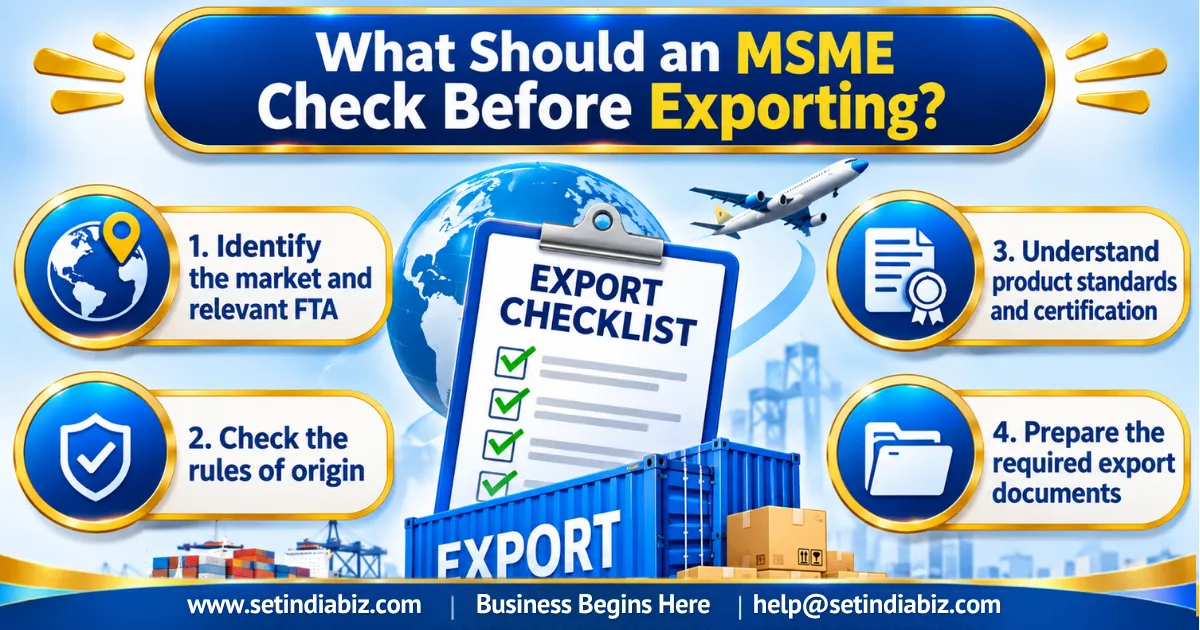
Before approaching an overseas buyer or accepting an export order, a business should work through four areas.
1. Identify the market and relevant FTA
Start by identifying the destination country and checking whether India has an applicable trade agreement with it. Then examine the agreement’s tariff schedule to see whether the product is covered and what preferential rate applies. Compare this with the normal import duty in that market.
2. Check the rules of origin
Confirm the product-specific origin criteria under the agreement. Check whether the materials, manufacturing process and value addition meet those requirements. Maintain purchase records, supplier declarations, production details and other documents that may be needed to establish origin.
3. Understand product standards and certification
Lower customs duties do not exempt an exporter from the destination country’s product regulations. Depending on the product and market, the business may need to meet safety, quality, labelling, packaging, testing or certification requirements. These should be checked before production or shipment, rather than after an order has been secured.
4. Prepare the required export documents
The exporter must be able to provide accurate commercial invoices, packing lists, shipping documents and other records required for the transaction. Where preferential tariff treatment is claimed, the exporter must also follow the agreement’s prescribed proof-of-origin procedure. This may require a preferential Certificate of Origin or another form of origin certification, depending on the agreement.
Export Readiness Requires the Right Business Compliance
Alongside FTA-specific conditions, an exporter must meet the general legal and tax requirements applicable to its business and goods.
- Importer-Exporter Code (IEC): An IEC issued by the Directorate General of Foreign Trade (DGFT) is generally required to export goods from India, subject to specified exemptions. IEC holders must also confirm or update their details online every year within the prescribed period. For service and technology exports, an IEC is required where the exporter seeks benefits under the Foreign Trade Policy.
- GST registration and compliance: Exporters must understand the GST treatment of their supplies, maintain proper invoices and records, and complete the applicable return and refund requirements. Exports are treated as zero-rated supplies under GST law.
- Letter of Undertaking (LUT): An eligible registered exporter can furnish an LUT to export goods or services without paying IGST upfront, subject to the applicable conditions. This is a GST procedure; it does not establish eligibility for preferential tariffs under an FTA.
- Export documentation: Depending on the goods and transaction, the exporter must maintain documents such as the commercial invoice, packing list, shipping bill and transport document. Product-specific permissions or certificates may also be required.
These requirements serve different purposes. IEC and GST compliance relate to the exporter’s business and tax obligations, while proof of origin is relevant to a claim for preferential customs duty under an FTA.
Market Access and Business Capability
An export order is only the beginning. Overseas buyers expect consistent quality, timely delivery and clear communication. A business that cannot maintain these standards may struggle to retain customers, even when its products enjoy a tariff advantage.
MSMEs should therefore review their production capacity, quality-control systems, workforce skills, technology and financial planning before taking on larger orders. Digital accounting and inventory systems can improve record-keeping and help businesses monitor costs and deliveries. Investment in testing, product development and better production processes can also help them meet buyer requirements.
The RBI Governor highlighted productivity, technology adoption, quality and formalisation as areas that can strengthen MSMEs. These are not separate from export growth. They determine whether a business can turn market access into repeat orders and sustainable operations.
Setindiabiz Support
A business entering international markets needs its basic corporate and tax compliance in order. Setindiabiz supports businesses with company and LLP incorporation, IEC registration and annual updation, GST registration and ongoing GST compliance, including export-related requirements such as LUT.
These services help businesses put the necessary registration and compliance arrangements in place. Product testing, overseas certifications, customs clearance and agreement-specific origin assessments may require separate specialised support.
FAQs
FTAs can reduce or remove import duties on eligible products exported to partner countries. They may also improve access to overseas markets, lower-cost inputs and opportunities in global supply chains. The benefit depends on the product and the terms of the relevant agreement.
No. Preferential duty applies only to products covered by the agreement and meeting its applicable conditions, including the rules of origin. Exporters should check the relevant tariff schedule before claiming a concession.
Rules of origin determine whether a product qualifies as originating in a country that is party to the agreement. The criteria may involve the source of materials, manufacturing processes, tariff classification changes or domestic value addition, depending on the agreement and product.
No. A Certificate of Origin is not a universal requirement for every export shipment. When an exporter claims preferential tariff treatment under an FTA, the agreement’s prescribed proof-of-origin procedure must be followed. The form of proof and issuing process can differ between agreements.
An IEC is generally required for exports of goods, subject to specified exemptions. For exports of services or technology, an IEC is required where the exporter seeks benefits under the Foreign Trade Policy. IEC holders must also complete the prescribed annual online confirmation or updation.
