
Overview: Addressing industry leaders at FICCI’s centenary Annual General Meeting and Annual Convention, themed Bharat 2047, Prime Minister Narendra Modi urged Indian businesses to move beyond domestic-market dependence and build products that can compete globally. He called for better product quality, greater domestic manufacturing, higher value addition and wider use of India’s Free Trade Agreements (FTAs) to expand exports.
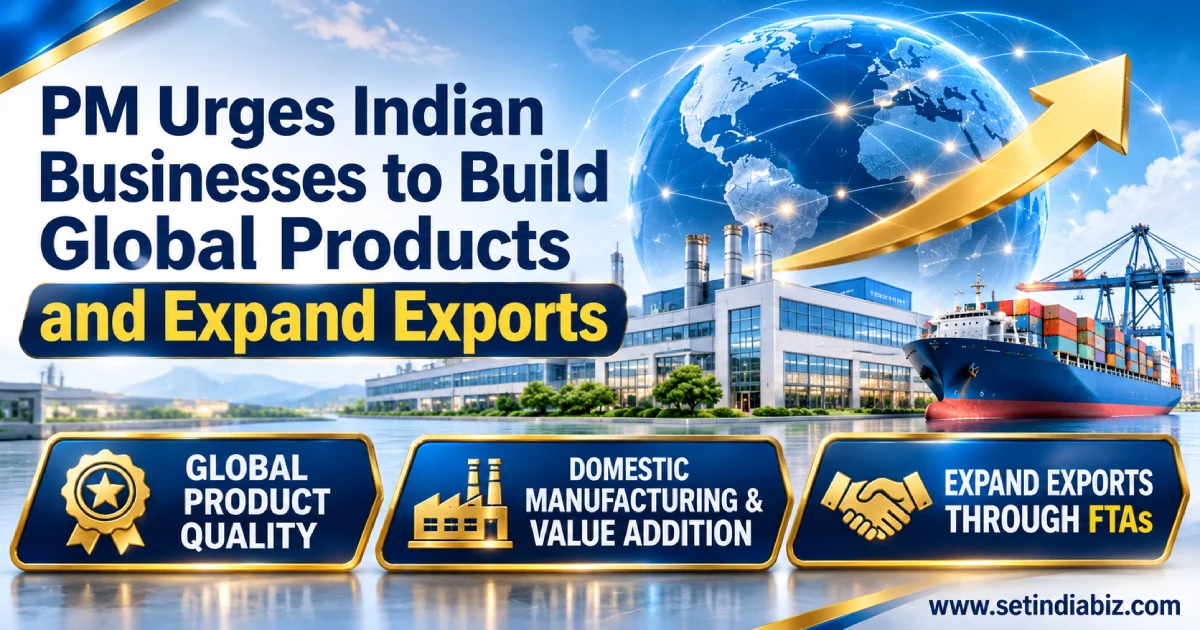
India’s large domestic market has supported business growth across several industries. Prime Minister Narendra Modi believes that this market should not become a comfort zone for Indian manufacturers. Addressing industry leaders at FICCI’s centenary convention, he called for a stronger focus on global customers, internationally competitive products and greater domestic manufacturing capabilities. He also urged businesses to make India First the foundation of their long-term investment decisions over the next 20 years.
Indian Consumers Deserve the Same Product Quality
The Prime Minister questioned the practice of presenting a product as “export quality” to convince Indian consumers to buy it. He said Indian customers deserve products of the same quality as those supplied to overseas markets.
His message was clear: businesses should not take India’s large consumer base for granted. Product quality, design and performance must meet high standards in both domestic and international markets.
Increase Domestic Manufacturing and Value Addition
The Prime Minister highlighted opportunities to reduce import dependence in sectors such as active pharmaceutical ingredients (APIs), bulk drugs, specialised steel and aluminium. He also called for greater value addition in minerals, agriculture and food processing.
He referred to the increase in the share of processed food in India’s agri-food exports, from around 13% to over 20% in the past 12 years. This reflects the scope for businesses to move beyond exporting raw materials and develop higher-value products.
Prepare Products for International Markets
Indian businesses were urged to make better use of Free Trade Agreements (FTAs) and study the requirements of overseas consumers. The Prime Minister suggested that companies understand local preferences in different markets, including product designs and colours.
He also identified opportunities in hand tools, power tools, packaging equipment, irrigation systems and factory-related machinery. Businesses entering these markets need to consider product standards, distribution networks and customer expectations in each country. Larger companies can also support smaller enterprises in developing manufacturing capacity and meeting the required quality standards.
Turn Policy Benefits into Business Growth
The Prime Minister referred to policy changes such as the reduction in the basic corporate tax rate from 30% to 22%, income-tax relief available under the new tax regime for individuals with income up to ₹12 lakh, and GST rationalisation. He urged businesses to use the benefits of reforms to expand investment, production and employment.
India’s merchandise exports reached US$49.47 billion in October 2026, the highest monthly figure recorded at the time. However, the merchandise trade deficit for FY 2025-26 stood at US$333.19 billion, compared with US$283.50 billion in FY 2024-25. The figures underline the continuing need to strengthen domestic manufacturing and export competitiveness.
Message for Indian Businesses
Businesses planning to enter or expand in overseas markets should review their structure and compliance requirements.
- Manufacturers and MSMEs: An Importer Exporter Code (IEC) is generally required for goods exports, subject to specified exemptions. Product-specific certifications may also apply. Private Limited Company or LLP incorporation can support business expansion, but neither is compulsory for exporting.
- Startups and consumer brands: Indian trademark registration can provide the basis for an international application through the Madrid System (Madrid Protocol). Each designated country examines the application under its own laws.
- Exporters: Eligible GST-registered businesses can furnish an annual Letter of Undertaking (LUT) in Form GST RFD-11 to make zero-rated supplies without payment of IGST. They must also follow applicable FEMA requirements for realisation and repatriation of export proceeds.
Setindiabiz Support
Setindiabiz provides business incorporation and compliance services for companies planning to establish or expand their operations. Our services include Private Limited Company and LLP incorporation, IEC registration and annual updates, GST registration and LUT filing, GST returns, trademark registration assistance and documentation for applicable FEMA requirements.
For businesses entering regulated sectors, Setindiabiz experts also support relevant registration and compliance processes. Statutory registrations, licences and approvals are issued by the respective government authorities.
FAQs
An IEC issued by the Directorate General of Foreign Trade (DGFT) is generally required for goods exports and imports, subject to specified exemptions. Service exporters may need an IEC to claim benefits under the Foreign Trade Policy or where a specific requirement applies.
Yes. A sole proprietorship can undertake export activities, subject to applicable registrations and compliance requirements. Exporting does not require a business to be incorporated as a company or LLP.
An eligible GST-registered exporter can furnish a Letter of Undertaking (LUT) in Form GST RFD-11 and make zero-rated supplies without payment of IGST, subject to applicable GST conditions.
The Prime Minister’s message places product quality, domestic value addition and global competitiveness at the centre of India’s business growth. For Indian businesses, expanding overseas will require more than identifying new markets. They must also build the right products, understand local requirements and maintain the registrations and compliance needed to operate across borders.
