
Overview: The Department for Promotion of Industry and Internal Trade (DPIIT) has identified 100 products for possible policy support to increase domestic manufacturing. Its assessment covered nearly 500 heavily imported products, including machinery, fertilisers, chemicals, plastics, cotton staple fibre, silicon wafers and carbon fibre. The department is expected to share its recommendations with the Finance Ministry for the FY 2027-28 Union Budget. No product-specific incentive has been approved under this exercise. However, the proposed measures have drawn attention to opportunities for Indian manufacturers and MSMEs.
The Department for Promotion of Industry and Internal Trade (DPIIT) has shortlisted 100 import-heavy products for potential support in the upcoming Union Budget. The exercise is aimed at identifying products where domestic manufacturing can be strengthened and dependence on imports reduced. The shortlist puts the focus on sectors where targeted policy measures, financial support or other interventions could improve India’s manufacturing capacity.
However, the proposed support measures are yet to be finalised, and the shortlist should not be treated as an announcement of approved incentives.
DPIIT Identifies 100 Products for Domestic Manufacturing
In June 2026, the DPIIT began examining around 500 heavily imported products to identify opportunities for expanding domestic manufacturing. Six sector-specific working groups were constituted to assess production capacity, industry requirements and the challenges businesses face in manufacturing these products locally.
The assessment covered products and materials across several sectors, including:
- Machinery and industrial equipment
- Fertilisers
- Chemicals and plastics
- Cotton staple fibre
- Silicon wafers
- Carbon fibre
Following the assessment and consultations with industry representatives, DPIIT shortlisted 100 products, including machinery, chemicals and plastics, for possible policy support.
The department is expected to submit its findings to the Finance Ministry for consideration in the Union Budget for FY 2027-28. The recommendations could cover:
- Financial and non-financial assistance
- Research and development support
- Changes in trade and tariff measures
- Improved testing and certification facilities
These proposals are still under consideration. The government has not announced the final product-wise list or approved any subsidy, tax exemption or production-linked incentive under this exercise.
Opportunities for Indian Manufacturers and MSMEs
The exercise focuses on products that India imports in large quantities and where domestic production may not meet local demand. Increasing local manufacturing could create opportunities for businesses supplying components, industrial materials and specialised products.
The extent of these opportunities will depend on the products eventually covered and the measures announced by the government.
- MSMEs and component suppliers: Smaller manufacturers may find opportunities to supply parts, industrial materials and other inputs to larger companies.
- Startups: Businesses developing machinery, automation systems and manufacturing technology may find customers among companies looking for domestic suppliers.
- Established manufacturers: Existing companies may consider increasing production capacity, developing new product lines or sourcing more components from Indian suppliers.
However, appearing on the shortlist will not automatically make a business eligible for government assistance. Any subsidy, tax benefit, PLI incentive or procurement preference will depend on a formal announcement and the conditions of the relevant scheme.
Compliance Requirements Before Manufacturing Expansion
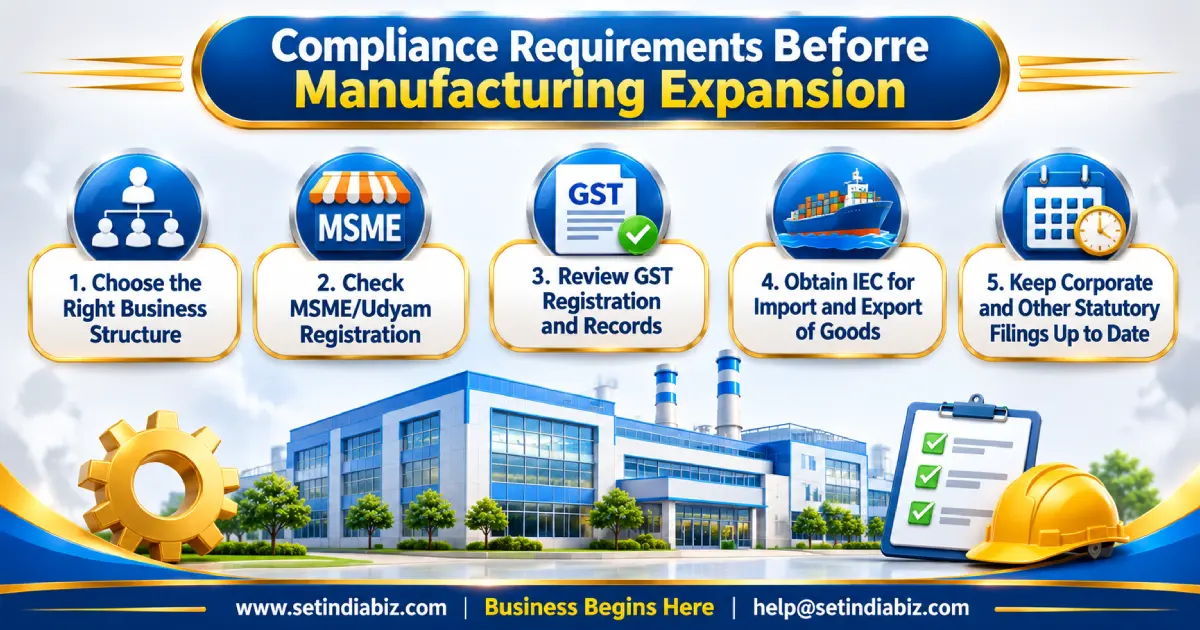
Starting a manufacturing unit or increasing production involves more than arranging finance and machinery. Businesses must also have the appropriate legal structure, registrations and statutory records. The requirements depend on the nature of the activity, the business structure, its location and the scale of operations.
1. Choose the Right Business Structure
Entrepreneurs setting up a manufacturing venture should consider whether a Private Limited Company or LLP suits their ownership and funding plans.
A Private Limited Company may be appropriate where the business expects to bring in investors, raise funds or operate through a separate corporate entity. An LLP may suit a business run by partners who want limited liability and a defined management arrangement.
An existing business planning a separate manufacturing operation should also examine whether to use its present entity or establish a new one.
2. Check MSME/Udyam Registration
Eligible micro, small and medium enterprises should maintain accurate Udyam registration details. Businesses should check their investment in plant and machinery or equipment, turnover and enterprise classification as their operations grow.
An existing Udyam registration should also be reviewed when the business changes its activities or other particulars. Registration does not automatically qualify an enterprise for assistance under DPIIT’s proposed manufacturing exercise.
3. Review GST Registration and Records
Manufacturers should check their GST registration, invoices, return filing and input tax credit records. The registration threshold depends on the nature of supplies, turnover and applicable state provisions. Certain activities also attract compulsory registration, subject to the relevant exemptions.
Opening another business location may require an amendment to the existing registration or a separate GST registration, depending on the circumstances.
Businesses should also ensure that their GST records reflect their actual operations and that returns are filed within the prescribed time.
4. Obtain IEC for Import and Export of Goods
Manufacturers may need to import machinery, components or raw materials before they can produce goods locally. Businesses planning to sell finished products overseas will also need to examine their export requirements.
An Importer Exporter Code (IEC) is generally required for importing and exporting goods, subject to specified exemptions. Businesses holding an IEC must also complete the prescribed annual update with the Directorate General of Foreign Trade (DGFT).
5. Keep Corporate and Other Statutory Filings Up to Date
Companies and LLPs must complete their applicable annual and event-based filings with the Ministry of Corporate Affairs. Businesses should also maintain proper accounting, tax and other statutory records.
Depending on the manufacturing activity and location, separate factory, environmental and other industry-specific approvals may be required. These should be checked with the relevant authorities before the unit starts operations.
Setindiabiz Support
A manufacturing business needs the right legal structure, registrations and continuing compliance arrangements. Setindiabiz handles these business formalities so that founders and management can concentrate on production, investment and business operations. Setindiabiz experts provide company and LLP incorporation, MSME/Udyam registration, GST registration and compliance, IEC registration, relevant business registrations and licences, and ongoing MCA and tax compliance.
Businesses setting up a new manufacturing venture or preparing an existing company for expansion can use our services to put their registrations and statutory records in order.
FAQs:
DPIIT has identified 100 products for possible policy support to increase domestic manufacturing. Its wider assessment covered nearly 500 heavily imported products, including machinery, fertilisers, chemicals, plastics, cotton staple fibre, silicon wafers and carbon fibre.
No specific subsidy or incentive has been approved under this exercise. DPIIT is expected to share its recommendations with the Finance Ministry for the FY 2027-28 Union Budget. Any benefit will depend on the government’s formal announcement and the applicable scheme conditions.
MSMEs may find opportunities to supply components, materials and other industrial inputs to larger manufacturers. However, the actual opportunities and any government assistance will depend on the products selected and the measures eventually announced.
No. Udyam registration provides recognition as a micro, small or medium enterprise, subject to the prescribed criteria. It does not automatically qualify a business for incentives under DPIIT’s proposed manufacturing exercise.
An IEC is generally required when a business imports or exports goods, subject to specified exemptions. A manufacturer importing machinery or raw materials or exporting finished products should check the applicable DGFT requirements.
A manufacturer should examine its business structure, Udyam registration where eligible, GST registration and records, IEC requirements, applicable business licences and statutory filings. The requirements will depend on the proposed activity and location.
DPIIT’s identification of 100 products has brought domestic manufacturing into focus ahead of the FY 2027-28 Union Budget. The proposed support may create opportunities for Indian manufacturers, but the actual benefits will become clear only after the government announces its decisions. Businesses considering expansion should follow these developments while keeping their registrations, tax records and statutory filings in order.
