
Overview: GIFT City has attracted fund management entities through its tax incentives and international financial services framework. However, recent difficulties in processing deductions under Section 80LA of the Income-tax Act, 1961, have raised concerns about the administration of these benefits. At the same time, recurring GST registration and return-filing requirements are adding to operating costs, even for entities with no GST liability.
Gujarat International Finance Tec-City (GIFT City) is being developed as India’s international financial services hub, with the aim of attracting global fund managers and cross-border financial activity. Its growth is reflected in the sector’s expansion. According to a Business Standard, GIFT City had around 235 registered fund management entities (FMEs), more than 400 schemes and cumulative commitments of about $45 billion in non-retail fund management as of June 2026.
There remain two practical concerns. Some FMEs faced disallowance of their Section 80LA deductions because the Centralised Processing Centre (CPC) system reportedly failed to recognise Form 10CCF submissions. Although representations to the tax authorities have helped resolve several cases, experts have also questioned the recurring GST compliance burden, including nil-return filing where no tax is payable. Together, these issues raise a wider question about the ease of operating a fund-management business from GIFT City.
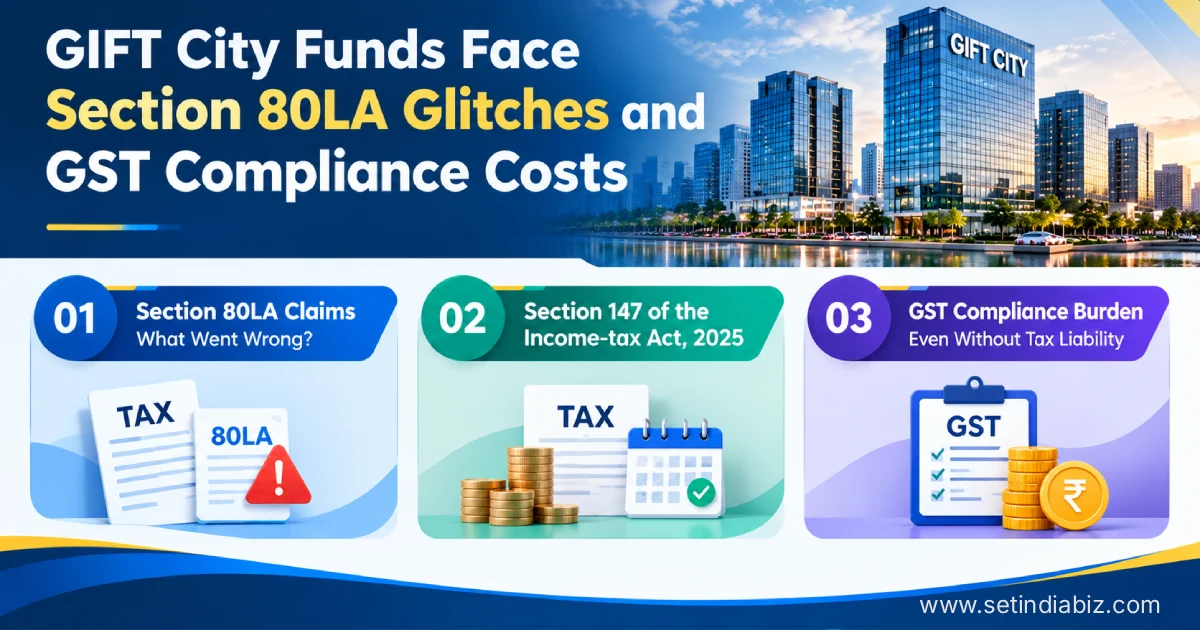
Section 80LA Claims: What Went Wrong?
Fund management entities (FMEs) had filed Form 10CCF to support deductions under Section 80LA of the Income-tax Act, 1961. However, the Centralised Processing Centre (CPC) system reportedly failed to recognise some submissions while processing returns, leading to disallowance at the processing stage.
Tax and legal professionals have reportedly noted that representations to the tax authorities, including by the International Financial Services Centres Authority (IFSCA), had helped resolve several cases.
The reported problem concerned the system’s recognition of filed reports, not an amendment withdrawing the deduction. Eligible entities must still meet the statutory conditions and furnish the accountant’s report. Certain specified funds also face separate investor-base, resident-participation and corpus tests.
Section 147 of the Income-tax Act, 2025
Section 147 of the Income Tax Act 2025, provides a 100% deduction for specified income of eligible Offshore Banking Units and IFSC units, subject to statutory conditions.
Following the amendment introduced by the Finance Act, 2026, an eligible IFSC unit is entitled to claim this deduction for any 20 consecutive tax years within a 25-year window. The assessee is granted the flexibility to select the starting tax year, which marks the commencement of both the 25-year eligibility window and the 20 consecutive tax years allocated for claiming the deduction.
The reporting form has changed. Rule 19AE of the Income-tax Rules, 1962, prescribes Form 10CCF for claims under Section 80LA. For claims under Section 147(4)(a) of the 2025 Act, Rule 69 of the Income-tax Rules, 2026, prescribes Form 35.
The applicable form depends on the law governing the relevant tax year. A return filed after 1st April, 2026, may still relate to an earlier period governed by the 1961 Act; the filing date alone does not determine the form.
Why Does GST Add to the Compliance Burden?
Tax professionals quoted in the report said FMEs may have to maintain GST registrations and file returns even when they have no output GST liability. Actual obligations depend on the entity’s structure.
Under the second provision to Section 25(1) of the Central Goods and Services Tax (CGST) Act, 2017, a person having an SEZ unit or being an SEZ developer must obtain a separate registration distinct from its place of business outside the SEZ in the same State or Union Territory. CBIC guidance confirms this requirement. It is not a blanket rule that every IFSC entity must register solely because it operates in GIFT City.
Once registered, a person required to file returns under Section 39(1) or (2) must file for every tax period, even if no supplies have been made. This creates the nil-return obligation.
Section 16 of the Integrated Goods and Services Tax (IGST) Act, 2017, treats supplies to an SEZ unit or developer for authorised operations as zero-rated. This does not, by itself, remove the registration and return-filing obligations of a registered unit. These filings add to operating costs even where no output tax is payable.
Setindiabiz Support
Establishing a business presence in GIFT City requires the right corporate structure, registrations and a plan for meeting ongoing statutory obligations. Setindiabiz supports businesses through this process, from incorporating an Indian company or subsidiary and completing India-entry documentation to obtaining GST registration and managing periodic GST returns. Our professionals also support relevant FEMA documentation and corporate filings, helping businesses establish their operations and keep their statutory compliance in order.
FAQs
The CPC system reportedly failed to recognise certain Form 10CCF submissions, resulting in disallowance during return processing.
No withdrawal was reported. The cases concerned processing difficulties; the deduction remains subject to statutory conditions.
An eligible IFSC unit can claim the deduction for 20 consecutive tax years out of 25 years from the relevant tax year, at its option.
GIFT City’s incentives will be more effective when supported by predictable tax administration and proportionate compliance requirements.
