
Overview: GIFT City’s banking assets reached approximately $193 billion at the end of September 2026, up from $120.69 billion in June. Foreign-currency deposits and international lending have contributed to the expansion. Earlier figures from the Ministry of Finance also show substantial use of the RBI’s FCNR(B) swap facility and increased ECB disbursements through IFSC Banking Units, reflecting the centre’s growing role in international financing.
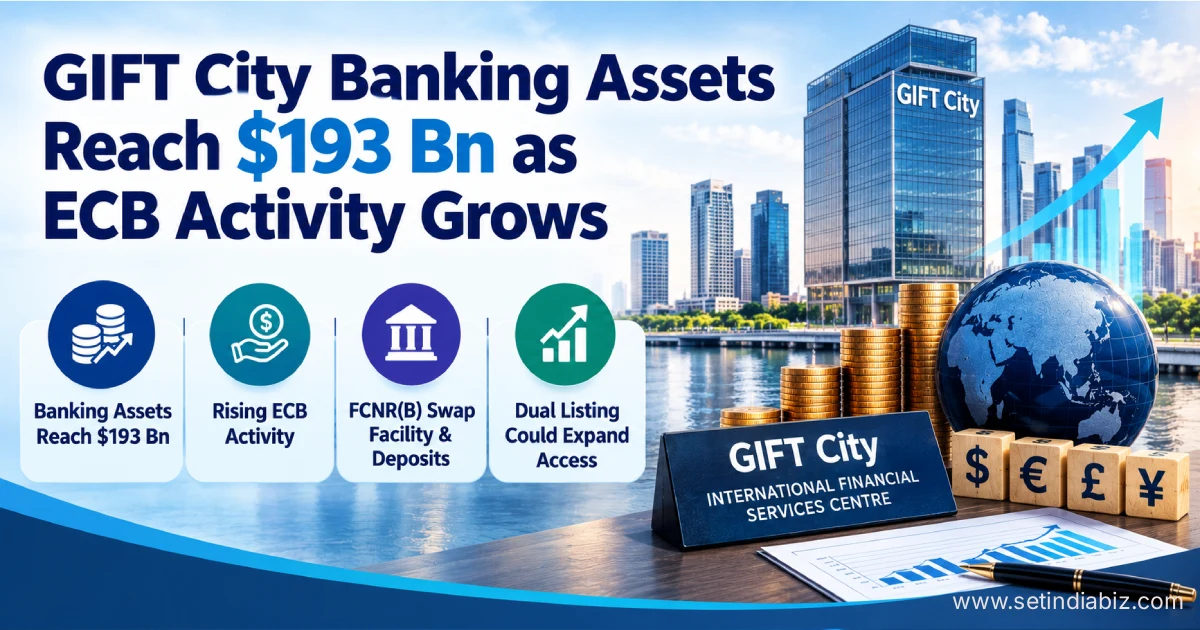
GIFT City’s international banking business has expanded sharply, with banking assets rising by nearly 60% in three months. The growth comes at a time when Indian businesses are looking at alternative channels for foreign-currency funding and international expansion.
The figures also highlight the role of regulatory measures in attracting foreign-currency deposits and supporting lending through the International Financial Services Centre (IFSC). For Indian companies, the development brings greater attention to GIFT IFSC as a financing channel, although access remains subject to borrower eligibility and applicable RBI and FEMA requirements.
Banking Assets Rise on Foreign-Currency Activity
According to data released on 29th October, 2026, by IFSCA Chairman K. Rajaraman, banking assets at GIFT City reached nearly $193 billion by the end of September 2026. This reflects a growth of almost 60%, adding over $72 billion to the $120.69 billion recorded at the end of June.
Foreign-currency deposits and international lending have contributed to the expansion. External Commercial Borrowings (ECBs) and the RBI’s special swap facility for Foreign Currency Non-Resident (Bank) FCNR(B) deposits have also supported banking activity at GIFT IFSC.
Figures released by the Ministry of Finance on 2nd September, 2026, show the scale of transactions under these arrangements:
- FCNR(B) swap facility: By 31st August, 2026, 20 IFSC Banking Units (IBUs) had sanctioned $54.02 billion under the RBI’s special swap facility. Approximately $52.82 billion had been disbursed.
- External Commercial Borrowings (ECB) disbursements: IFSC Banking Units disbursed $11.62 billion in ECBs between April and August 2026.
- International bond listings: Indian banks raised another $11.12 billion through bond listings on IFSC exchanges during the same five-month period.
The RBI originally planned to keep the FCNR(B) swap window open until 30 September 2026. However, it advanced the closure to 31 August after the facility achieved its objective ahead of schedule. The strong response indicates the demand for foreign-currency funding through this channel.
These figures relate to different reporting periods and categories of banking activity. They should not be treated as a direct breakdown of the increase in total banking assets between June and September.
What the Growth Means for Indian Companies
The expansion gives eligible Indian businesses another channel to examine when planning foreign-currency borrowing or overseas operations. IFSC Banking Units are already disbursing ECBs, demonstrating that GIFT City is an active route for cross-border credit.
However, borrowing through GIFT IFSC does not exempt Indian companies from the RBI’s ECB framework or applicable FEMA requirements. A company must establish its eligibility, check whether the proposed use of funds is permitted and assess the applicable maturity and borrowing cost conditions.
Foreign-currency exposure also needs attention. Changes in exchange rates can affect the cost of repayment, making hedging and the terms of the loan important considerations. The availability of banking funds at GIFT City does not automatically mean that every Indian business can obtain an ECB or secure cheaper borrowing.
Dual Listing Could Expand Access to International Investors
GIFT City’s development is not limited to banking and lending. Regulators are also working on a route that could allow Indian companies already listed on domestic stock exchanges to access international investors through IFSC exchanges.
The existing direct-listing framework allows eligible unlisted public Indian companies to issue and list their equity shares on recognised international exchanges in GIFT IFSC, subject to prescribed conditions.
The proposed additional route concerns companies whose shares are already listed on Indian stock exchanges such as NSE and BSE. SEBI and IFSCA have been discussing the regulatory arrangements for this facility, including requirements relating to public shareholding, pricing, taxation and investor protection.
The additional route is still under development and should not be treated as an operational listing facility. If implemented, it could give eligible Indian companies another channel to reach international investors.
Setindiabiz Support
To assist Indian businesses navigating cross-border financing, Setindiabiz provides end-to-end guidance on FEMA compliance and required documentation. Our services cover External Commercial Borrowing (ECB) documentation, Form ECB filings, Loan Registration Number (LRN) procedures, and ongoing ECB-2 reporting submitted via designated authorized dealer banks.
We also support businesses with corporate structuring, foreign investment compliance and related RoC filings. Companies considering overseas borrowing or expansion can seek assistance in addressing the applicable regulatory and reporting requirements.
FAQs
GIFT City’s banking assets reached approximately $193 billion at the end of September 2026, compared with $120.69 billion at the end of June. This represents a nearly 60% increase.
Foreign-currency deposits, international lending, ECB transactions and the RBI’s special FCNR(B) swap facility have contributed to the expansion.
Eligible Indian companies can explore ECB financing through IFSC Banking Units, subject to the RBI’s ECB framework, FEMA requirements and the lender’s conditions.
It was a special facility introduced by the RBI to encourage banks to mobilise fresh FCNR(B) deposits and provide foreign-currency funding through the banking system. Its window, originally scheduled to close on 30th September, 2026, was advanced to 31st August after the facility achieved its objective ahead of schedule.
The proposed additional dual-listing route for companies already listed on Indian stock exchanges is still under development. The existing direct-listing framework allows eligible unlisted public Indian companies to list on recognised IFSC exchanges, subject to prescribed conditions.
GIFT City’s banking growth and rising ECB activity show its expanding role in India’s international financing system. For Indian companies, the IFSC offers another route to examine when planning foreign-currency borrowing and overseas expansion. However, eligibility, permitted use of funds, currency exposure and FEMA compliance remain central to any financing decision.
