
Overview: Commerce and Industry Minister Piyush Goyal has said that the government is willing to cover the entire cost of expensive export certifications for micro and small enterprises (MSMEs) under the Export Promotion Mission (EPM). The announcement includes compliance linked to EU carbon and deforestation rules. Existing Directorate General of Foreign Trade (DGFT) guidelines prescribe reimbursement limits and claim conditions, so exporters should confirm the applicable terms before spending on certification.
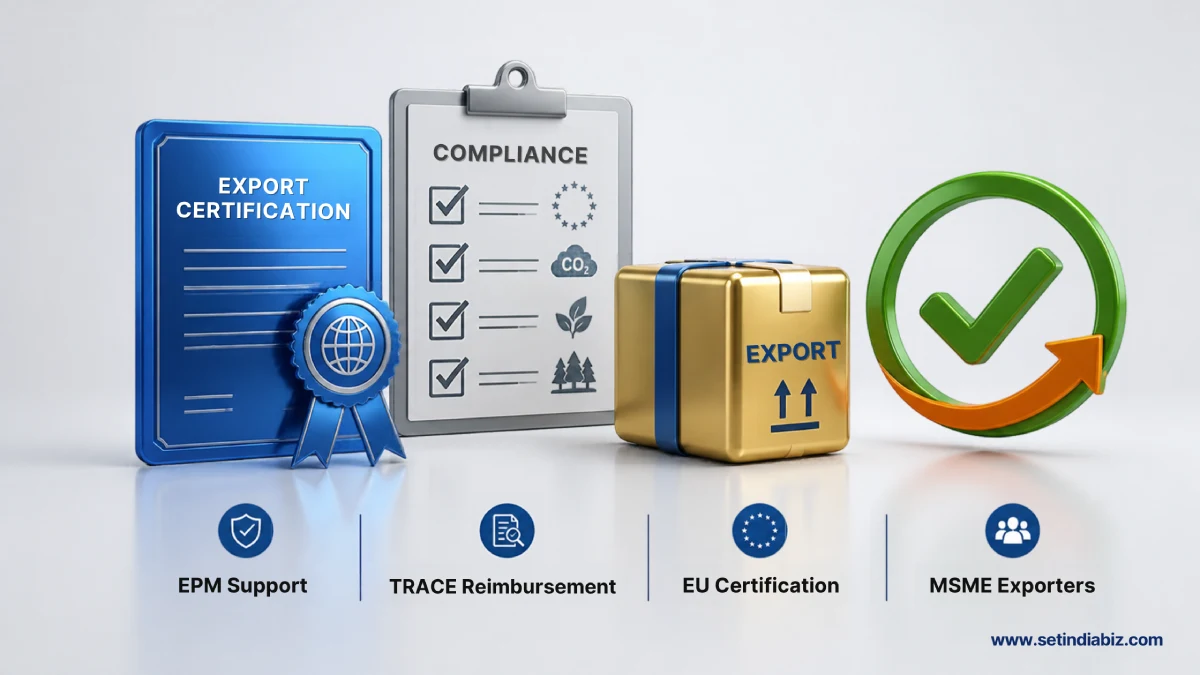
Export certification can be expensive for smaller businesses entering overseas markets. Speaking in Berlin on 23rd October 2026, Commerce and Industries Minister of India, Piyush Goyal urged existing and prospective exporters to approach the Directorate General of Foreign Trade (DGFT) for support under EPM.
The announcement could ease the cost of meeting overseas standards. However, the existing TRACE scheme has specific reimbursement limits and an application process. Exporters need to understand those rules while awaiting further instructions on the proposed full-cost support.
What Has the Government Announced?
Goyal said the government was willing to cover the full cost of expensive certifications for micro and small enterprises. Other businesses could receive assistance on a graded basis. The announcement also refers to compliance costs linked to the European Union’s Carbon Border Adjustment Mechanism (CBAM) and deforestation-related requirements. The government is exploring the approval of verification agencies in India.
These measures could benefit exporters facing costs for product testing, emissions measurement, verification and supply-chain traceability. However, the minister’s statement does not, by itself, amend the existing DGFT guidelines or guarantee full reimbursement for every certification.
What Reimbursement Does the DGFT TRACE Scheme Offer?
The Trade Regulations, Accreditation and Compliance Enablement (TRACE) initiative operates under EPM’s Niryat Disha sub-scheme. It supports eligible testing, inspection, certification and other compliance requirements for overseas markets.
DGFT amended the TRACE guidelines through Trade Notice No. 09/2026-27 dated 1 July 2026. The existing framework provides the following assistance:
| Enterprise category | Assistance | Annual ceiling |
|---|---|---|
| Micro and small enterprises | Up to 95% of eligible costs, excluding applicable taxes, duties and cess, or the prescribed ceiling, whichever is lower | ₹50 lakh per IEC per financial year |
| Medium enterprises | Up to 80% of eligible costs, excluding applicable taxes, duties and cess, or the prescribed ceiling, whichever is lower | ₹50 lakh per IEC per financial year |
Cases exceeding ₹50 lakh may be considered individually by the designated sub-committee. Higher assistance is not automatic.
These figures describe the existing scheme. Exporters should not assume that the minister’s announcement has already replaced the prescribed rates or limits.
How Can Exporters Claim TRACE Reimbursement?
Businesses should follow the applicable procedure before spending on certification.
1. Check eligibility. Applicants must meet the scheme conditions, including holding a valid Importer Exporter Code (IEC) and Udyam registration. The proposed certification must also fall within DGFT’s eligible list.
2. File an Intent-to-Claim. Submit the online Intent-to-Claim (IC) before obtaining the certificate, test report or compliance document. The IC remains valid for two years for the related reimbursement claim.
3. Submit the reimbursement claims. After certification, file the first reimbursement claim (RC-1) with the required certificate or report, invoice, proof of payment and supporting evidence. Under the amended guidelines, 50% of the approved assistance is released at this stage.
The second claim (RC-2) requires evidence of exports linked to the certification and proof of realisation. Export evidence must be submitted within two years of receiving the first instalment. Otherwise, the second instalment lapses, and the first may be recovered.
Filing an IC does not guarantee reimbursement. Check the latest DGFT instructions before incurring expenditure.
Which EU Rules May Affect Indian Exporters?
CBAM: The Carbon Border Adjustment Mechanism covers specified goods, including iron and steel, aluminium, cement, fertilisers, electricity and hydrogen. Relevant exporters may face emissions-reporting and verification requirements.
EUDR: The EU Deforestation Regulation covers specified commodities, including cattle, cocoa, coffee, oil palm, rubber, soya and wood, along with certain derived products. Relevant supply chains must meet applicable traceability and due-diligence requirements.
Neither regulation applies to every product exported to the EU. Businesses should check whether their goods fall within the relevant scope before arranging certification.
Setindiabiz Support
Setindiabiz supports businesses with Import Export Code (IEC) registration, amendments and IEC renewal-related formalities, along with relevant export documentation and registration requirements and your continuous complainces. Businesses can seek support with these formalities while confirming TRACE eligibility, approved certifications and reimbursement conditions directly with DGFT.
FAQs
No. The minister has expressed willingness to cover the full cost of expensive certifications for micro and small enterprises. The applicable entitlement must be confirmed against the current scheme rules and subsequent official instructions.
Yes. Under the existing TRACE procedure, the Intent-to-Claim must be filed before obtaining the relevant certification, test report or compliance document.
Cases exceeding the annual ceiling may be considered individually by the designated sub-committee. Approval is not automatic.
No. It covers specified goods and related product categories. Exporters should check the applicable requirements for their products.
The announcement could reduce certification costs for micro and small exporters. Businesses should review the TRACE guidelines, confirm eligibility and file the Intent-to-Claim before spending on certification. Further DGFT instructions will clarify how the proposed full-cost support will operate alongside the existing reimbursement framework.
