
Overview: The Income-tax Act, 1961, gives tax authorities revisionary powers under Section 263. The corresponding provision under the Income-tax Act, 2025, is Section 377. Both allow revision of an assessment order that is erroneous and prejudicial to the interests of the Revenue.
A difference of opinion does not automatically justify revision. The Bombay High Court’s ruling in Principal Commissioner of Income Tax-25 v. Milestone Real Estate Fund highlights why the enquiries made by the Assessing Officer and the assessment record matter.
Receiving a direct tax revision notice can put a business under pressure, particularly when its original assessment has already been completed. The key question is whether the Assessing Officer (AO) made a legally sustainable decision or failed to examine an issue that required attention.
Understanding the limits of revisionary powers and preserving the evidence considered during assessment can help a taxpayer prepare a focused response. Businesses facing departmental proceedings may also need appropriate income-tax assessment and representation support.
Section 263 and Section 377: Which Law Applies?
Section 263 of the Income-tax Act, 1961, governs revision proceedings under the earlier law. Section 377 of the Income-tax Act, 2025, provides the corresponding power under the new Act, which came into force on 1st April 2026.
The applicable law depends on the relevant tax year and the transition provisions. Proceedings relating to earlier tax years may continue under the 1961 Act, including proceedings initiated after the new Act took effect. The applicable provisions should therefore be checked before responding to a notice.
Under both frameworks, the authority must establish that the assessment order is erroneous and prejudicial to the interests of the Revenue. Both conditions must be satisfied. A different interpretation or a preference for another outcome does not, by itself, justify revision.
Lack of Inquiry vs Inadequate Inquiry
A key issue in revision proceedings is whether the Assessing Officer (AO) failed to make the necessary enquiries or examined the issue but the revisional authority simply disagreed with the conclusion.
This captures the distinction between a lack of inquiry and a difference of opinion. However, inadequate inquiry may also justify revision where the statutory conditions are met.
- Lack of inquiry: The AO failed to make enquiries or verification that should have been made, or allowed relief without properly examining the claim. In such cases, the revisional authority may have grounds to revise the assessment.
- Inadequate inquiry: The AO raised relevant questions, examined the evidence and considered the taxpayer’s explanation, but the Principal Commissioner of Income Tax (PCIT) believes the investigation should have gone further. The record and the legal basis of the decision must be examined before concluding that revision is justified.
Explanation 2 to Section 263 and Section 377(3) of the 2025 Act contain provisions under which an order may be deemed erroneous and prejudicial to the Revenue in specified circumstances, including failure to make necessary enquiries or verification.
A taxpayer should not assume that the existence of a questionnaire or written reply alone protects an assessment order. What matters is whether the disputed issue was examined and whether the statutory conditions for revision are met.
The Milestone Real Estate Fund Ruling
In Principal Commissioner of Income Tax-25 v. Milestone Real Estate Fund, decided on 19th January 2026, the Bombay High Court dismissed the Revenue’s appeal against the ITAT’s decision to set aside a revision order under Section 263.
The case concerned an exemption claim by a venture capital fund. During the original assessment, the AO sought information about the fund’s eligibility, investments, activities and supporting records. The taxpayer furnished explanations and documents, and the AO accepted the claim after examining the material.
The High Court held that the PCIT could not simply replace the AO’s view with a different one in these circumstances. The ruling highlights the importance of the assessment record. However, an assessment is not immune to revision merely because the AO made some enquiries.
How to Respond to a Revision Notice
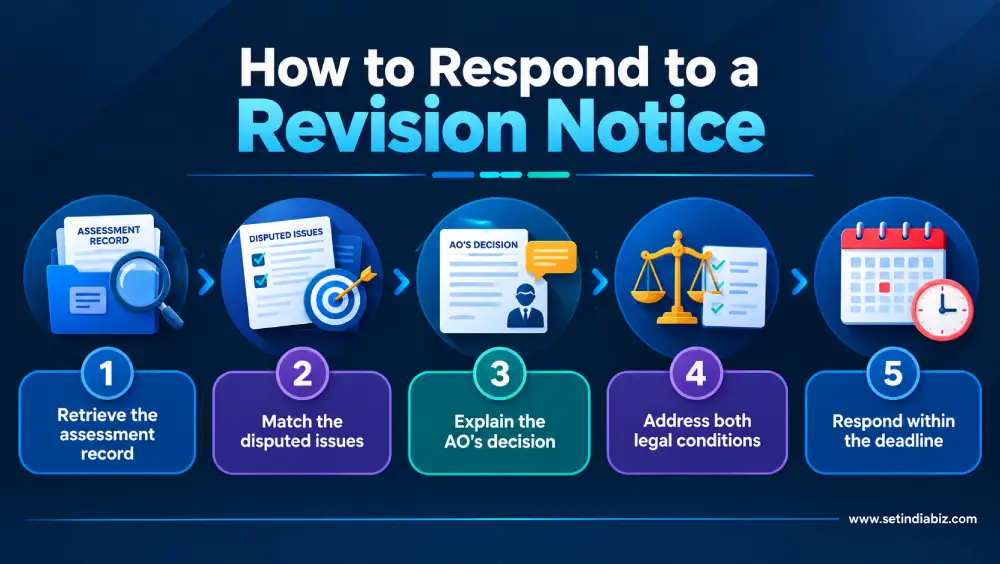
If your business receives a notice under Section 263 or Section 377, take these steps:
- Retrieve the assessment record: Collect questionnaires, notices, written replies, supporting documents and relevant order-sheet entries.
- Match the disputed issues: Identify the transactions or claims questioned in the revision notice and locate the evidence submitted during assessment.
- Explain the AO’s decision: Show how the material was examined and why the conclusion was consistent with the applicable law.
- Address both legal conditions: Explain why the alleged error does not meet the statutory test, or why the order is not prejudicial to the Revenue, as applicable.
- Respond within the deadline: Address the allegations with supporting records and relevant judicial decisions. Guidance on responding to other departmental communications is available in this guide to income-tax notices under Section 133(6), although the legal requirements for a Section 263 or Section 377 notice are different.
Setindiabiz Support
Setindiabiz professionals support businesses with Income Tax Assessment and Representation, including preparing responses to departmental questionnaires and representations. Maintaining organised accounts and supporting documents also makes it easier to respond when an assessment is questioned.
Navigating Section 263 and Section 377 notices requires subtle technical distinction between a “lack of inquiry” and a “difference of opinion”. Our experts help businesses with comprehensive Income Tax Assessment and Representation Services. Our tax leads reconstruct your complete audit record, identify previous lines of departmental inquiry, and draft targeted, precedent-backed responses to revision notices.
FAQs
Not merely because another view is possible. The statutory conditions for revision must be met, taking account of the assessment record and applicable law.
The general limit under Section 263(2) and Section 377(4) is two years from the end of the financial year in which the order sought to be revised was passed. Statutory exclusions and exceptions may affect the calculation.
Yes. An adverse revision order can be challenged before the Income Tax Appellate Tribunal, subject to the applicable appeal provisions and limitation period.
