
Overview: A business current account handles customer receipts, supplier payments, payroll and other routine expenses. The right account depends on the business structure, transaction volume, banking facilities and regulatory requirements. Founders should compare account charges, payment facilities and documentation before applying. Businesses with borrowing arrangements or overseas operations must also consider applicable RBI and FEMA requirements.
A retailer handling daily cash collections has different banking needs from a consultancy receiving overseas payments or a manufacturer managing supplier payments and working capital. The right account should match the business’s operations, not just its advertised features.
The legal structure also matters. Banks verify the account holder, ownership, documents and authorised signatories before opening an account. Preparing these records in advance can prevent avoidable delays.
What is a Business Current Account?
A current account is a demand deposit account designed for frequent transactions. Businesses use it to receive customer payments, pay suppliers, manage expenses and maintain day-to-day liquidity. Depending on the bank and account variant, facilities may include bulk payments, cash management, payment gateway collections and trade services.
Current accounts generally do not pay interest on the balance. Banks may set minimum balance requirements, transaction limits, cash deposit charges and other service fees. These vary by bank and account type.
A current account is different from a Cash Credit (CC) or Overdraft (OD) facility. It processes business funds, while CC and OD provide sanctioned borrowing for working capital or short-term cash flow needs.
Which Current Account Suits Your Business Structure?
Banks verify the legal identity of the proposed account holder and ask for documents appropriate to that structure. The table outlines common arrangements, although the precise checklist varies by bank.
| Business structure | Banking arrangement | Key documents and considerations |
|---|---|---|
| Sole proprietorship | Account in the proprietor’s name or an accepted business or trade name | Proprietor’s KYC and acceptable proof of business activity. GST registration is not the only possible proof. |
| Partnership firm | Account in the firm’s name | Partnership deed, PAN, partner KYC and authority to operate the account. Registration under the Indian Partnership Act, 1932. |
| Limited Liability Partnership (LLP) | Account in the LLP’s legal name | Certificate of Incorporation, LLP PAN, LLP Agreement and authorised partner details. An LLP is a separate body corporate under Section 3 of the LLP Act, 2008. |
| Private limited company | Account in the company’s name | Certificate of Incorporation, company PAN, constitutional documents, beneficial ownership information and required authorisation. |
| Public limited company | Account in the company’s name | Corporate documents, PAN, KYC and authorised signatory records. Listed companies must also meet applicable securities-law obligations. |
| One Person Company (OPC) | Account in the company’s name | Incorporation documents, PAN, company records and authorised signatory details under the Companies Act, 2013. |
| Indian subsidiary of a foreign company | Account in the Indian company’s name | Corporate KYC, beneficial ownership disclosures, authorised signatory records and applicable foreign investment reporting. The subsidiary is a separate Indian legal entity. |
| Branch Office of a foreign company | Account for permitted Indian branch operations | Applicable FEMA documents and permissions or registration records. Transactions must remain within the office’s permitted activities. |
| Liaison Office of a foreign company | Account for permitted liaison activities and expenses | Applicable FEMA documents and authorisations. The office cannot undertake commercial or revenue-generating activities in India. |
| Project Office of a foreign company | Account for permitted project-related transactions | Project documentation and applicable FEMA conditions. Operations must relate to the authorised project. |
Banks may request additional documents depending on ownership, business activity and transaction patterns. Confirm the bank’s checklist before applying.
What Should You Compare Before Opening an Account?
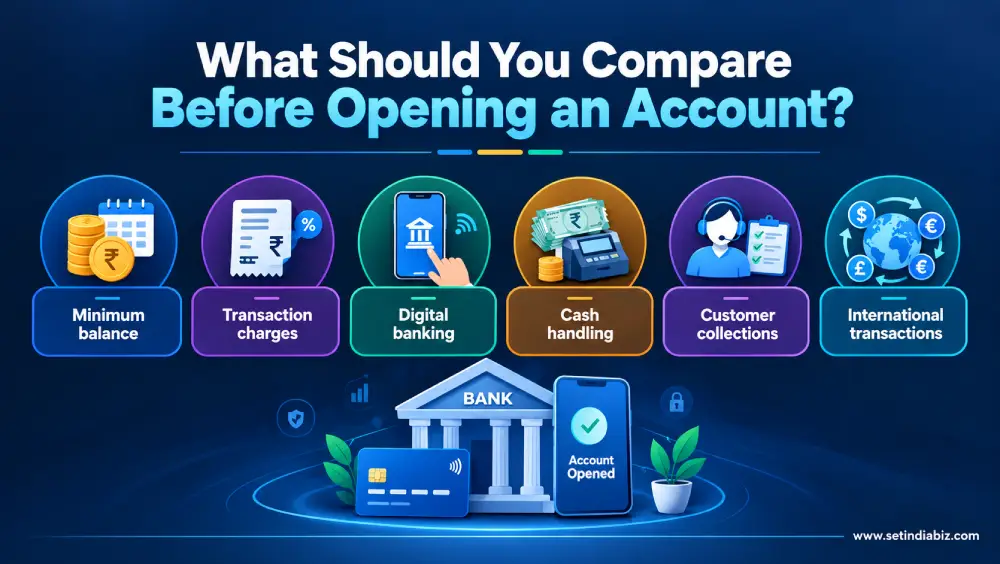
Choose an account based on how the business receives and spends money.
- Minimum balance: Check the monthly or quarterly balance requirement and charges for falling below it.
- Transaction charges: Compare free transfer limits, cheque charges, cash deposit allowances and additional transaction fees.
- Digital banking: Frequent payments may require bulk transfers, multiple-user access, approval controls and accounting-system integration.
- Cash handling: Retailers and distributors should examine branch cash deposit limits, cash handling charges and collection services.
- Customer collections: Online businesses may need payment gateway settlements, QR collections and tools to reconcile receipts.
- International transactions: Importers, exporters and businesses receiving overseas payments should compare remittance charges, foreign exchange services and trade finance facilities.
A premium account makes sense only if its additional facilities justify the fees and balance requirements. A consultancy may prioritise low-cost digital transfers, while a distributor may need high cash deposit limits and a broad branch network.
Current Account vs Cash Credit vs Overdraft
These facilities serve different purposes.
| Facility | Main purpose | Typical use |
|---|---|---|
| Current account | Managing deposits and routine transactions | Customer receipts, supplier payments and operating expenses |
| Cash Credit (CC) | Working capital borrowing, commonly against eligible stock and receivables | Purchasing inventory and meeting operating requirements |
| Overdraft (OD) | Borrowing up to an approved limit under agreed terms | Managing temporary cash flow gaps |
Opening a current account does not automatically provide access to CC or OD. Banks assess creditworthiness, security and repayment capacity separately before sanctioning borrowing.
RBI rules for businesses with bank borrowings
RBI rules on current accounts depend partly on how much a business has borrowed from the banking system. Where total banking exposure is below ₹10 crore, banks may open current or overdraft accounts without these restrictions.
At ₹10 crore or more, a bank may generally maintain such an account if it accounts for at least 10% of the borrower’s total banking exposure or its total fund-based exposure.
If no bank meets the 10% threshold, or only one bank meets it, the two banks with the largest exposures to the borrower may maintain current accounts or overdraft (OD) accounts. This provision allows the borrower to maintain these accounts with those banks despite the usual 10% eligibility requirement.
Special provisions apply in certain cases, so borrowers should confirm the arrangement with their banks before opening or changing accounts. Different conditions apply to borrowers without CC or OD facilities. At aggregate banking exposure of ₹50 crore or more, an escrow mechanism is required. For exposure of ₹5 crore or more but below ₹50 crore, lending banks may open current accounts, while non-lending banks are restricted to collection accounts. Borrowers below ₹5 crore are subject to the applicable undertaking and monitoring requirements.
These rules have exceptions and detailed conditions. Businesses with existing borrowing should confirm the applicable provisions and coordinate with their lenders before opening another account. Multiple accounts are not prohibited automatically, but eligibility depends on the borrower’s circumstances and the relevant RBI directions.
Legal and Regulatory Checks
KYC and account authorisation: Banks conduct Know Your Customer (KYC) checks before opening an account. Depending on the business structure, they may verify the proprietor, partners, directors, authorised signatories and beneficial owners. Companies and LLPs generally need incorporation records, PAN and relevant authorisation documents.
Foreign offices and FEMA: An Indian subsidiary of a foreign company is different from its Branch Office, Liaison Office or Project Office. A subsidiary operates as an Indian incorporated entity, while foreign offices must follow the applicable Foreign Exchange Management Act (FEMA) framework and their permitted activities.
A Liaison Office cannot undertake commercial, trading or industrial activity or earn income in India. Its account is intended for permitted funding and expenses connected with liaison activities, not for collecting payments for commercial sales.
Branch Offices and Project Offices must also keep banking transactions within the applicable permissions and conditions.
Keep business records separate: A dedicated account makes it easier to reconcile receipts and payments, prepare financial statements and maintain tax and accounting records. A company or LLP should use an account in its own name to maintain a clear distinction between business funds and the personal finances of its owners or members.
Checklist Before Applying for a Current Account
Before submitting an application, confirm that:
- The proposed account name matches the business’s legal records or a trade name accepted by the bank.
- PAN, incorporation or registration documents and ownership details are ready.
- Authorised signatories and account operating instructions have been approved.
- Minimum balance conditions, transaction charges and cash deposit limits suit the business.
- Digital payment, collection and accounting requirements are covered.
- Existing CC/OD facilities and applicable RBI account-opening restrictions have been checked.
- FEMA requirements for any foreign entity or office have been addressed.
FAQs
There is no blanket rule requiring every business to maintain a current account. A sole proprietor may be able to use a savings account for business transactions if the bank permits it and its terms allow such use. Companies and LLPs should maintain accounts in their own legal names and keep business funds separate from the personal funds of their owners or partners. The appropriate account depends on the entity’s legal structure, banking requirements and nature of business activity.
Yes. GST registration is not universally required just to open a current account. A bank may accept other prescribed evidence of business activity, subject to its policy and applicable KYC requirements. Whether GST registration is required depends on the business and the applicable law.
The appropriate arrangement is an account opened in the LLP’s or company’s own legal name. Using an owner’s personal account for business transactions can complicate accounting and weaken the separation between personal and entity finances.
A Liaison Office cannot undertake commercial or revenue-generating activities in India. Its account is intended for permitted funding and expenses connected with liaison activities, subject to applicable FEMA conditions.
Multiple accounts may be possible, but businesses with borrowing facilities must check the RBI rules governing current accounts. Restrictions can apply based on aggregate banking exposure and the lender’s share of that exposure.
A current account is used to receive and make payments. Cash Credit is a bank-sanctioned working capital borrowing facility, subject to the bank’s terms and conditions.
Setindiabiz Support
Banking documentation starts with the legal records of the business. Incorporation details, entity PAN, ownership information and authorised signatories must be consistent with the documents submitted to the bank. Foreign companies with an Indian presence must also consider the applicable FEMA framework.
Setindiabiz supports entrepreneurs with company and LLP incorporation, post-incorporation compliance, corporate documentation and relevant foreign entity and FEMA compliance. Keeping these records in order helps businesses establish banking arrangements and manage ongoing statutory obligations.
