
Overview: The 57th GST Council meeting on Thursday, 8th October, 2026, may consider a package of measures affecting pharmaceutical and life-sciences businesses. Proposals reportedly include wider or clearer export treatment for clinical research, testing and contract manufacturing for overseas clients, ITC relief on free samples and certain expired medicines, and statutory backing for faster provisional refunds under the inverted duty structure. None of these proposals is final until approved and implemented.
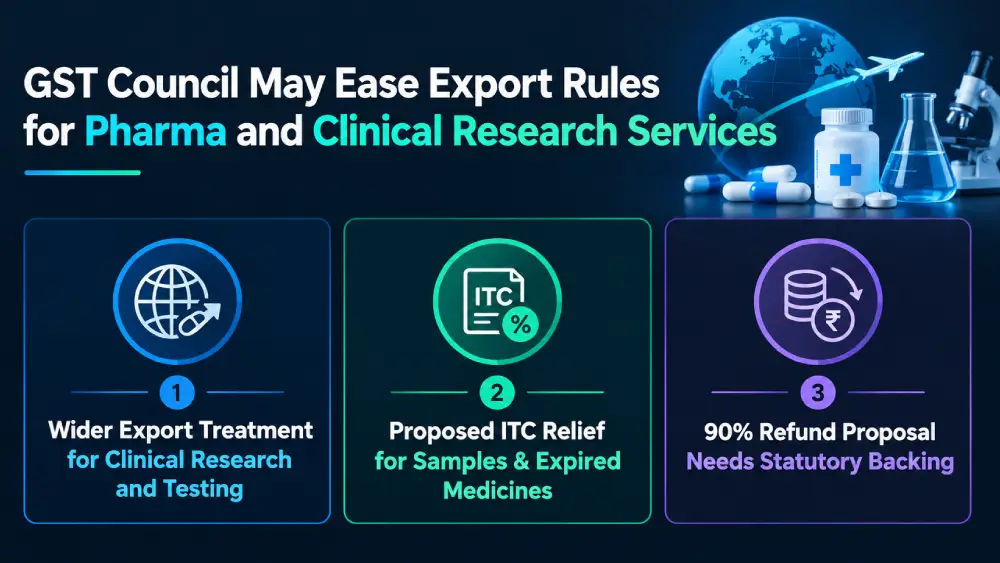
India’s pharmaceutical and clinical research industry could see targeted GST changes as the 57th GST Council prepares to meet on Thursday, 8 October 2026. According to a Business Standard report, proposals under consideration include export treatment for clinical trials, testing and analysis undertaken in India for overseas sponsors, along with measures on input tax credit (ITC) and accumulated refunds.
The proposals matter to contract research organisations (CROs), pharmaceutical manufacturers and other life-sciences businesses that work with foreign clients. They could affect how such supplies are classified, how much GST credit businesses can retain and how quickly accumulated credit can be recovered.
One point needs clarification, however. Clinical-trial services are not being brought within the export framework for the first time. A special place-of-supply provision for specified pharmaceutical research and development services was introduced through Notification No. 04/2019-Integrated Tax following the 37th GST Council meeting. The current proposal appears to focus on widening or clarifying the treatment of a broader range of work performed in India for overseas clients.
Wider Export Treatment for Clinical Research and Testing
The existing framework addresses specified pharmaceutical research and development services supplied to overseas recipients, including clinical trials. In December 2025, the Karnataka High Court had also held in Iprocess Clinical Marketing Pvt Ltd v Assistant Commissioner of Commercial Taxes that the relevant clinical-trial services qualified as exports and treated the 2019 notification as clarificatory in the circumstances before it.
The latest proposal could therefore be more significant for the scope and practical certainty of export treatment. According to the reported proposal, work performed in India for foreign clients could include clinical trials, testing, analysis and contract manufacturing. The proposed treatment may also cover goods manufactured in India for a foreign company but delivered to its customer in India.
CROs and pharmaceutical businesses with overseas sponsors should therefore review contracts, invoicing arrangements, place-of-supply positions and export documentation rather than assume that every foreign-client assignment automatically qualifies as an export.
Proposed ITC Relief for Samples, Expired Medicines
Another proposal could address a recurring cost for pharmaceutical manufacturers. The measure may allow them to retain Input Tax Credit (ITC) on free physician samples and on medicines or other goods that must be written off or destroyed after expiry.
The issue is important because the existing GST framework restricts ITC in specified situations involving free samples and goods that are lost, destroyed or written off. Any Council-approved relaxation could reduce the tax cost of these unavoidable activities, but businesses would still need clear records establishing the nature, quantity, expiry and disposal of the goods.
90% Refund Proposal Needs Careful Reading
Pharmaceutical manufacturers can also face an inverted duty structure, where GST on inputs is higher than the rate on finished medicines. This can result in accumulated ITC and working capital remaining tied up in refund claims.
The 90% provisional refund mechanism is not a completely new proposal. The 56th GST Council had recommended extending 90% provisional refunds to inverted-duty claims, and the risk-based system became operational for relevant applications from 1st October, 2025, pending the necessary statutory changes.
The proposal now being reported is better understood as giving statutory backing and greater certainty to that mechanism rather than introducing the 90% facility for the first time.
What Pharma and CRO Businesses Should Watch
No business should change its GST position merely because a proposal has been reported. The Council must first approve the measure, followed by the necessary notification, rule or legislative amendment.
Pharma companies and Contract Research Organisations (CROs) should nevertheless examine their overseas contracts, GST classification, place-of-supply positions, foreign remittance records, ITC reconciliations and refund documentation. Businesses with recurring cross-border research or manufacturing arrangements should also assess whether their existing structure will satisfy any revised conditions.
SetIndiaBiz Support
SetIndiaBiz experts support businesses with GST structuring, export documentation, place-of-supply analysis, ITC reviews and refund assessments. Cross-border arrangements should be reviewed alongside the underlying contracts and business model so that GST treatment, documentation and compliance remain aligned. Early review can also identify positions that may need to change if the Council approves the proposed measures.
FAQs
Are clinical trials currently eligible for export treatment under GST?
Specified pharmaceutical R&D services already have a special place-of-supply framework. The current proposal appears aimed at broader or clearer treatment for related services and overseas-client arrangements.
Is the 90% inverted-duty refund facility new?
No. A risk-based 90% provisional refund mechanism for inverted-duty claims has been operational since October 2025. The current proposal may provide statutory backing.
Will ITC on free samples and expired medicines become available automatically?
No. The reported ITC relief is still a proposal. Any benefit will depend on the final Council decision and the legal provisions issued afterwards.
The meeting on Thursday could provide important GST clarity for India’s pharma and clinical research ecosystem. The larger story is not that clinical trials are suddenly becoming exports, but that the Government may broaden or clarify export treatment while addressing ITC and refund issues that affect the sector’s costs and working capital. Businesses should watch the Council’s decision and the subsequent legal changes before acting on the proposals.
In This Article
Author Bio

Setindiabiz Editorial Team is a multidisciplinary collective of Chartered Accountants, Company Secretaries, and Advocates offering authoritative insights on India’s regulatory and business landscape. With decades of experience in compliance, taxation, and advisory, they empower entrepreneurs and enterprises to make informed decisions.
