
Overview: According to reports citing government sources, the GST Council may consider a proposal to protect genuine buyers from losing input tax credit (ITC) when suppliers fail to deposit GST with the government. The proposal aims to place the recovery burden on defaulting suppliers rather than genuine buyers who have completed their transactions and paid the applicable tax. If approved, the change could reduce ITC disputes and ease compliance for businesses.
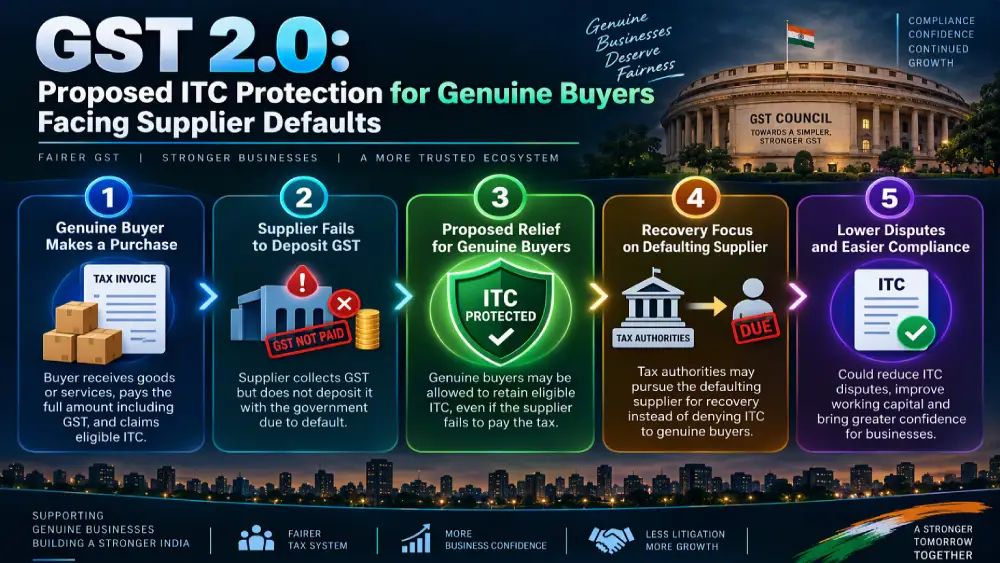
A business may buy goods or services, pay the full invoice value, including GST, and still face the risk of losing its input tax credit if the supplier fails to pay the tax to the government.
The GST Council may address this issue at its meeting on the 7th October. The proposed change could offer relief to genuine buyers and reduce disputes over ITC claims. However, businesses will still need proper invoices, payment evidence and accurate GST records to establish that their transactions are genuine.
GST Council May Protect Genuine Buyers from ITC Loss
The GST Council is likely to consider a proposal to protect genuine buyers from ITC loss caused by supplier tax defaults. The proposal is part of the process reforms being discussed under GST 2.0. It aims to make suppliers more accountable for their tax obligations. Under the proposed approach, tax authorities would pursue the defaulting supplier for recovery instead of automatically denying credit to the buyer. The final decision rests with the GST Council.
The issue has long been a source of concern for businesses. Buyers can verify invoices and reconcile their GST records, but they may have little control over whether a supplier later deposits the tax collected.
How the Proposed ITC Protection May Work
Under the proposal, a genuine buyer may be allowed to retain eligible ITC even if the supplier fails to pay the tax to the government.
The protection is intended for genuine transactions, not arrangements involving fake invoices or deliberate tax evasion. Businesses that knowingly participate in fraudulent transactions would not receive the same protection. The final conditions and safeguards will depend on the Council’s decision and any subsequent legal changes.
If the proposal is approved, the approach could change how authorities deal with supplier defaults. Instead of making a genuine buyer bear the loss in every case, recovery could focus on the supplier responsible for the unpaid tax.
What This Could Mean for Businesses
The proposed change could benefit businesses that regularly purchase goods and services from vendors, distributors, manufacturers and service providers.
Potential benefits include:
- Fewer ITC disputes: Genuine buyers could face fewer demands to reverse eligible credit because of a supplier’s default.
- Better working capital: Businesses may avoid tying up funds to replace disputed ITC, subject to the final rules.
- Fairer treatment of buyers: Tax recovery could focus on the party responsible for the default.
- Greater confidence in vendor relationships: Smaller and newer suppliers may become easier to consider, provided normal due diligence is followed.
These benefits depend on the proposal being approved and implemented. Businesses should not assume that the existing ITC conditions have changed.
Records Businesses Should Keep Ready
Even if the proposal moves forward, businesses will need evidence to show that their purchases are genuine and that they have met the applicable conditions.
They should review the following records:
- Tax invoices and purchase orders.
- Proof of payment to suppliers, including the GST component.
- Goods receipt notes, delivery records or evidence that services were received.
- Supplier GST details and invoice entries in relevant GST statements.
- Purchase registers, ITC workings and GST return reconciliations.
Regular vendor checks and timely reconciliation can help identify missing invoices or other discrepancies before they become larger disputes.
Setindiabiz Support for GST and ITC Compliance
A change in the ITC rules could reduce disputes, but businesses will still need reliable records and a clear process for checking supplier compliance.
Setindiabiz helps businesses strengthen their GST compliance through ITC reconciliation, vendor compliance reviews, GST return checks, registration and amendment services, and documentation for tax notices and disputes.
Our CA, CS and legal teams can review purchase records, supplier invoices, payment evidence and GST reconciliations to identify gaps and help businesses prepare for regulatory changes. Businesses with high purchase volumes or extensive vendor networks can benefit from a regular review of their ITC position.
The proposed protection is a welcome development for genuine buyers, but it is not yet law. Businesses should continue following the current GST rules until the Council announces its decision and the necessary legal changes take effect.
Watch
FAQs
What is the proposed GST change for genuine buyers?
The GST Council may consider protecting genuine buyers from losing eligible ITC when suppliers fail to deposit GST with the government.
Will buyers automatically retain ITC if a supplier defaults?
No such blanket protection has been approved yet. The proposal is subject to the Council’s decision, and the final conditions will determine which buyers qualify.
What records should businesses maintain to support ITC claims?
Businesses should retain valid tax invoices, proof of payment, evidence of receipt of goods or services, supplier details and reconciled GST records.
When will the proposed ITC protection take effect?
The proposal is expected to be considered at the GST Council meeting on 7 October 2026. Any effective date will depend on the final decision and the required legal changes.
In This Article
Author Bio

Shivani Tyagi
Shivani Tyagi is a legal professional with background in legal research, drafting, and compliance analysis. Skilled in reviewing legal documents, statutory and case law research, she focuses on simplifying corporate legal topics and brings research-driven clarity to Setindiabiz's compliance-focused blogs.
