
Overview: Foreign Portfolio Investors (FPIs) sold a net ₹10,602 crore of Indian government securities under the Fully Accessible Route (FAR) in September 2026. It was the highest monthly outflow in six months. Rising US Treasury yields and a narrower India-US bond yield gap reduced the appeal of Indian debt. The development also highlights the need to understand FPI entry requirements, exit rules and SEBI compliance.
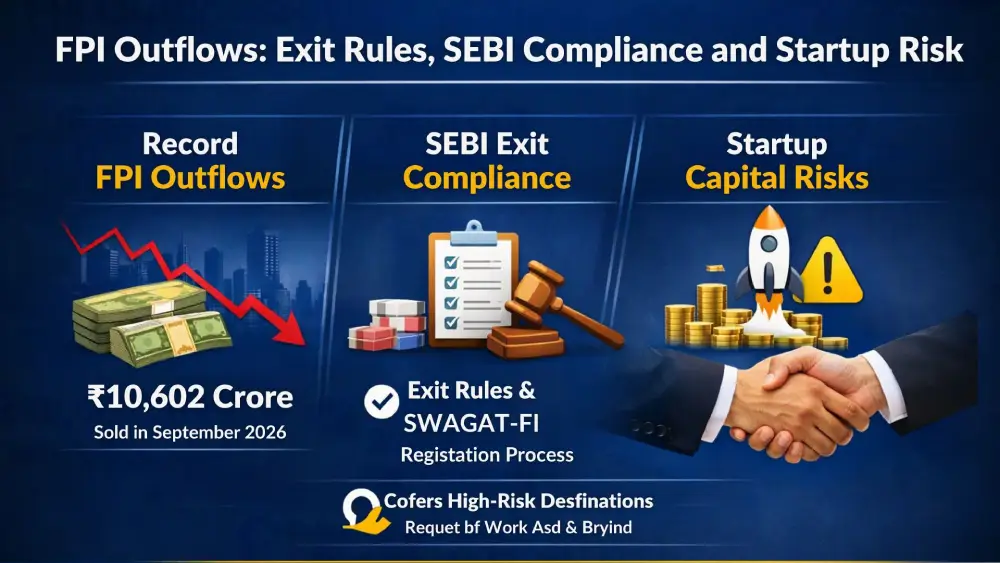
Foreign Portfolio Investors (FPIs) sold ₹10,602 crore of Indian government securities in September 2026, marking their highest monthly outflow through the Fully Accessible Route (FAR) in six months. The selling comes as global bond yields and market conditions put pressure on foreign demand for Indian debt. For businesses dealing with foreign capital, the development also brings FPI registration, exit rules and SEBI compliance into focus.
Foreign capital can move quickly when global interest rates and market conditions change. The September outflow is a market development, not a new SEBI exit-rule change. But it is a useful reminder for businesses to understand how FPI registration, investment and exit processes work.
FPI Outflows Reverse Earlier Buying
FPIs sold a net ₹10,602 crore of government securities under FAR in September 2026. This was much higher than the ₹846 crore of net selling recorded in August. It also reversed four months of buying, after FPI purchases reached about ₹41,773 crore in June.
The selling came as US Treasury yields rose and the India-US bond yield gap narrowed. The US 10-year Treasury yield was around 5.24%, while India’s 10-year government bond yield was about 7.19%. This reduced the yield advantage of Indian debt for overseas investors.
Earlier in 2026, FAR was expanded to cover additional 15-, 30- and 40-year Government Securities. These measures helped support foreign participation in the Indian government bond market.
Bloomberg also postponed the inclusion of Indian government bonds in its global bond indices in July. The decision added another layer of uncertainty for foreign investors.
FPI Entry Rules and SEBI Compliance
FPI entry involves registration under the SEBI framework and compliance through the prescribed intermediary structure.
Key requirements include:
- Registration and processing through a Designated Depository Participant (DDP).
- KYC, PAN, beneficial ownership and applicable FATCA/CRS requirements.
- Compliance with applicable investment limits, disclosures and reporting requirements.
- Keeping registration and investor information updated with the relevant intermediaries.
SEBI also introduced the Specialised Window for Accelerated Global Access for Trusted Foreign Investors (SWAGAT-FI) for specified eligible FPIs and FVCIs. The framework provides a unified registration process and reduces repeated compliance requirements. It came into effect on 1st June, 2026. Eligible SWAGAT-FI FPIs can have a 10-year registration cycle instead of the standard three-year cycle.
FPI Exit Rules: Selling Investments vs Surrendering Registration
Selling securities does not automatically mean that an FPI has surrendered its registration. These are separate processes.
| FPI Exit Stage | Main Compliance Focus |
|---|---|
| Selling investments | Trade execution, settlement, applicable tax and regulatory requirements |
| Surrendering registration | Nil balances, no outstanding derivatives, clearance of dues and the prescribed DDP/SEBI process |
An FPI that wants to surrender its registration must complete the prescribed process through its DDP. The DDP must confirm that the FPI’s relevant bank and securities accounts have nil balances and are blocked, there are no outstanding derivative positions, the CP code is blocked, and there are no pending SEBI dues or proceedings.
The applicable framework also provides a 180-day period in specified circumstances for an FPI to liquidate its existing Indian securities positions.
The key point is simple: selling investments and surrendering an FPI registration are not the same thing.
SEBI also issued a circular on the 7th September, 2026, easing regulatory compliance for FPIs investing only in Government Securities. The relaxation removes the requirement to furnish investor-group details for eligible Government Securities-only FPIs.
What Does This Mean for Startups?
Private startups receiving foreign equity generally operate under the FDI framework, rather than the FPI framework.
So, a change in FPI flows does not automatically change the compliance position of a privately held startup.
The connection becomes more relevant when a business is preparing for an IPO, has institutional investors or expects to access listed markets.
Businesses can prepare for changing foreign capital flows by:
- Maintaining adequate cash-flow and liquidity buffers.
- Diversifying funding sources and investor concentration.
- Keeping FEMA, tax and foreign-investment documents updated.
- Preparing early for SEBI disclosures and governance requirements before an IPO.
- Monitoring foreign-investor participation and wider market conditions.
Watch
FAQs
What are FPI exit rules?
FPI exit rules cover the requirements that apply when an FPI sells its investments or formally surrenders its registration.
Does the September 2026 outflow introduce new SEBI exit rules?
No. The ₹10,602 crore outflow is a market development. It does not itself create a new FPI exit regulation.
Are private startups governed by FPI or FDI rules?
Private startups receiving foreign equity generally fall under the FDI framework, subject to the nature and structure of the investment and applicable regulations.
What is required to surrender an FPI registration?
The surrender process involves the prescribed DDP and SEBI procedure. It includes checks on relevant account balances, outstanding derivatives, dues, proceedings and other applicable requirements.
How can businesses prepare for changing foreign capital flows?
Businesses can maintain suitable liquidity, diversify funding sources, monitor foreign-investor exposure and keep applicable FEMA, tax and securities-market compliance updated.
Setindiabiz Support
Setindiabiz supports businesses with foreign investment structuring, FEMA and SEBI documentation, regulatory compliance, tax-related documentation and business structuring. Our experts help businesses identify the applicable FPI or FDI framework, organise regulatory and investor documents, and maintain compliance during investment, restructuring or exit-related activities.
For startups and entrepreneurs, professional support can be useful when bringing in foreign capital, managing institutional investment, preparing for an IPO or reviewing compliance requirements linked to foreign investors.
September’s FPI outflow shows how global interest rates and market conditions can affect foreign investment in Indian government securities. For businesses, the important distinction is between selling investments and surrendering FPI registration. Startups should also first identify whether their foreign investment falls under the FPI or FDI framework and then maintain the relevant FEMA, tax and securities-market compliance.
In This Article
Author Bio

Setindiabiz Editorial Team is a multidisciplinary collective of Chartered Accountants, Company Secretaries, and Advocates offering authoritative insights on India’s regulatory and business landscape. With decades of experience in compliance, taxation, and advisory, they empower entrepreneurs and enterprises to make informed decisions.
