
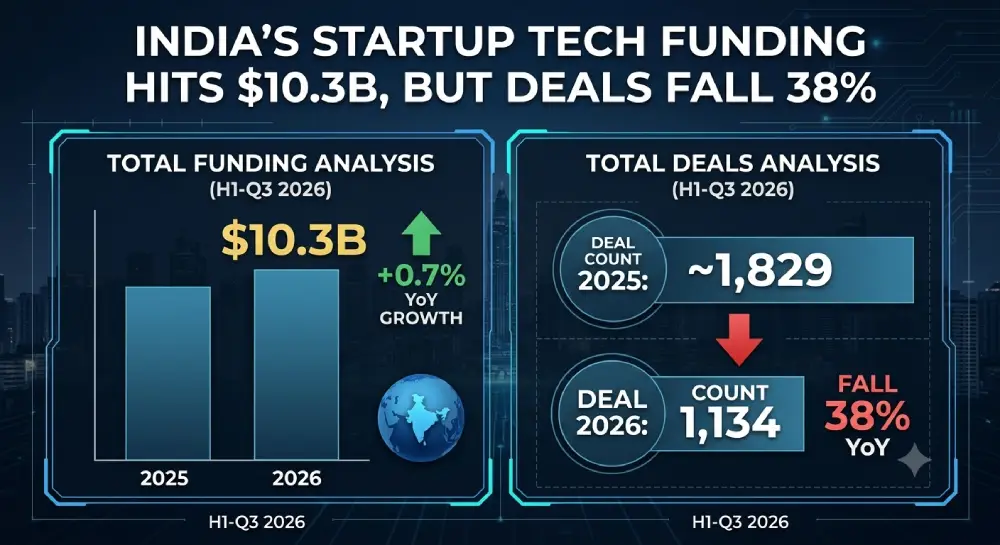
Overview: India’s technology startups raised $10.3 billion in the first nine months of 2026, up 7% from a year earlier. However, funding rounds fell 38% to 1,134, showing that capital is increasingly concentrated in fewer, larger transactions. Seed funding also declined sharply, while enterprise technology, AI infrastructure and FinTech attracted stronger investor interest. The trend is important for startups and entrepreneurs planning fundraising, as access to capital is becoming more selective.
Introduction
India’s tech funding market is showing a clear shift in 2026. Startups raised more capital overall, but the number of funding rounds fell sharply, with investors putting larger cheques into a smaller number of businesses. The decline in seed funding and first-time funded companies makes the trend particularly relevant for early-stage startups and entrepreneurs planning their next fundraising round.
Tech Funding Rises as Deal Activity Falls
According to Tracxn’s India Tech 9M 2026 Report, technology companies raised $10.3 billion between 1 January and 21 September 2026, compared with $9.7 billion during the same period in 2025. However, the number of funding rounds dropped from 1,838 to 1,134.
The concentration was also visible in larger transactions. India recorded 18 funding rounds of at least $100 million, led by Nxtra’s $1 billion private-equity round, Neysa’s $600 million Series B and C rounds, and CRED’s $540 million Series H.
| Funding Indicator | 9M 2026 | Change |
|---|---|---|
| Total tech funding | $10.3 billion | +7% |
| Funding rounds | 1,134 | -38% |
| Seed funding | $698 million | -37% |
| Early-stage funding | $4.2 billion | +27% |
| New unicorns | 6 | Up from 4 |
Seed Funding Faces Greater Pressure
The earliest stage of the funding pipeline remained under pressure. Seed funding fell 37% to $698 million, while first-time funded companies declined 30% to 338.
Series A and later rounds also fell 23% to 409. At the same time, early-stage funding increased 27% to $4.2 billion, showing that funding was not moving evenly across all stages. Larger amounts were being deployed in a smaller group of businesses, while the number of companies receiving funding at the earliest stages declined.
Enterprise Tech and AI Attract Larger Bets
Enterprise Infrastructure funding surged 436% to $1.6 billion, while Enterprise Applications funding increased 49% to $3.5 billion. FinTech funding rose 13% to $2.2 billion. AI Infrastructure alone attracted $1.2 billion, making it one of the key investment themes during the period.
India also added six new unicorns in the first nine months, compared with four during the corresponding period of 2025.
What Does This Mean for Startups?
For startups, the data points to a more selective fundraising environment. Founders seeking seed or first-time institutional funding may need stronger financial projections, a clear business model, investor-ready documentation and evidence of scalability.
The fall in first-time funded companies also makes fundraising preparation more important. Before approaching investors, founders should ensure that their corporate structure, financial records, ownership details and other investor documents are properly organised.
The funding pattern does not mean that early-stage capital has disappeared. Rather, the available data shows that funding is becoming more concentrated, making preparation increasingly important for businesses seeking external investment.
Setindiabiz Support
Setindiabiz helps startups and entrepreneurs with business structuring, fundraising-related documentation, compliance and corporate requirements. Founders preparing for external investment should review their entity structure, financial records, ownership pattern and investor documentation before approaching potential investors.
For guidance on startup fundraising and investment readiness, businesses can also explore Setindiabiz resources on startup funding in India.
FAQs
Did India’s tech funding increase in 2026?
Why did funding rise when funding rounds declined?
What happened to seed funding in 2026?
Which technology sectors attracted more funding?
In This Article
Author Bio

Shivani Tyagi
Shivani Tyagi is a legal professional with background in legal research, drafting, and compliance analysis. Skilled in reviewing legal documents, statutory and case law research, she focuses on simplifying corporate legal topics and brings research-driven clarity to Setindiabiz's compliance-focused blogs.
