
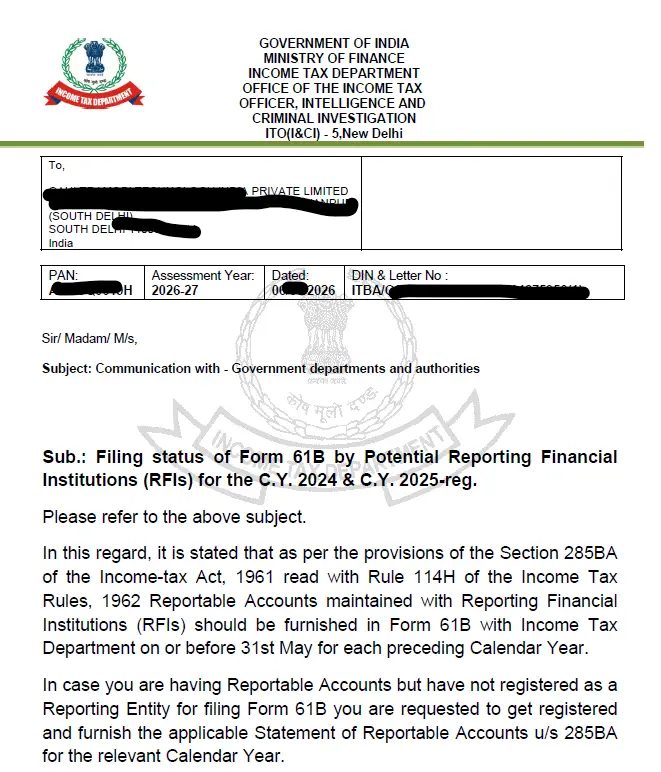
Companies across India are receiving a letter from the Income Tax Department’s Intelligence and Criminal Investigation wing about their Form 61B filing status as a “potential Reporting Financial Institution”. For most private companies, it is a false alarm: they are not financial institutions and owe nothing beyond a short reply. The letter still carries a deadline and a penalty warning, so it should not be sat on. This guide explains who must actually file Form 61B, how to check whether your company is one of them, and how to respond.
Why So Many Companies Got This Notice
The letter comes from the Office of the Income Tax Officer (Intelligence and Criminal Investigation), the ITO(I&CI), which runs the department’s data-matching and reporting-compliance work. It is a verification exercise, not a tax demand. The department has flagged a wide set of companies whose profile might make them a reporting financial institution, and is asking each one to confirm its Form 61B position for calendar year 2024 (CY 2024) and calendar year 2025 (CY 2025), including a nil position where that applies.
The word “potential” is the key to the letter. The ITO(I&CI) has not concluded that you are a reporting financial institution; it does not yet know your category, so it is asking you to check the Rule 114F definition and reply. Getting the notice is not a finding that you owe anything.
Two signs mark it as a bulk sweep rather than a targeted assessment: it covers two full years at once, and it asks even nil filers to respond. It points every recipient to the same two portals: incometax.gov.in to register and report.insight.gov.in to file, and the penalty line is a standard warning. Section 285BA(5) of the Income-tax Act, 1961 lets the department issue a further notice requiring the statement within a set time, and that later notice, not this one, is what raises the stakes. Answer this letter on time, and the file usually closes.
What Form 61B Reports and Why
Form 61B (Statement of Reportable Accounts) is mandated under Section 285BA of the Income-tax Act, 1961, and Rules 114F to 114H of the Income-tax Rules, 1962. It requires specific financial institutions to report accounts held by non-resident individuals to facilitate cross-border information exchange.
This exchange is governed by FATCA (via an Inter-Governmental Agreement signed on 09 July 2015 and effective 31 August 2015) and CRS (via the Multilateral Competent Authority Agreement joined on 03 June 2015). Implemented under CBDT Notification No. 62/2015 dated 07 August 2015, reporting financial institutions must submit details like the holder’s name, tax identification number, account balance, and income in Form 61B for international exchange. Form 61B is distinct from Form 61A (SFT).
Are You a Reporting Financial Institution?
This is the only question that decides whether Form 61B applies to you. An entity is a reporting financial institution only if it is first a financial institution, and Rule 114F recognises just four kinds. A company that trades goods, makes products, writes software, offers professional services or simply holds investments for its own promoters is usually none of them, and owes no Form 61B at all. Run your company against the four tests before doing anything else. The four categories and their Rule 114F Explanation tests are outlined below.
| No | Category | The test (Rule 114F) |
|---|---|---|
| 1 | Depository institution |
Accepts deposits in a banking or similar business
Examples:
|
| 2 | Custodial institution |
20% or more of gross income from holding financial assets for others
(shorter of last three financial years or period of existence)
Examples:
|
| 3 | Investment entity |
Trades or manages funds and portfolios for others as a business,
or is managed by another financial institution and earns mainly
from financial assets.
Examples:
|
| 4 | Specified insurance company |
Issues or pays under a cash value insurance or annuity contract
Example: Life insurers |
If your company sits in none of the four, it is not a financial institution and has no Form 61B obligation. Rule 114F also carves out non-reporting institutions such as governmental entities, the central bank, and recognised provident, gratuity and Employees’ State Insurance funds. The ordered test is simple: decide first whether you are a reporting financial institution, then apply due diligence to your accounts, and file only if an account is reportable.
The category that catches people is the investment entity, where a company whose income is mainly from financial assets and which is managed by another financial institution, such as a portfolio manager or an AIF manager, can be pulled in even though it feels passive. If someone else manages your investments for a fee, get the classification checked rather than assuming you are out.
What “Potential RFI” Means
The notice calls you a “potential” reporting financial institution because the department has not verified your category. The term is not in the Act or the Rules; it is shorthand for “you might qualify, please confirm”. Placing your company inside, or outside, the four tests is the confirmation the department wants.
How to Respond to the Notice
Every recipient must respond by the date in the letter, even a company that is plainly not a financial institution. There are three clean paths, and the right one follows from the four-category test above. Two involve filing on the reporting portal; the third is a short declaration that you are not a reporting financial institution. Whichever applies, keep the acknowledgement, because that record protects you if the file is reopened later.
The table sets out the three situations and what each one requires.
| No | Your situation | What to do |
|---|---|---|
| 1 | RFI with reportable accounts | Register at the Income Tax e-filing portal, complete Rule 114H due diligence, and file a full Form 61B for CY 2024 and CY 2025. |
| 2 | RFI with no reportable accounts | File a Nil Form 61B (Preliminary Response, “NIL, No Reportable Accounts” – report.insight.gov.in |
| 3 | Not a financial institution | Submit a non-liability Preliminary Response and send a written reply to the ITO(I&CI) – report.insight.gov.in |
An RFI that has to file registers first: it generates an ITDREIN (Income Tax Department Reporting Entity Identification Number) through a Principal Officer on the e-filing portal, then prepares the statement on the Insight Reporting Portal, signs it with the Designated Director’s digital signature, and uploads it. An RFI with nothing to report still submits a Preliminary Response and selects “NIL, No Reportable Accounts”, because a nil statement
is mandatory for Form 61B, unlike Form 61A.
A company that is not a financial institution has two steps. Submit a Preliminary Response on report.insight.gov.in declaring non-liability, and back it with a short letterhead reply to the issuing ITO(I&CI) stating that the company falls in none of the four Rule 114F categories and has no Form 61B obligation for CY 2024 or CY 2025. Keep both records. If the classification is genuinely unclear, particularly the investment-entity question, the Setindiabiz process experts can assess your status against Rule 114F and prepare either the reply or the filing.
Penalties for Not Filing
The penalty warning at the foot of the letter is real, but it repays reading closely, because the daily amount is modest and there is a defence for genuine cases. Two provisions apply, one for not filing at all and one for filing inaccurate data. Neither bites a company that is genuinely not a reporting financial institution and says so on time. The real exposure sits on a reporting financial institution that stays silent, or that files careless information.
The two figures to know are set out below.
| Default | Provision | Amount |
|---|---|---|
| Failure to furnish Form 61B | Section 271FA, Income-tax Act, 1961 | ₹500 per day of default, rising to ₹1,000 per day for the period after a Section 285BA(5) notice |
| Inaccurate Form 61B | Section 271FAA, Income-tax Act, 1961 | ₹50,000, plus ₹5,000 per inaccurate reportable account where the inaccuracy is caused by false or inaccurate account-holder information |
Two things soften this. Section 273B allows the Section 271FA penalty to be waived where there was reasonable cause, so an honest lapse that is corrected is defensible. And for the ₹5,000-per-account addition under Section 271FAA, an RFI that reported in good faith on the account holder’s information can recover that amount from the holder. The real risk is not the daily rate; it is ignoring the letter, which invites the Section 285BA(5) notice that lifts the figure to ₹1,000 a day. A timely reply, even a nil or non-liability one, keeps you clear of it.
The New Law from April 2026
One point matters for any notice you act on in 2026. The Income-tax Act, 2025 came into force on 01 April 2026 and replaced the 1961 Act, but Section 536 preserves the old law for earlier periods, which is why a notice for CY 2024 and CY 2025 correctly cites Section 285BA and Rule 114H. Going forward, the same obligation continues under new numbering: the reportable-account provision becomes Section 508, the FATCA and CRS rules become Rules 238 to 240 of the Income-tax Rules, 2026, and Form 61B becomes Form 166, the Annual Statement of Reportable Accounts. Read which Act and form your particular notice names before acting on it.
Frequently Asked Questions
My company only trades or makes products. Do I need to file Form 61B?
What happens if we ignore the notice?
How do we tell the department we are not a reporting financial institution?
Is Form 61B the same as Form 61A?
What is the due date for Form 61B?
Conclusion
Although a Form 61B notice can be unsettling for founders, it usually requires a simple response. Based on Rule 114F, if your company is not a bank, custodian, fund manager, or insurer, it is not a reporting financial institution; submitting a non-liability Preliminary Response and written confirmation to the ITO(I&CI) will resolve the issue. If it is a reporting entity, you must register for an ITDREIN and file a standard or Nil Form 61B for CY 2024 and CY 2025. Most importantly, do not ignore the deadline. If your status as an investment entity is uncertain or filing is required, Setindiabiz experts can evaluate your company against Rule 114F and prepare the response or filing on time.
In This Article
Author Bio

Setindiabiz Editorial Team is a multidisciplinary collective of Chartered Accountants, Company Secretaries, and Advocates offering authoritative insights on India’s regulatory and business landscape. With decades of experience in compliance, taxation, and advisory, they empower entrepreneurs and enterprises to make informed decisions.
