
Overview : Advantages of the GST composition scheme: Section 10 of the Goods and Services Tax Act contains the provisions regarding the registration of taxpayers under the GST Composition Scheme. One of the basic objectives of introducing the GST composition scheme in India was to reduce the burden of tax compliance, especially for small-scale businesses, thereby easing their overall cost of operations. Almost all business owners, after the introduction of GST, have migrated from their previous tax regime to the GST tax regime. However, the problem for small taxpayers may be that they do not have enough resources or revenues to comply with all the procedures prescribed under GST.
Accordingly, the Government of India decided to introduce the GST Composition Scheme, where a taxpayer whose annual turnover is less than Rs. 1.5 Crore can choose not to register as a regular GST taxpayer. Rather, he can choose to get enrolled as a Composition taxpayer so that he can pay taxes at a marginal rate as compared to a regular GST scheme. However, a composition taxpayer cannot issue a tax invoice and cannot claim for input tax credit as a result of opting for the same.
Conditions to Opt for the GST Composition Scheme
The following are a few conditions that must be fulfilled before opting for the GST composition scheme:
- The threshold limit to become eligible for GST registration under the GST Composition Scheme is 1.5 Crore. However, in the case of North-Eastern and hilly states, the threshold limit is Rs . 75 lakhs. This suggests that a taxpayer having an annual turnover less than or equal to the prescribed threshold can opt for the composition scheme under GST.
- The GST composition scheme can be opted for only when all activities of the business are registered under a single PAN of the business.
- A taxpayer registered under the composition scheme must pay taxes on a quarterly basis and also needs to file returns in form GSTR-4 quarterly by the 18th of the first month of the next quarter.
- A taxpayer registered under the GST Composition Scheme is not eligible to issue a tax invoice.
- A taxpayer registered under the GST Composition Scheme also cannot claim the Input Tax Credit (ITC) on the purchase of goods
Advantages of the GST Composition Scheme
The following are some of the prominent reasons a taxpayer must consider when choosing to get registered under the composition scheme:
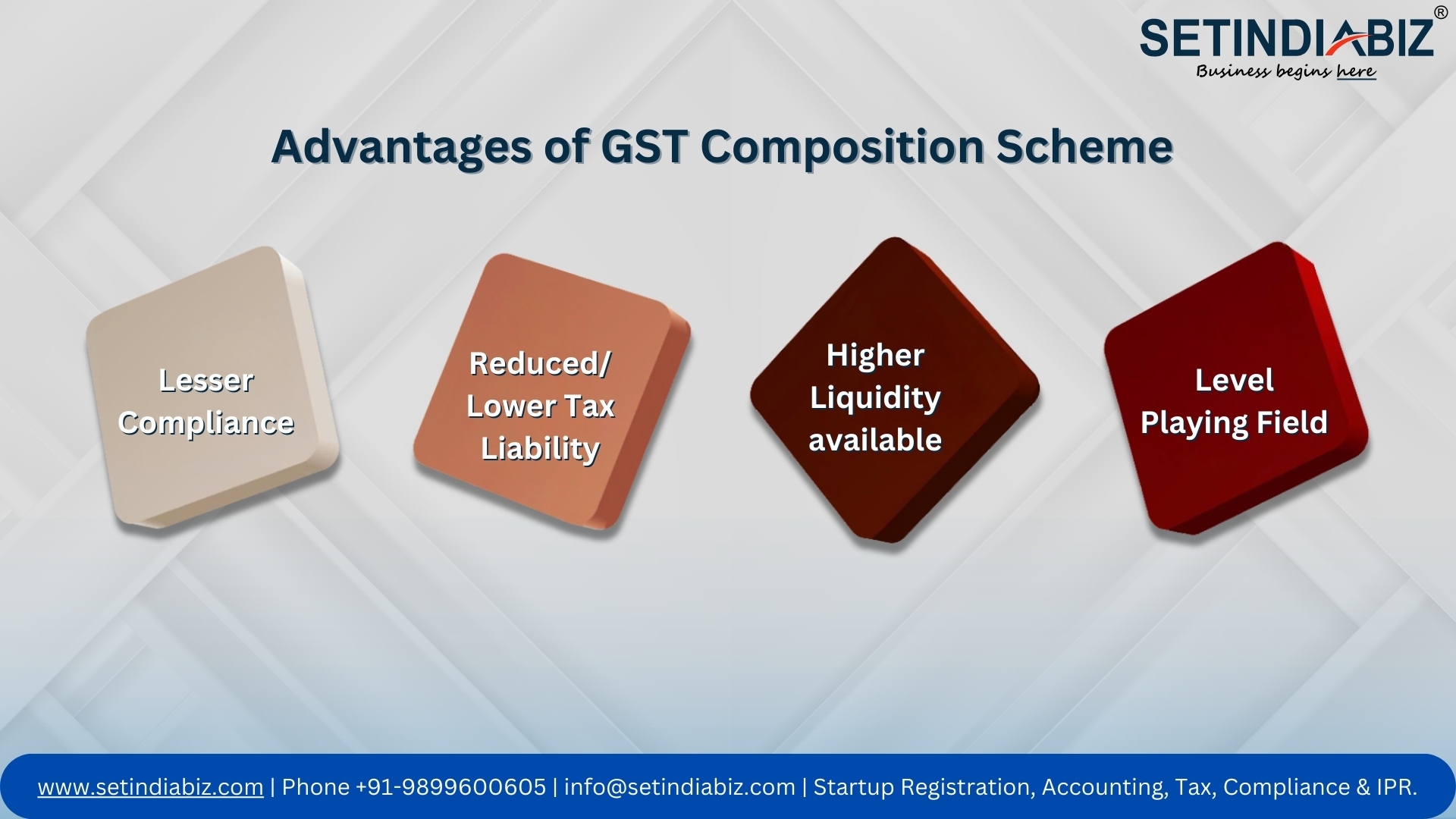
Lesser Compliance
Under the composition scheme, the taxpayer has to furnish returns quarterly and thus the taxpayer does not have to worry about keeping records throughout the year. This enables the taxpayer to focus on his business activities rather than being worried about fulfilling tax compliance.
Reduced/Lower Tax Liability
One of the major benefits of getting registered as a GST composition taxpayer is that the tax rates on which the taxes are to be paid are as low as 1%, 2%, 4%, and 6%.
Higher Liquidity available
Another major advantage of getting enrolled as a composition dealer is that there will be availability of higher funds for the business due to reduced cost burden owing to the lessened tax compliance. Compared to that, a regular taxpayer has to pay output tax on sales at the standard rate of 18%.
Level Playing Field
It is to be noted that if a taxpayer does not choose to register under the Composition Scheme of GST, it cannot be inferred that he has lost the competitive edge. As the profit margin of the dealer registered under a composition Scheme is less compared to that of a regular taxpayer.
Moreover, a Composition taxpayer can outplay the economy by offering goods and services at competitive prices to get a good hold in the local market as a supplier of goods.
Conclusion
With the above explanation, it can be concluded that the GST composition scheme will be a growth mechanism for small business owners who are engaged in intra-state sale of goods and services or in the import-export of goods and services. In case the taxpayer is engaged in an inter-state supply of goods, then the advantage of the composition scheme cannot be availed, and he has to get enrolled as a regular taxpayer under GST.
FAQ’s
Can a person opt for a Composition Scheme while making a fresh or new registration under GST?
Can an existing GST registered taxpayer opt for the payment under the composition scheme?
Can suppliers engaged in providing services opt for composition scheme?
What is the validity of registration under the GST composition Scheme?
Can a person registered under composition scheme supply goods to SEZ (Special Economic Zone)?
Related Articles :
- Documents Required For GST Registration
- GST Portal: Check Composition Scheme Status
- GST Registration Number Verification at GST Portal
- Advantages of GST in India
- Difference Between GST and Income Tax
In This Article
Author Bio

Setindiabiz Editorial Team is a multidisciplinary collective of Chartered Accountants, Company Secretaries, and Advocates offering authoritative insights on India’s regulatory and business landscape. With decades of experience in compliance, taxation, and advisory, they empower entrepreneurs and enterprises to make informed decisions.
