
Overview: The United Kingdom has announced more than £1 billion in commercial deals linked to India following the implementation of the Comprehensive Economic and Trade Agreement (CETA) on 15th July, 2026. At the 12th October Joint Economic and Trade Committee meeting, both countries reviewed progress and discussed ways to improve business use of the agreement. The developments create opportunities for exporters and investors, while existing FEMA, FDI and export-documentation requirements continue to apply.
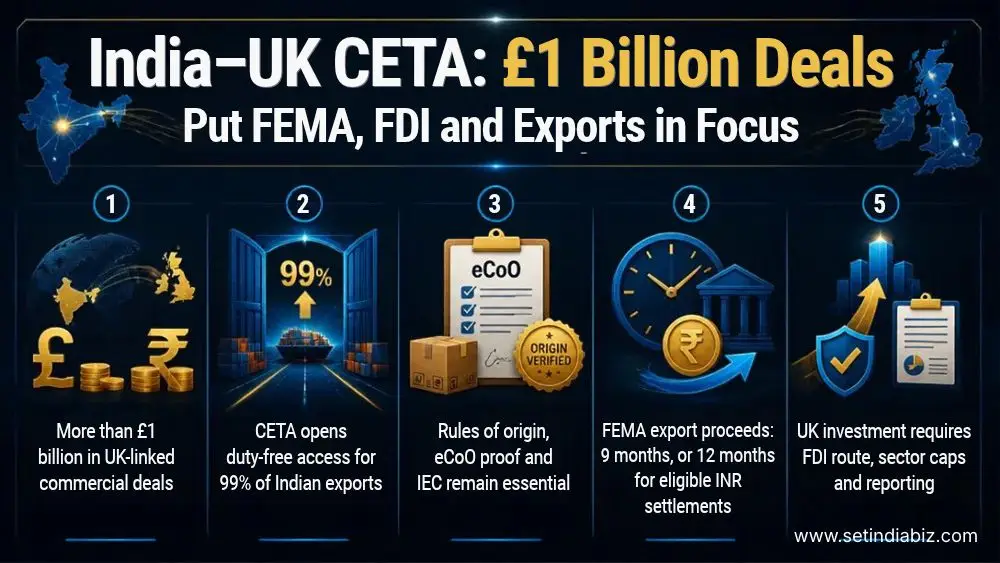
India and the United Kingdom are working to turn market-access benefits of the Comprehensive Economic and Trade Agreement (CETA) into actual business activity. At the 12th October, 2026, India-UK Joint Economic and Trade Committee (JETCO) meeting in New Delhi, both sides reviewed implementation and agreed to track businesses’ use of preferential tariffs.
The UK also announced more than £1 billion in commercial deals linked to India. The announcements cover aviation, technology, retail, engineering and exports. However, they represent different forms of commercial activity, not a single pool of foreign investment into India.
Key Commercial Deals Under the India-UK CETA
The announced deals include several distinct opportunities:
- Menzies Aviation: The UK aviation services provider is expected to generate more than £600 million in revenue over a 15-year ground-handling licence in Bengaluru. The arrangement is backed by a £6 million investment and is expected to support more than 1,000 jobs in India.
- Meta for Data Technologies (MFD): The company plans to invest £50 million in AI, data and quantum research facilities in the UK, creating 500 skilled jobs. This is investment in the UK, not an FDI inflow into India.
- Angel & Rocket: The UK children’s clothing brand plans to open 100 stores in India over five years, with estimated revenue of £43 million.
- RANsemi: The UK technology company has signed a strategic partnership to expand its 5G Open Radio Access Network (Open RAN) semiconductor technology in India. The potential export opportunity is valued at more than £100 million over five years.
These figures include projected revenue, planned investment and potential exports. They should not be treated as completed transactions or actual FDI inflows unless the relevant investment has taken place.
FEMA, FDI and Export Compliance: Key Considerations
1. Export compliance under CETA
CETA provides duty-free access for 99% of Indian exports to the UK. However, businesses cannot assume that every shipment automatically qualifies for preferential treatment. Eligibility depends on the applicable tariff schedule, rules of origin and supporting documentation.
India’s first CETA Certificates of Origin were issued through the electronic Certificate of Origin (eCoO) 2.0 platform on a self-certification basis. Exporters should check the origin requirements for their products, maintain invoices and shipping records, and obtain the prescribed proof of origin. They should also maintain a valid Importer Exporter Code (IEC) where required.
2. FEMA and export proceeds
The revised FEMA export-import framework took effect on 1st October 2026. Export proceeds generally must be realised and repatriated within nine months. The period is 12 months where exports are invoiced and/or settled in Indian rupees, subject to the applicable conditions.
An Authorised Dealer (AD) bank may extend the period where the exporter requests an extension and the bank is satisfied with the reasons. Businesses should monitor overseas receivables, track applicable deadlines and reconcile outstanding export records through the relevant banking process.
3. FDI reporting for cross-border investments
UK investors considering an investment in an Indian business must check the applicable sectoral cap, entry route, pricing requirements and sector-specific conditions. Some investments may proceed under the automatic route, while others require government approval.
Reporting depends on the transaction. Form FC-GPR is used for reportable issues of capital instruments to non-residents, while Form FC-TRS applies to specified transfers between residents and non-residents. Eligible Indian entities must also assess their annual Foreign Liabilities and Assets (FLA) return obligations.
A commercial agreement, projected revenue or export opportunity does not automatically amount to FDI into India. Businesses should identify the nature of the transaction before deciding which regulatory requirements apply.
Setindiabiz Support
Setindiabiz supports businesses with FEMA reporting, FDI structuring, IEC registration and export-import documentation. Companies exploring opportunities under CETA can seek assistance with investment-route assessment, regulatory filings and cross-border transaction records. This helps businesses manage compliance requirements while focusing on commercial expansion.
FAQs
No. CETA sets out trade commitments between India and the UK. FEMA and the applicable Reserve Bank of India regulations continue to govern relevant foreign-exchange transactions, export proceeds and foreign investment reporting.
No. Preferential duty depends on the product’s tariff treatment, compliance with the relevant rules of origin and the required supporting documents. Exporters should verify eligibility before claiming a concession.
The company should check the applicable FDI sectoral cap, entry route, pricing requirements and sector-specific conditions. It should also identify the relevant reporting requirements, including FC-GPR or FC-TRS filings where applicable.
