
Overview: The Department of Commerce has set up an FTA Utilisation Cell to help Indian businesses understand and make greater use of Free Trade Agreements (FTAs). The cell will work with industry associations, Export Promotion Councils (EPCs) and state governments to explain FTA opportunities, identify markets and improve utilisation. EPCs will also prepare market-specific action plans covering non-tariff barriers, quality standards and potential anchor companies.
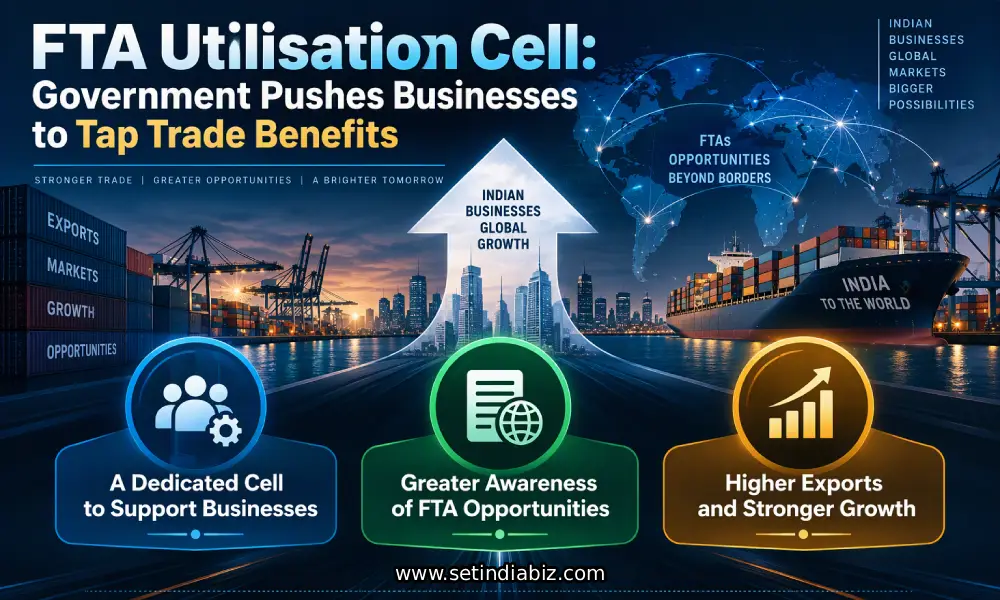
India has expanded its network of Free Trade Agreements (FTAs), but greater market access has not always translated into higher exports. The Department of Commerce has now set up an FTA Utilisation Cell to bridge that gap by taking information on tariff benefits, market opportunities and trade requirements directly to businesses.
The initiative is aimed particularly at helping exporters and MSMEs identify markets and make better use of India’s existing trade agreements.
What the FTA Utilisation Cell Will Do
The Department of Commerce will work with industry associations, EPCs and state governments to help businesses understand the opportunities available under India’s FTAs.
The cell will focus on:
- Explaining FTA benefits and market opportunities to businesses;
- Helping EPCs improve FTA utilisation;
- Developing market-specific action plans with partner countries;
- Identifying non-tariff barriers and quality requirements; and
- Mapping potential anchor companies and export opportunities.
The government has already held a national workshop on the newer trade agreements. Discussions with states, industry and exporters are planned, followed by district-level workshops during the current financial year.
EPCs have also been asked to prepare five-year action plans for individual markets. These plans are expected to address market opportunities, non-tariff barriers, quality standards and potential anchor companies.
India’s Expanding FTA Network
India has finalised trade agreements covering partners including the four-nation European Free Trade Association (EFTA), New Zealand, Mauritius, the UAE, Australia, Oman, the European Union (EU) and the UK.
The India-EFTA Trade and Economic Partnership Agreement (TEPA) came into force on 1st October, 2025, while the India-UK trade agreement came into force on 15th July, 2026. The India-EU agreement is expected to become operational next year.
Together, the four EFTA countries, the 27 EU member states and the UK represent 32 countries covered by India’s trade agreements. These are high-income, high-consumption markets where Indian businesses can potentially expand their exports.
Opportunity for Exporters and MSMEs
For exporters and MSMEs, the utilisation cell could make information on FTA benefits and potential markets easier to access.
FTA benefits go beyond lower customs duties. Greater tariff predictability can help businesses assess investments, build supply chains, plan pricing and take longer-term decisions about overseas markets.
The EFTA market illustrates the opportunity. India currently accounts for only about US$ 2-3 billion, or less than 1%, of EFTA’s total imports, according to the Commerce Secretary. At the same time, more than 99% of India’s trade value with EFTA countries now enters at zero tariff.
Agriculture is another potential growth area. While tariffs have not fallen to zero across every agricultural product, several products where India has strengths have received zero-duty or preferential access.
Why This Matters
An FTA creates market access, but it does not automatically generate export orders. Businesses still need to check product classification, rules of origin, documentation, quality standards and destination-market requirements before claiming preferential treatment.
The new cell could make this information more accessible, particularly for MSMEs that may not have dedicated international trade teams. Better utilisation of existing FTAs could help Indian businesses diversify markets and build longer-term export strategies.
Businesses entering FTA partner markets should therefore assess the applicable tariff benefits along with rules of origin, export documentation and regulatory requirements. Professional review of these requirements can also help prevent documentation gaps and incorrect claims of preferential treatment.
FAQs
The FTA Utilisation Cell is an initiative of the Department of Commerce to help Indian businesses understand and make greater use of opportunities available under Free Trade Agreements. It will work with industry associations, Export Promotion Councils and state governments.
MSMEs can use FTAs to identify suitable markets and assess preferential or zero-duty access. They must also check rules of origin, product standards, documentation and other requirements before claiming FTA benefits.
Export Promotion Councils will work with the Department of Commerce to improve FTA utilisation and prepare market-specific action plans. These plans will cover export opportunities, non-tariff barriers, quality standards and potential anchor companies.
Setindiabiz Support
Setindiabiz supports Indian exporters, startups and MSMEs with export documentation, regulatory compliance, business structuring and cross-border trade requirements.
Setindiabiz experts can help businesses assess relevant Free Trade Agreement opportunities, rules of origin, export documentation and regulatory requirements, and organise the compliance processes involved in entering FTA partner markets.
Watch
